Illustration: AI
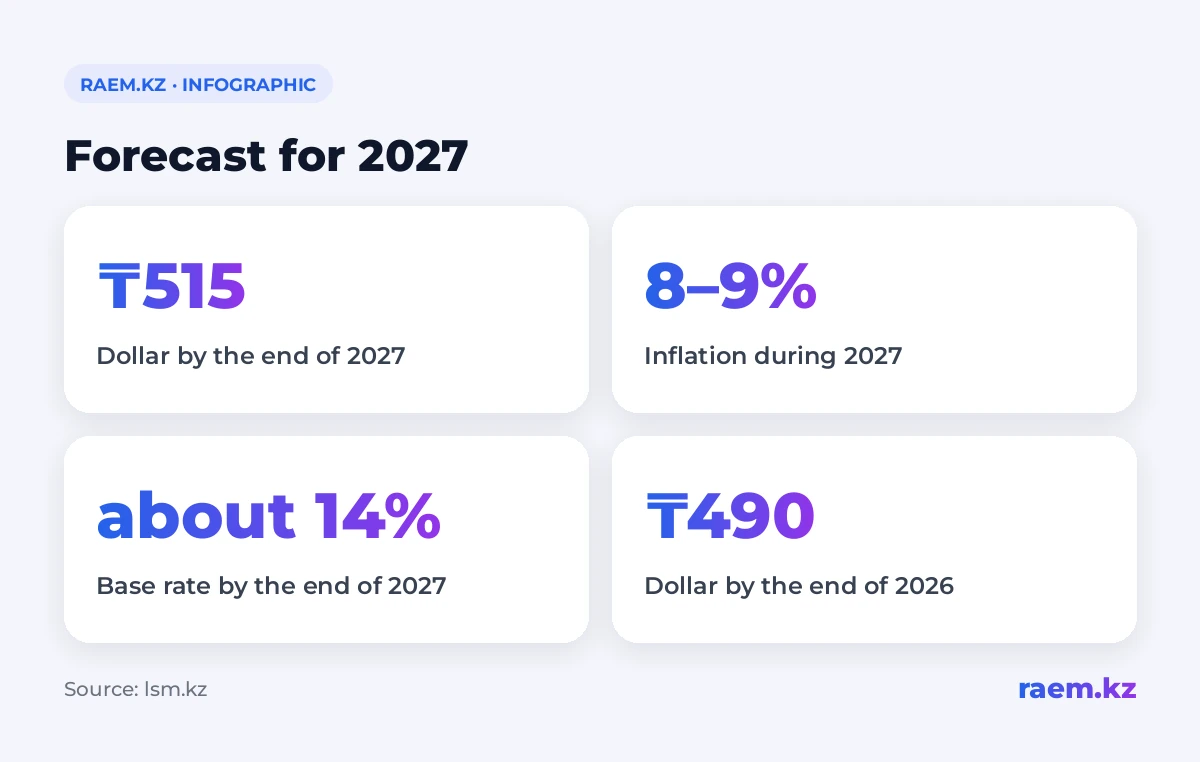
Halyk Research forecasts an exchange rate of 515 tenge to the dollar by the end of 2027 and inflation of 8–9% during the year (lsm.kz). Analysts also expect the base rate to be around 14% by the end of next year. This is a forecast: exchange rate movements will depend on foreign currency supply and demand, interest rates and oil prices.
What dollar exchange rate is expected by the end of 2027?
Halyk Research’s estimate is 515 tenge to the dollar. Analysts link the potential weakening of the tenge to a gradual decline in the base rate and oil prices.
For comparison, they maintain their forecast of 490 tenge to the dollar for the end of 2026. Analysts describe this estimate as conservative and say the tenge could be stronger if the current balance of supply and demand holds.
Both figures refer specifically to the end of the respective year. They do not represent an annual average exchange rate or the dollar’s value throughout all twelve months.
Why the tenge strengthened in 2026
In the third quarter, the exchange rate averaged 462.11 tenge to the dollar, compared with 476 tenge in the previous quarter. The tenge strengthened amid a decline in the National Bank’s net foreign currency supply and heavy trading on the exchange. The requirement for the quasi-state sector to sell 50% of its foreign currency earnings was also suspended from July 2026.
Analysts identify the high base rate, National Bank operations and additional sources of foreign currency as factors shaping the exchange rate. They also point to inflows from non-resident investors into the market for government securities — debt issued by the state.
“We consider the contribution of fundamental factors to the tenge’s appreciation this year to be less significant,” Halyk Research stressed.
What could affect the exchange rate through the end of 2026?
Analysts expect the National Bank’s foreign currency supply to decline in the fourth quarter. They also factor in the usual year-end increase in demand for foreign currency and an expected cut in the base rate.
These factors underpin Halyk Research’s conservative year-end exchange rate estimate. If the current balance of supply and demand holds, analysts say the tenge could strengthen further.
How much could prices rise in 2027?
Halyk Research forecasts inflation of 8–9%, compared with around 10% at the end of 2026. This means prices will continue to rise, although at a slower expected pace.
The forecast reflects moderately tight monetary policy and a slowdown in consumer lending. Analysts also note that risks that could fuel price increases remain.
How far could the base rate fall?
Halyk Research sees scope for the base rate to fall to 15.5% by the end of 2026. Its projection for the end of 2027 is around 14%.
A gradual decline in the base rate also helps explain the dollar forecast. Analysts identify the high rate as a factor behind the tenge’s current strength, and a decline in the rate as a possible reason for future weakening.
In plain terms
Halyk Research’s forecast combines slower price growth with a possible weakening of the tenge. Analysts forecast inflation of 8–9% in 2027, with the dollar at 515 tenge and the base rate at around 14% by year-end.
If you are planning next year’s spending, use these figures as forecast benchmarks, taking into account the conditions analysts attach to them.