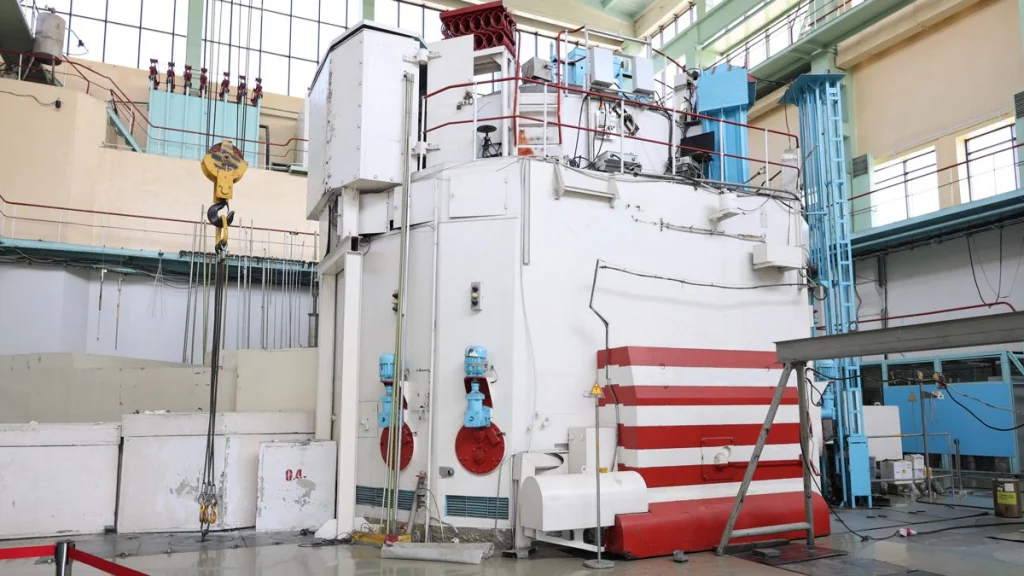
Nestled in the settlement of Alatau near Almaty, Kazakhstan’s flagship research reactor WWR-K operates 24/7 in scientific silence. Far from weapons-grade experiments, this water-cooled nuclear research facility serves as a vital production hub for life-saving oncology radiopharmaceuticals and exports high-purity neutron-irradiated “London Blue” topazes to the global gemstone industry.
Operated by the Institute of Nuclear Physics (INP), the facility demonstrates that civilian nuclear technology delivers immediate, measurable humanitarian and economic benefits.
Saving Lives: Technetium-99m and Iodine-131 for Oncology
The reactor core’s intense neutron flux is utilized to synthesize critical medical radioisotopes:
- Technetium-99m (Tc-99m) Generators: The workhorse of modern diagnostic nuclear medicine. With a short half-life of 6 hours, Tc-99m is injected into patients to perform precision SPECT scans, detecting metastatic bone cancer, heart disease, and pulmonary embolisms with minimal radiation exposure.
- Iodine-131 (I-131) Radiopharmaceuticals: Utilized worldwide for targeted internal radionuclide therapy, destroying malignant thyroid cancer cells and managing hyperthyroidism without major surgery.
Transforming Raw Minerals into ‘London Blue’ Topazes
Beyond clinical medicine, the INP generates millions of dollars in commercial export revenues through the industrial transmutation of minerals. Naturally mined topazes are often pale or completely transparent. When placed inside specialized irradiation channels in the reactor core, fast neutrons alter the mineral’s crystal lattice, inducing the deep, coveted velvety azure hue known internationally in luxury jewelry as “London Blue.”
Following precise radiological decontamination and decay cooling periods verified by IAEA standards, the gemstones are completely safe and exported to jewelry houses across Germany, Japan, and the United States.
A 1967 Scientific Jewel Upgraded for the 21st Century
Commissioned originally in 1967, the WWR-K reactor underwent a comprehensive safety modernization in cooperation with the IAEA and the US Department of Energy, converting from highly enriched uranium to low-enriched uranium (LEU) fuel. Today, it remains one of the safest and most scientifically productive research reactors in Eurasia.