

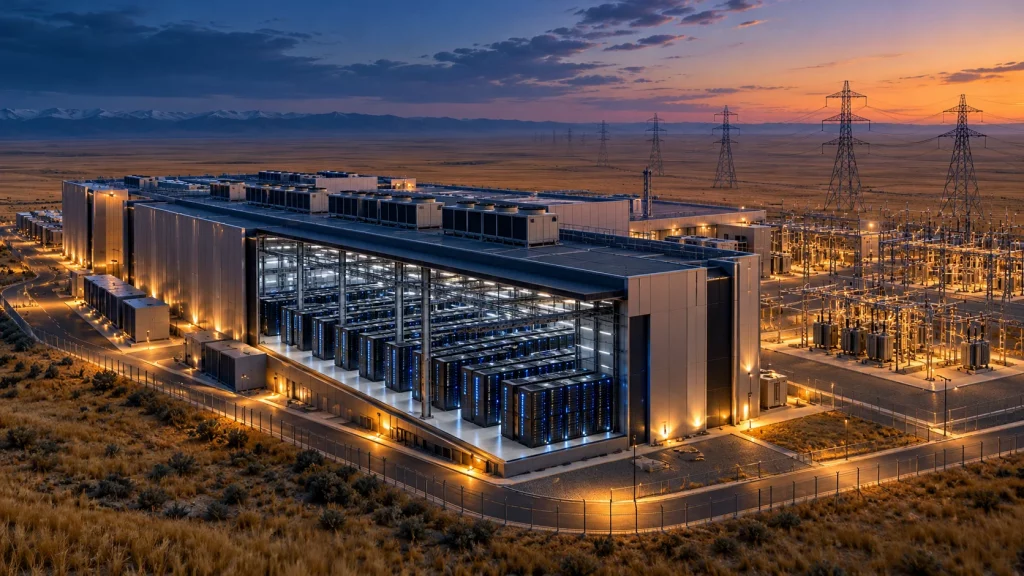
Accelerating artificial intelligence adoption could establish hyperscale data centers as one of the largest emerging consumers of electric power across Kazakhstan. At the AI & Digital Bridge 2026 forum, Kazakhtelecom CEO Bagdat Mussin declared the strategic potential for more than 5 GW of supplemental grid capacity dedicated to high-performance computing infrastructure. Concurrently, Freedom Holding Corp. founder Timur Turlov stated that initial demand for Phase 1 capacity at his company’s flagship GPU data center already outstrips available supply twofold, reports Digital Business.
These announcements highlight the ambitious scale of Kazakhstan’s digital strategy. However, bridging the gap between customer demand, physical data center construction, and multi-gigawatt grid delivery demands rigorous infrastructural coordination.
What the 5 GW Figure Signifies in Practice
According to Digital Business reporting, Mussin linked future data center buildouts to broader national power grid expansions. He described an envelope exceeding 5 GW of additional generation that Kazakhstan could channel toward data center facilities and advanced compute workloads. Mussin further expressed expectations that compute infrastructure consumption could reach 1 GW within several years.
Consequently, 5 GW cannot be characterized as contracted enterprise interconnect requests or an approved utility demand forecast. The statement does not identify which specific power generation assets will supply this capacity or establish project milestones.
Nonetheless, the magnitude clarifies the order of magnitude involved. A gigawatt measures instantaneous electrical power. Evaluating annual energy consumption requires understanding equipment operating hours and average baseload utilization factors.
Scale: Exceeding One-Third of National Annual Consumption
Per national grid operator KEGOC, Kazakhstan consumed 124.6 billion kWh of electricity in 2025 while generating 123.1 billion kWh. Peak national grid load reached 17,724 MW.
By comparison, 5 GW equals 5,000 MW — representing approximately 28% of the country’s peak grid capacity.
If hypothetical computing clusters operated continuously at a flat 5 GW baseload across all 8,760 hours of a calendar year, total energy demand would reach 43.8 billion kWh. That represents approximately 35% of Kazakhstan’s total electrical consumption for 2025.
This calculation serves as an index of scale rather than a commercial forecast. It assumes constant 100% capacity utilization; actual telemetry will depend on phased commissioning timelines, variable workload cycles, and power usage effectiveness (PUE) overhead from cooling systems.
Nevertheless, it illustrates the emergence of an entirely new heavy-industrial power consumer category with macro-level grid consequences.
Examining the 200% Demand Assessment by Turlov
Per Digital Business, Turlov estimated current commercial demand for Phase 1 of Freedom’s NVIDIA-powered data center at 200% of constructed capacity. He highlighted interest from enterprise partners prepared to contract up to 100 MW of future computing capacity under five-year commitments at premium tariffs.
These figures describe distinct commercial phenomena. The commentary does not establish that binding purchase agreements totaling 200 MW have been executed against a 100 MW installation. Exact Phase 1 MW capacity and specific contract terms were not detailed in the release.
Turlov also suggested that the full 100 MW — initially contemplated for cross-border compute export — might be absorbed entirely by domestic Kazakhstani demand. This represents an entrepreneurial appraisal of domestic market momentum.
From an energy planning perspective, the next necessary development is translating market interest into binding grid connection schedules: specifying which data halls, in which regions, will draw power on defined commissioning dates.
Compute Exports Require Parallel Energy Expansion
Mussin envisions a model where Kazakhstan leverages domestic primary energy resources to manufacture compute services for cross-border export. He underscored cross-border high-throughput fiber telecommunications as a vital prerequisite.
The economic logic is straightforward: deploying computing infrastructure within national borders to deliver digital services for global enterprise clients. Yet profitability must be evaluated net of high capital expenditure for GPUs, electricity, transmission losses, and operational facilities maintenance.
For the national energy system, the fundamental question centers on generation sources. Potential pathways include building dedicated power stations, leveraging spinning reserves, and reinforcing high-voltage transmission lines — each project requiring custom infrastructure mixes.
Structural risks emerge if hyperscale facilities are ready for interconnect before transmission and generation assets are energized. Commitments to compute expansion must therefore align with actionable utility supply agreements.
AI Reshapes Global Power Grids
Kazakhstan approaches this opportunity amidst a global surge in AI computing demand. In its Energy and AI report published in April 2025, the International Energy Agency projected that global data center electricity consumption could more than double by 2030, reaching approximately 945 TWh.
Artificial intelligence represents the primary growth catalyst. However, the IEA highlighted modeling uncertainties: realized load depends on enterprise adoption velocity, microchip energy efficiency gains, and electrical grid bottleneck remediation.
This macro trend does not imply that exponential power growth will automatically occur in Kazakhstan. Rather, it explains why technology conglomerates, energy utilities, and sovereign states are aggressively competing to host digital infrastructure.
Evaluating Value Created per Megawatt
Prospective data center ventures should be measured against interrelated criteria: actual energized capacity, verified workload utilization, energy source sustainability, and broader macroeconomic return.
Crucially, stakeholders must determine who finances grid substation upgrades and reserve margins. Equally important is ensuring that local Kazakhstani enterprises, academic researchers, and public digital services retain affordable access to domestic GPU clusters.
If multi-gigawatt declarations translate into operational hardware, data centers will evolve into central pillars of national industrial and energy policy. Kazakhstan’s competitiveness in the global AI economy will depend not only on silicon and fiber, but on the grid’s ability to deliver reliable electrical power.



