Illustration: AI
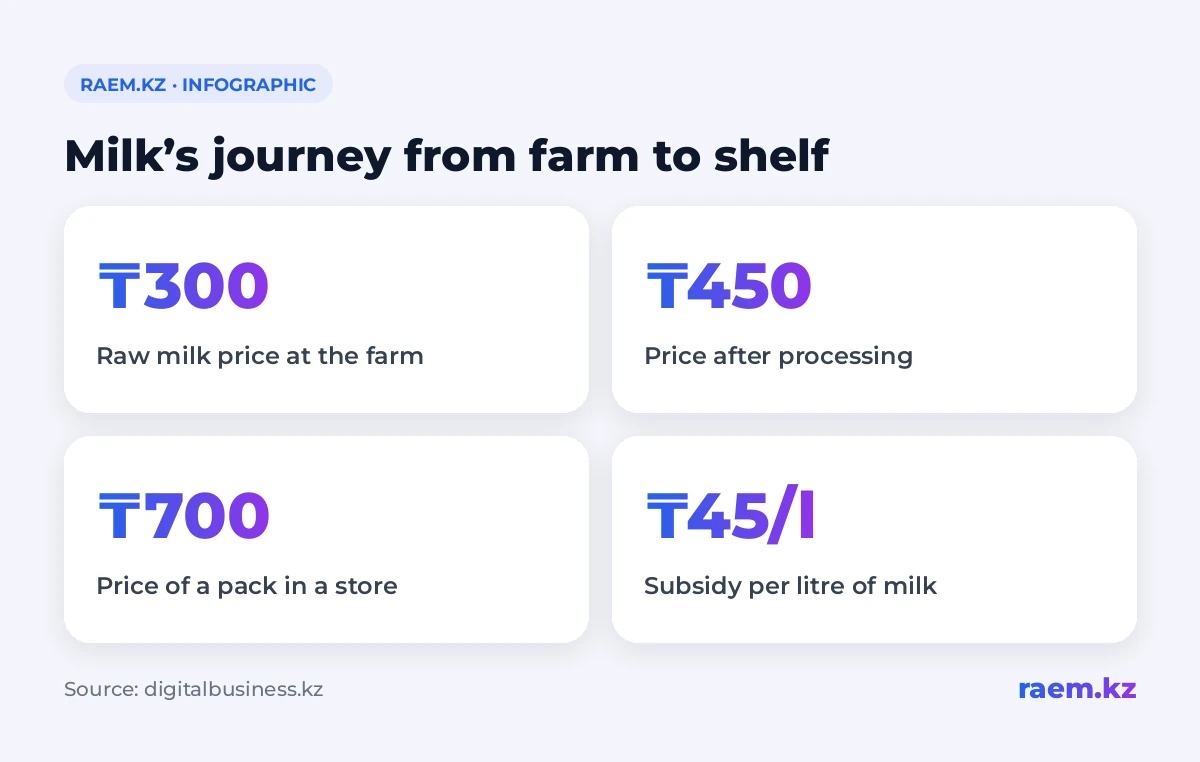
The shelf price of milk includes the cost of raw milk, processing, delivery and store expenses. Farmer Daniyar Abitayev explains that, in the supply chain he describes, raw milk sells for around 300 tenge, while a carton reaches 700 tenge in the store. In his view, a subsidy of 45 tenge per litre helps keep prices down for shoppers (digitalbusiness.kz).
How much farmers receive for milk
Abitayev discussed milk pricing on the Digital Business podcast. He said his farm sells raw milk for around 300 tenge. A processing plant then collects it and prepares it for sale.
The gap between the farm’s selling price and the shelf price builds up over several stages. Each business in the chain has its own expenses, from processing raw milk to running refrigerators on the shop floor.
What processors pay for
The plant has to collect the milk, clean it, pasteurise it, process it and package it. It also pays for heating, electricity, staff wages and taxes. All these costs feed into the price at which the product moves on to the next stage.
According to Abitayev, the processor factors in a minimum return of around 10% and sells the batch for roughly 450 tenge. Here, the return means how profitable the business is. These figures describe the supply chain outlined by the farmer.
Why milk reaches 700 tenge in stores
Wholesale distributors take over after the processing plant. They deliver batches to retail chains and maintain their own vehicle fleets and distribution centres. Their prices include storage, logistics, taxes and a profit margin.
The store adds the final markup. Retail chains also have warehouses, refrigeration equipment, lighting, shop floors and staff.
Abitayev cites Magnum, Small and Galmart as examples. After all these stages, a carton of milk reaches 700 tenge on the shelf.
How the subsidy affects milk prices
The farmer describes government support of 45 tenge per litre. He explains that this payment allows the farm to sell its milk for less. Abitayev links support for producers to the affordability of milk for shoppers.
“The farmer can sell the product for less so that it ultimately becomes more affordable on the shelf,” he explained.
Abitayev also challenges the idea that subsidies automatically generate excessive profits for farms. He considers support justified for producers that turn out millions of litres of milk a year and points to the industry’s tough working conditions.
How much milk could cost without the subsidy
By Abitayev’s calculation, without the payment, the farm would raise its selling price from 300 to 345 tenge. He says the increase would then pass through the processor, distributor and store.
The farmer suggests that the retail price would then reach around 780–800 tenge instead of 700. He explains that this is because businesses in the chain calculate their margins as percentages. This is Abitayev’s hypothetical calculation for a scenario in which support is withdrawn.
What shoppers should keep in mind
Put simply, the price covers the work of the entire chain, from the farm to the shop floor. In Abitayev’s assessment, the subsidy keeps the initial price of raw milk down and, through it, affects the final cost.
When considering these figures, bear in mind that 300 tenge refers to raw milk, while 700 tenge is the price of a carton on the shelf. The forecast of 780–800 tenge applies to a scenario without the subsidy.