
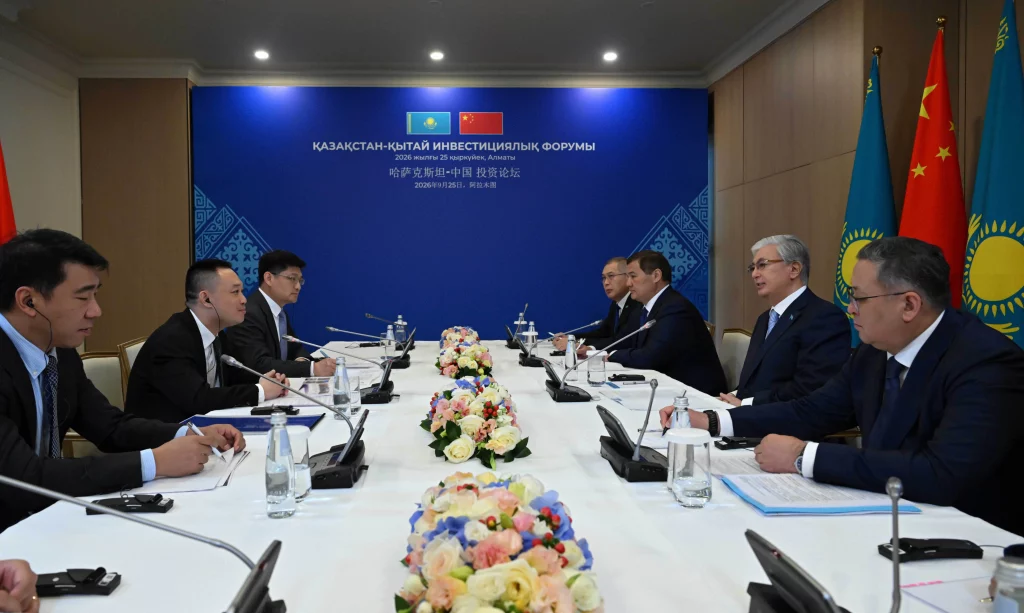
A joint venture project with China’s Pinduoduo is scheduled to launch in Kazakhstan in October 2026. This was announced by the head of the company’s international operations, Weng Peichen, during a meeting with President Kassym-Jomart Tokayev on September 25 in Almaty. The meeting was also attended by Zhou Jian, CEO of logistics giant YTO Express. The specific operational model of the project was not disclosed in the official communique.
Concurrently, the parties discussed the Almaty SkyHub multimodal transport and logistics hub, designed to process cross-border goods for subsequent transit to markets across the European Union, the Eurasian Economic Union (EAEU), and Central Asia. By the time of the meeting, the existing Qazpost–YTO joint venture had already delivered 12.5 million parcels, according to published metrics.
These announcements encapsulate various phases of e-commerce expansion: existing line-haul parcel deliveries, planned physical infrastructure, and a new marketplace initiative. They are unified by the objective of scaling cargo velocity through Kazakhstan. However, there is currently no basis to consider the October launch as the physical operational commissioning date of the SkyHub facility itself.
Pinduoduo Is Already Accessible to Kazakhstani Consumers
The October initiative cannot be characterized as Pinduoduo’s absolute debut in Kazakhstan. Local consumers can already order products directly from the Chinese platform and receive them via specialized logistics services.
Qazpost’s official portal features a detailed guide on ordering from Pinduoduo via its Keruen delivery service: customers are assigned a dedicated virtual warehouse address in China, which they input during checkout, after which parcels arrive at the sorting facility for consolidated shipping. Tracking updates are integrated into the Qazpost mobile app.
Almaty SkyHub: Regional Transit Infrastructure
In official communications, Almaty SkyHub is presented as a high-capacity hub engineered for rapid cargo clearance with seamless onward transit to the EU, EAEU, and Central Asian markets. Such geographic positioning implies servicing multiple trade vectors, including flows independent of Kazakhstan’s domestic consumer market.
Further specifications are outlined in Qazpost’s corporate presentation. The SkyHub overview indicates that YTO Express acquired 45 hectares of industrial land in the Almaty region to construct the logistics hub. The company also confirmed completing the master site plan, projecting a total built area of 442,000 square meters. These represent planned project specifications and do not imply immediate commissioning of the entire facility.
The economic viability of such a facility relies heavily on cargo handling operations: receiving, bonded storage, automated sortation, customs clearance, and modal transfer. Commercial revenue opportunities will accrue to local warehouse operators, motor carriers, technical subcontractors, and enterprise IT developers.
Nonetheless, designating export routes does not automatically guarantee consistent cargo density along each corridor. Making the hub fully operational requires binding airline and trucking agreements, standardized customs protocols, and synchronized dispatch schedules. Its ultimate economic scale will be determined by commissioned sorting capacity, operating lanes, and processed freight tonnage.
Kazakhstan’s E-Commerce Market Exceeds KZT 3.7 Trillion
Infrastructure expansion is unfolding against the backdrop of rapid domestic market growth. According to the Bureau of National Statistics (BNS), Kazakhstan’s retail e-commerce turnover, including marketplaces, reached approximately KZT 3.77 trillion in 2025. A year earlier, the metric stood at KZT 3.16 trillion, marking a nominal annual increase of 19.4%.
Digital marketplaces generated 86% of this total volume, with e-commerce capturing a 14.3% share of overall retail trade. These metrics delineate domestic commerce according to national statistical methodology and should not be confused with Pinduoduo’s individual sales or the aggregate value of all cross-border parcels.
For domestic merchants, streamlined Chinese logistics intensifies price competition: local consumers can easily compare domestic retail markups against factory-direct pricing from abroad. This price pressure is particularly acute in generic, commoditized consumer goods where product differentiation is minimal.
Domestic retailers, however, can defend market share through instant product availability, local customer support, warranty fulfillment, and hassle-free returns. The final attractiveness of cross-border commerce hinges on total delivered cost and service quality; lower sticker prices do not always guarantee a superior purchasing experience.
What the October Rollout Means for Business
For Kazakhstani businesses, the significance of the project will depend on the specific role made available to them. Enabling domestic merchants to sell directly on the platform would create an additional export distribution channel. Conversely, expanding incoming parcel delivery primarily broadens consumer choice while increasing volume across local courier networks. Regional transit handling would generate substantial contracts for warehouse and freight operators.
Currently, these remain projected avenues. The published announcement does not detail which specific format the October launch will inaugurate.
Following the official launch, key operational variables to monitor include: who operates the customer-facing service, which delivery options are enabled, how pricing tiers are structured, how returns are adjudicated, and whether Kazakhstani sellers can onboard inventory. For SkyHub, precise construction milestones and phased commissioning timelines will be paramount.
As of late September, three facts are firmly established: Pinduoduo goods are actively delivered to Kazakhstan, Qazpost–YTO processes substantial parcel volumes, and a new collaborative milestone is slated for October. Its genuine market impact will become quantifiable once the concrete product architecture and commercial terms are officially unveiled.