Between 2019 and 2024, state film studio «Kazakhfilm» produced 47 animated films backed by 1.37 billion tenge in public funding. Yet only four of those titles ever reached national television broadcast schedules, and not a single one secured a theatrical release in commercial cinemas.
Simultaneously in Almaty, private animation house Tasqyn scaled to approximately 100 employees, began licensing IP rights to streaming platforms, and launched its animated series across international markets. Another independent studio, ARA Studios, after expanding to over 20 in-house animators, was forced to dismantle its physical studio model and restructure entirely as a decentralized, remote freelance collective.
Kazakhstani animation exists suspended between these two opposing realities: state-financed production that frequently fails to connect with audiences, and private creative studios striving to decipher how to transform animation into an economically viable, repeatable commercial enterprise.
According to industry assessments by the Creative Industries Alliance of Kazakhstan (CIAQ), the domestic animation sector currently employs approximately 650 professionals, generating roughly 5 billion tenge in gross market turnover. CIAQ formally categorizes domestic animation as an emerging, nascent sector.
1.37 Billion Tenge for 47 Animated Titles: The Distribution Void
One of the most revealing analytical documents regarding Kazakhstani animation originated not from creative producers, but from government auditors.
According to Ministry of Culture and Information records published by the Supreme Audit Chamber, between 2019 and 2024 Kazakhfilm produced 47 animated projects with an aggregate budget of 1,374.6 million tenge.
In 2019, 140 million tenge was allocated across four productions; in 2022, 20 projects absorbed 552.9 million tenge; in 2023, ten projects received 323.9 million tenge; and in 2024, 13 projects were financed with 357.7 million tenge.
The core systemic failure was distribution rather than mere artistic production. Out of 47 completed films, only four were broadcast across national television networks (El Arna, Khabar, Qazaqstan, and Balapan). Zero titles achieved wide theatrical distribution. Furthermore, auditors highlighted that negotiations initiated back in 2019 to license titles to domestic SVOD streaming platforms and digital media aggregators were never formalized.
In the economics of animation, this disconnect is fatal. Producing an animated film does not inherently create an economic market. Without structured distribution pipelines that deliver content to paying audiences, producers cannot recoup capital to fund subsequent production cycles.
Between 2025 and 2026, the state maintained targeted financing. Kazakhfilm and the State Center for the Support of National Cinema (GNKNO) backed full-length feature releases, such as «Altyn Adam» (Golden Man), which premiered on June 5, 2025. While domestic theatrical releases mark progress, achieving profitability purely through Kazakhstan’s limited domestic box office remains mathematically challenging.
The Commercial Front: Tasqyn Studio and Diversified Monetization
At the opposite end of the spectrum operates Tasqyn Studio, founded in Almaty in the summer of 2022. Positioned as a full-cycle studio spanning screenwriting, visual conceptualization, voiceover, and musical score, Tasqyn maintains six original animated series and two comic book properties, supporting an in-house team of approximately 100 professionals.
Its portfolio includes properties such as «Kunshikter», «Bes Tai-Tai», «Seriktes», «Aldar», «Sugir», and «Adamtas». In discussions with Forbes Kazakhstan, founder Madina Sutbayeva explained that early releases were distributed freely via YouTube without immediate monetization.
Subsequently, the studio transitioned toward institutional licensing, commercial brand integrations, and retail merchandising. By mid-2025, direct content sales to streaming platforms accounted for 10–15% of revenue, retail merchandise and YouTube ad revenue generated approximately 10%, while the dominant revenue driver stemmed from strategic corporate partnerships and commercial integrations.
Tasqyn syndicated content across Kinopoisk, Ivi, TV+, Khabar, and in-flight entertainment systems on Air Astana and Air India. Producing content that airlines and regional SVOD services pay to license represents a fundamental departure from non-commercial state grants.
ARA Studios and the Cashflow Vulnerability of Independent Boutiques
The contrast between Tasqyn and ARA Studios illustrates the fragility of studio unit economics. Founded by Ramazan Shabdukarimov, ARA Studios developed the acclaimed pilot «Maqta Qyz», winning the pitching competition at the 2023 Baiqonyr Film Festival.
The studio expanded its physical office and assembled a team of more than 20 full-time artists and animators. However, when anchor financing hit multi-month operational delays, the burn rate of maintaining payroll without immediate syndication revenue proved unsustainable. The founders made the painful decision to dissolve the physical studio and convert to a remote, distributed contractor network.
This structural vulnerability haunts independent animation: animation is labor-intensive and capital-frontloaded. A 10-minute 2D episode can absorb months of meticulous production. If commercial contracts or grant tranches stumble, fixed studio overhead can extinguish an enterprise before its characters ever meet their audience.
Global IP Architecture: Why Free YouTube Views Do Not Equal an Industry
To many independent creators, YouTube represents the ultimate shortcut bypassing broadcast gatekeepers. Yet digital viewership does not automatically translate into a solvent enterprise.
Tasqyn’s flagship series «Kunshikter» averaged roughly 20,000 views per standalone episode on YouTube, while full 12-episode compilation releases achieved 464,000 views over a year. While vital for cultivating cultural awareness and language immersion for Kazakh-speaking youth, YouTube CPM ad payouts in Central Asia are insufficient to sustain a multi-artist studio payroll.
Global animation giants like Disney, Sanrio, or Studio Ghibli operate on an entirely different economic logic: the cartoon is effectively an extended marketing vehicle designed to establish durable emotional affinity for characters, unlocking immense downstream royalties through toys, apparel, school supplies, food licensing, and theme park attractions.
Generative AI Disrupts Lower-Tier Production Economics
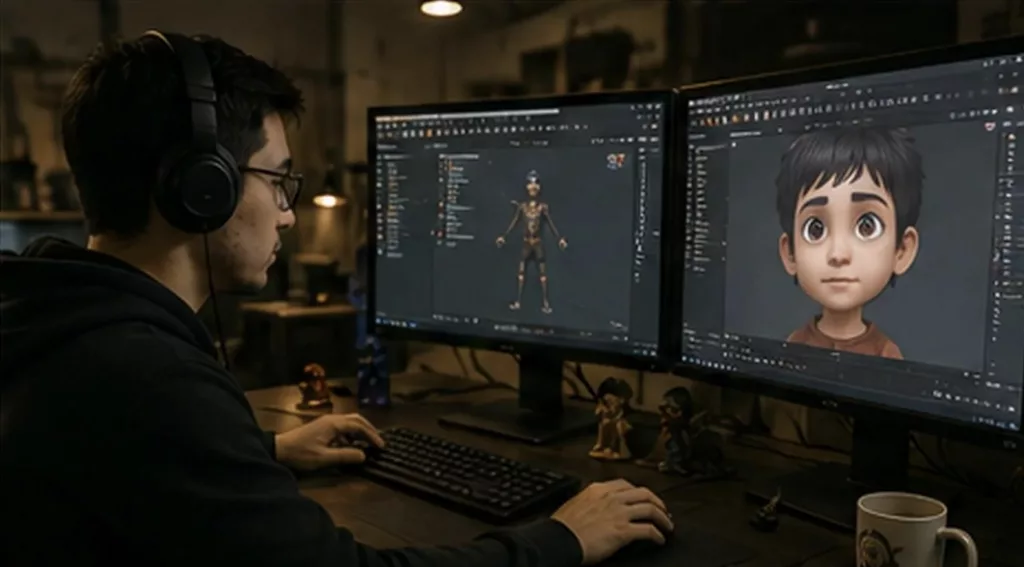
In 2026, traditional animation studios encountered a disruptive competitive vector: Generative AI tools drastically lowering the cost of digital animation production.
Broadcaster Turkistan showcased the pilot episode of «Guardians of Turkestan», an animated series produced utilizing generative AI pipelines. Creator Gasyr Kuralbay assembled the initial episode within seven days at a cash expenditure of approximately 70,000 tenge—comprising roughly $100 for AI compute subscriptions and 20,000 tenge for soundtrack mastering.
On the commercial front, startup StoryLove, founded by Alikhan Tokhtarov and Daniyar Bokishev, launched an AI-driven personalized animation platform. According to Forbes Kazakhstan, by 2026 the studio processed up to 800 automated orders monthly, exporting digital assets to international consumers.
While AI generation cannot yet match the artistic fidelity, nuanced character acting, and emotional depth of dedicated 2D/3D studio features, it fundamentally undercuts the entry-level pricing floor for commercial advertising, explainer videos, and social media shorts—the exact bread-and-butter contracts that small studios historically relied upon to bridge operational overhead between flagship creative releases.
The Critical Bottleneck: Turning Characters into Multi-Year IP Franchises
Studio founders rarely cite a shortage of creative talent as the primary structural barrier. Industry veterans note that Kazakhstan possesses outstanding 2D illustrators, 3D modelers, and rigging specialists, with junior animators frequently seeking steady employment.
The vulnerability resides entirely in the monetization flywheel. Global animation economics flourish when a single animated property unlocks an extensive economic chain: multi-season streaming syndication, global localization, retail merchandising, interactive gaming spin-offs, and toy licensing.
This explains why two talented local teams can diverge so dramatically: one studio scales to 100 professionals by locking in international co-productions and distribution, while another must downsize to survive on intermittent service gigs.
At approximately 5 billion tenge, Kazakhstani animation represents a small industrial footprint alongside traditional television or digital advertising. However, structural consumer demand for high-quality children’s content remains insatiable. The next evolutionary phase will be determined not by the sheer quantity of government-funded shorts produced, but by whether domestic creators build enduring characters and franchises that audiences demand across multiple seasons, toy aisles, and global streaming platforms.