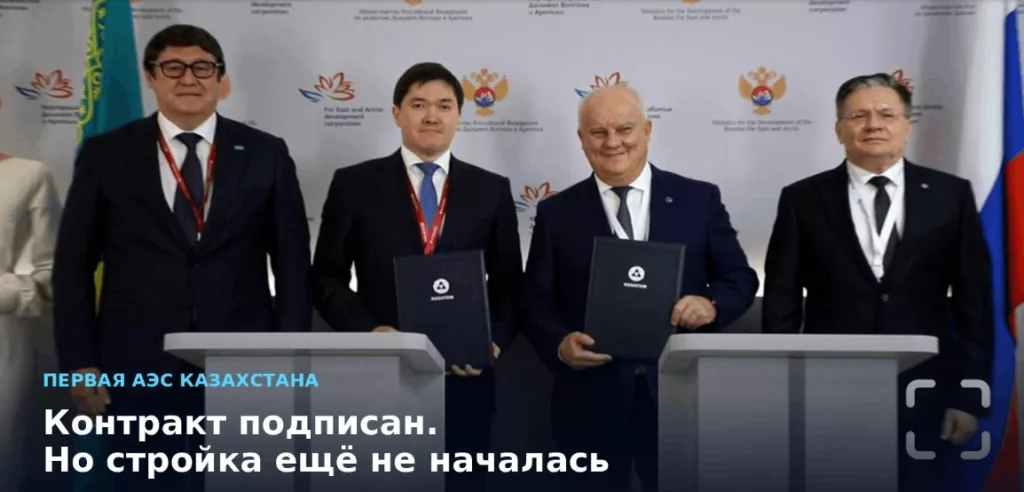
Kazakhstan and Rosatom subsidiary Atomstroyexport finalized the engineering, procurement, and construction contract for the planned Balkhash Nuclear Power Plant (NPP). This represents the project’s most significant contractual milestone following the national referendum—yet contract pricing and concrete construction timelines remain undisclosed.
Signing the Primary EPC Contract: Commercial Pact vs. Pouring First Concrete
On September 3 in Vladivostok, Kazakhstan Nuclear Power Plants LLP (KNPP) and JSC Atomstroyexport (the engineering division of Russian state atomic corporation Rosatom) signed the foundational contract governing site design, reactor engineering, equipment procurement, and construction of Kazakhstan’s first commercial nuclear power facility.
In official statements, authorities characterized the event as a transition to the «practical implementation phase». Functionally, the project now has a primary general contractor bound to guide the plant from architectural blueprints and reactor fabrication to a turnkey operating asset.
However, an essential legal sequence separates contract execution from trackside earthmoving: both sovereign parties must finalize statutory intergovernmental ratification protocols dating back to May 28, 2026, including formal ratification by the Government of Kazakhstan. Consequently, assertions that «physical plant construction has commenced» remain premature.
A Two-Year Trajectory: From National Referendum to Contract Ratification
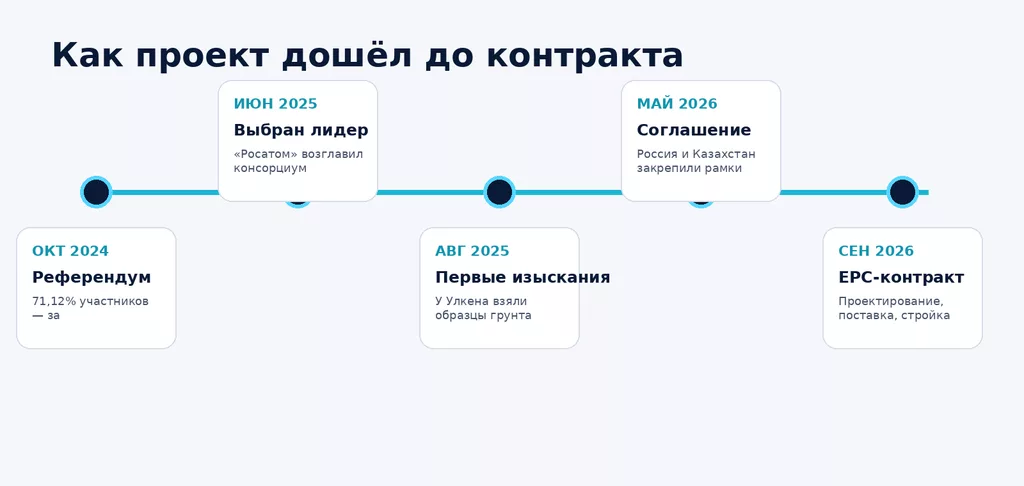
Chronological progression of key policy and contractual milestones for Kazakhstan’s first nuclear power station. RAEM Analytical Graphic
The sovereign political mandate was established through the national referendum on October 6, 2024. A decisive 5,561,937 citizens—representing 71.12% of participating voters—endorsed nuclear power generation on a national voter turnout of 63.66%.
In mid-2025, the Government of Kazakhstan designated Ulken village, situated on the shores of Lake Balkhash in the Almaty region, as the certified site for the dual-unit power station.
Official procurement reviews evaluated four international reactor vendor candidates: Rosatom (VVER-1200, Russia), KHNP (APR-1400, South Korea), CNNC (Hualong One, China), and EDF (EPR-1200, France). Ultimately, Kazakhstani authorities selected Russia’s Generation III+ VVER-1200 reactor design as the foundational technology.
Visualization of the twin-unit Generation III+ VVER-1200 nuclear power facility slated for construction at Lake Balkhash.
Key Commercial Terms Still Awaiting Official Publication
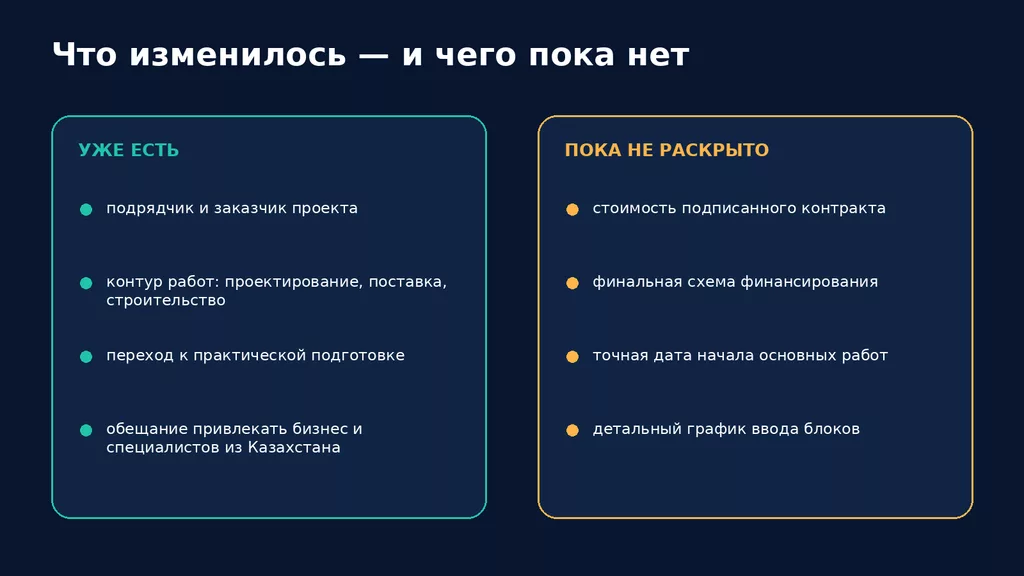
Official government communiqués omit critical commercial specifics: total project capital expenditure (CAPEX), sovereign debt financing terms, interest rate schedules, equity participation ratios, and legal liability for construction cost overruns. A detailed Gantt milestone chart—delineating the pouring of first nuclear safety concrete, fuel loading, grid synchronization, and commercial commissioning—has not been published.
Public statements previously cited 2035–2036 as the target operational window, with site ground preparation commencing in 2027. Following the Vladivostok signing, these dates were not reaffirmed, functioning as indicative benchmarks rather than locked contractual deadlines.
What Kazakhstan Gains Beyond Baseload Electricity: Industrial Localization
The central economic commitment emphasized by state planners is industrial localization. Kazakhstani manufacturers and construction contractors are slated to provide substantial domestic content, raw materials, civil engineering, and long-term facility maintenance.
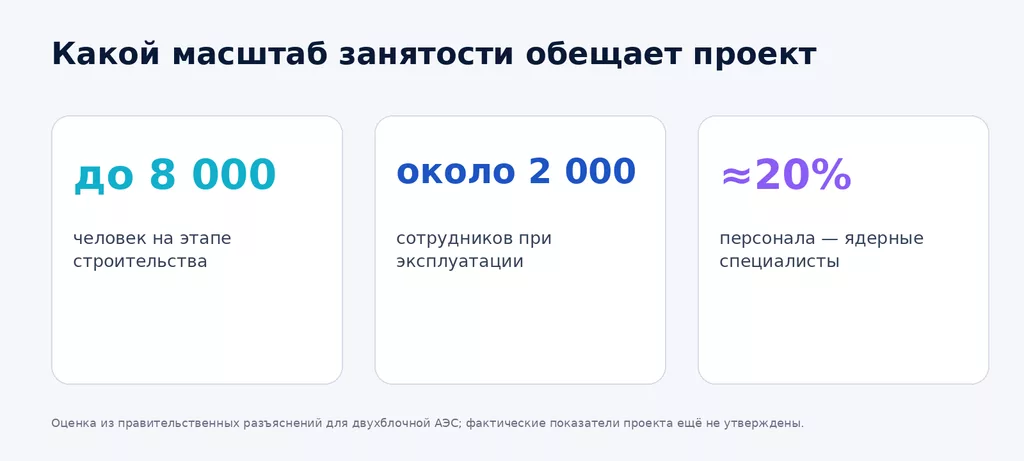
Projected employment metrics across construction and ongoing operational lifecycles based on official government briefings.
International benchmarks cited by the Ministry of Energy suggest that constructing a two-unit nuclear station creates up to 8,000 peak civil construction jobs, with permanent operational staffing requiring approximately 2,000 specialists—at least 20% of whom must hold specialized nuclear engineering credentials.
For domestic industry, the pivotal question is precise procurement quotas: what percentage of balance-of-plant contracts will be legally ring-fenced for Kazakhstani firms. Broad aspirational statements will become meaningful only once binding local procurement schedules are codified.
Why Baseload Power Is Indispensable for Industrial and AI Modernization
An atomic power station delivers unyielding baseload power: generating massive, predictable gigawatts 24 hours a day, 365 days a year, unaffected by weather intermittency. This power profile is indispensable for heavy metallurgy, automated transit rail networks, and hyperscale AI compute clusters.
Locating the facility at Lake Balkhash connects power directly into Kazakhstan’s energy-deficient southern grid, where structural power deficits are most severe. However, proximity to an inland endorheic lake introduces heightened ecological sensitivities regarding water cooling budgets, environmental impact, and nuclear safety protocols.
Consequently, the signing of the EPC agreement does not end the national dialogue on nuclear power—it inaugurates an era of intense technical scrutiny where every financial liability, safety standard, and localized procurement target must be verified with transparent numbers.