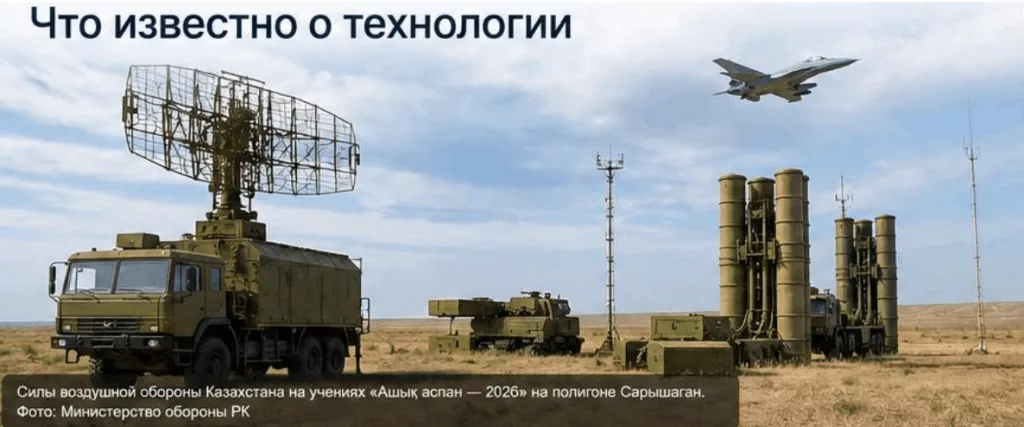
At the Saryshagan military testing range in central Kazakhstan, Air Defense and Air Force units conducted the large-scale «Ashyq Aspan — 2026» (Open Skies) live-fire tactical exercises. Among other mission objectives, military commanders tested automated command-and-control (C2) systems incorporating artificial intelligence elements. The Ministry of Defense did not disclose who developed the software.
The maneuvers concluded on August 31 as part of the broader «Batyl Toytarys — 2026» command-and-staff war games. The drills were directed by Deputy Defense Minister and Commander-in-Chief of the Air Defense Forces Major General Kairat Sadykov (toppress.kz, elordainfo.kz citing the MoD press service).
This is not Kazakhstan’s first step toward digital airspace management. Automated command systems have operated within the Air Defense Forces since at least 2020, and in 2025 they were evaluated under combat-simulated conditions for the first time. However, this is the very first instance where military leadership publicly reported the operational employment of artificial intelligence elements within this air defense loop.
What Exactly Was Tested at Saryshagan
The primary stated objective of the Saryshagan maneuvers was assessing the readiness of military command bodies and combat crews to repel coordinated, saturation aerial strikes (sputnik.kz).
Tactical scenarios focused on countering heterogeneous drone swarms, coordinating multi-layered air defense batteries, and executing decentralized decision-making during high-speed electronic jamming environments. Live combat firings involved S-300PS long-range surface-to-air missile systems, Buk-M2E medium-range anti-aircraft complexes, and Pantsir-S1 point-defense batteries, integrated alongside MiG-31BM interceptors and Su-30SM multirole fighters.
During the exercise, target designations and threat prioritizations were fed through an automated battle management loop. According to military observers, the AI component was tasked with trajectory extrapolation, threat scoring, and optimal weapon-target assignment (WTA) across mixed missile complexes.
The Evolution of Kazakhstan’s Air Defense C2 Systems
To understand the significance of the Saryshagan tests, one must trace Kazakhstan’s air defense digitalization trajectory over the past decade:
- The Legacy Era (Pre-2018): Air defense command centers relied heavily on voice communications, manual plotting boards, and isolated automated radar posts. Sensor data from radar stations had to be transcribed and verified by human operators before reaching divisional firing batteries, generating target hand-off delays ranging from 45 to 90 seconds.
- Unified Automated C2 Architecture (2018–2022): Kazakhstan deployed digital telemetry networks integrating stationary radar posts (such as GM-403 Nur and Rosa-RB) with central command posts. Digital data links cut target distribution latency to 10–15 seconds, but target classification remained largely algorithmic and rule-based.
- AI-Augmented Sensor Fusion (2025–2026): Modern combat operations in Ukraine and the Middle East demonstrated that low-flying, terrain-following cruise missiles and cheap FPV/reconnaissance drones easily overwhelm rule-based radar filters. At Saryshagan, the integrated AI module demonstrated machine-learning-driven target discrimination: filtering false bird/weather radar returns, detecting drone flight patterns, and predicting swarm strike corridors in fractions of a second.
Domestic Engineering vs. Foreign Defense Technology
A central question remains: Who developed the AI software tested by Kazakhstan’s Armed Forces? The Ministry of Defense maintains strict confidentiality, but defense analysts identify three plausible avenues:
- Kazakhstan Paramount Engineering (KPE) / Domestic Military Research Institutes: Kazakhstan’s domestic military-industrial complex has increasingly hired local software developers from Astana Hub to build specialized military telemetry, drone navigation, and situational awareness interfaces. Developing domestic algorithms ensures that national cryptographic keys and operational doctrine remain under sovereign control.
- Modernized Belarusian or Russian Defense Integrators: Kazakhstan maintains close technological alignment with regional air defense systems via the Unified Regional Air Defense System. Belarusian defense enterprises (such as KB Radar and Agat) have actively marketed AI-enhanced radar processing software to CSTO allies.
- Dual-Use Western or Chinese AI Architectures: Kazakhstan has diversified its radar acquisitions, operating French Thales Ground Master 403 radars alongside Russian systems. Bridging NATO-standard radars with Soviet/Russian-origin S-300 and Buk missile batteries requires complex, custom middleware—a challenge that often prompts the development of indigenous automated translation nodes.
Strategic Context: The Drone Threat and Saturation Tactics
Modern air defense doctrine is undergoing an unprecedented global revolution. Contemporary military conflicts have dismantled traditional airspace defense assumptions in three decisive ways:
Cost Asymmetry: Firing a $1.2M S-300 missile to intercept a $20,000 Shahed-style long-range loitering munition rapidly depletes national defense budgets and missile arsenals. Automated AI systems are essential to determine whether incoming threats require expensive surface-to-air missiles, mobile anti-aircraft guns, electronic warfare jamming, or directed energy counter-drone fire.
Mass and Velocity: Human operators experience cognitive overload when dozens of small targets appear simultaneously on radar screens traveling at diverse altitudes and speeds. Machine learning algorithms process hundreds of simultaneous radar tracks, calculating interception geometry and firing vectors instantaneously.
Electronic Warfare Resilience: When satellite navigation (GPS/GLONASS) is suppressed by heavy electronic jamming, automated command systems must synthesize fragmented visual, acoustic, and passive radio-frequency intelligence into a unified situational map.
What Remains Unanswered
Despite the successful conclusion of the «Ashyq Aspan — 2026» drills, key operational questions remain confidential:
Procurement and Deployment Scale: Is this AI management system an experimental prototype tested with a single division, or has it entered standardized serial procurement across all Air Defense regional commands?
Sovereignty of Software Code: Does Kazakhstan hold complete source code access and intellectual property rights, enabling domestic military engineers to reprogram threat libraries without foreign technical approvals?
Acoustic and Optical Integration: Has Kazakhstan integrated civilian acoustic monitoring sensors or border camera feeds into this military AI network to counter low-altitude radar-evading drones?
RAEM will continue monitoring modernization disclosures across Kazakhstan’s defense technology and GovTech sectors.