

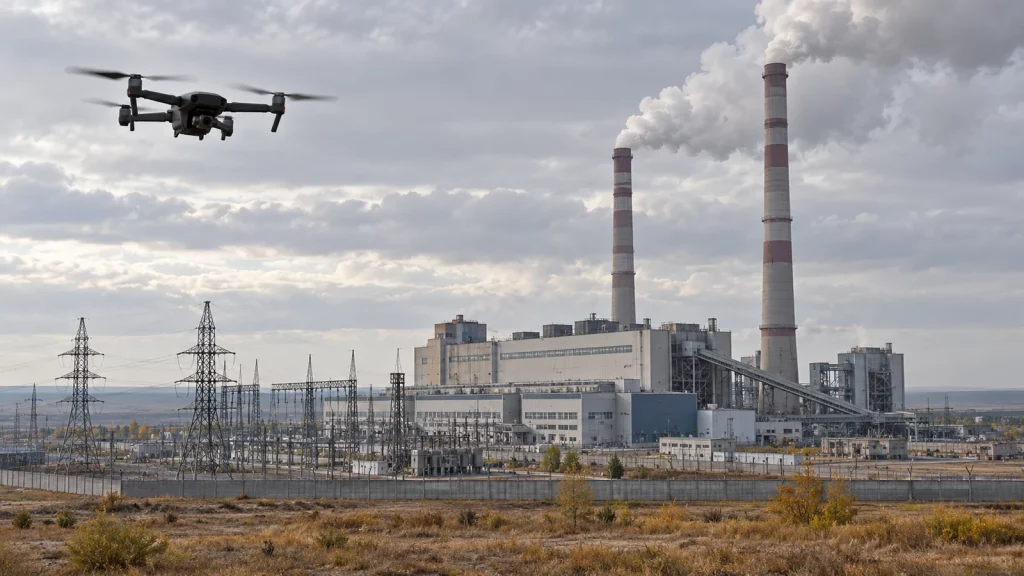
Kazakhstan is planning to deploy artificial intelligence to defend vital energy facilities against drone strikes. Key announced priorities include automated drone detection and suppression, cyber threat mitigation, and specialized staff training for coordinated attack scenarios.
The strategic plans were outlined by Minister of Energy Yerlan Akkenzhenov during a government cabinet meeting on October 6. AI adoption is slated across both digital network perimeters and physical security infrastructure.
A portfolio of 45 AI-enabled initiatives has been assembled across the fuel and energy complex. Government data indicates that 34 of these projects are currently in the deployment phase. However, this metric applies to the sector-wide portfolio: it does not confirm that operational counter-drone perimeters have already been installed at power generation plants.
Protection Against Drones and Cyber Attacks
Countering drone incursions is officially integrated into physical facility security. Concurrently, authorities intend to advance cybersecurity: identifying industrial network vulnerabilities and training technical operators to neutralize cyberattacks.
Official government briefings place heavy emphasis on supervisory control systems that directly manage thermal plants, electrical grids, and generation units. Industrial operational technology (OT) security is treated as a dedicated pillar of energy sector modernization.
Hands-on specialist training is already underway. In 2026, Kazakh National University hosted the ENERFORT-2026 industrial cyber exercises involving over 120 critical infrastructure specialists. Similar operational simulations will be held annually.
Public disclosures do not identify specific generation stations, equipment deployment timelines, vendor selections, or procurement costs. At this stage, the announcement outlines a strategic operational direction rather than a fully fielded, turnkey defense umbrella.
Origins of the 23 Billion Tenge Projection
The Minister estimated the projected economic dividend from industrial AI applications at approximately KZT 23 billion annually. In official communications, this aggregate sum derives from three distinct operational use cases.
The overwhelming majority — up to KZT 22.5 billion per year — stems from automated logistics planning for refined petroleum products. An additional KZT 300 million is attributed to natural gas demand forecasting, and KZT 370 million to industrial occupational safety workflows.
Consequently, the KZT 23 billion figure cannot be interpreted as financial savings from counter-drone warfare or capital defense procurement budgets. It reflects the cumulative projected dividend of three industrial optimization models. Mathematical methodology was not detailed in published reports.
What Else the Ministry of Energy Is Planning
The energy sector digitalization roadmap comprises 20 discrete initiatives across three strategic pillars: enterprise digital twins, artificial intelligence applications, and cyber-physical security. Phased execution extends through 2029.
Prior to the end of 2026, authorities plan to ratify an approved registry of priority AI systems, unified digital twin architectures, and baseline cybersecurity standards. Scaled enterprise deployment is slated for 2027.
For counter-drone defense, upcoming milestones will include documented equipment installations at designated sites and empirical field trial data. Currently, the minister’s announcement establishes intent to incorporate counter-UAS capabilities into Kazakhstan’s energy protection doctrine.



