
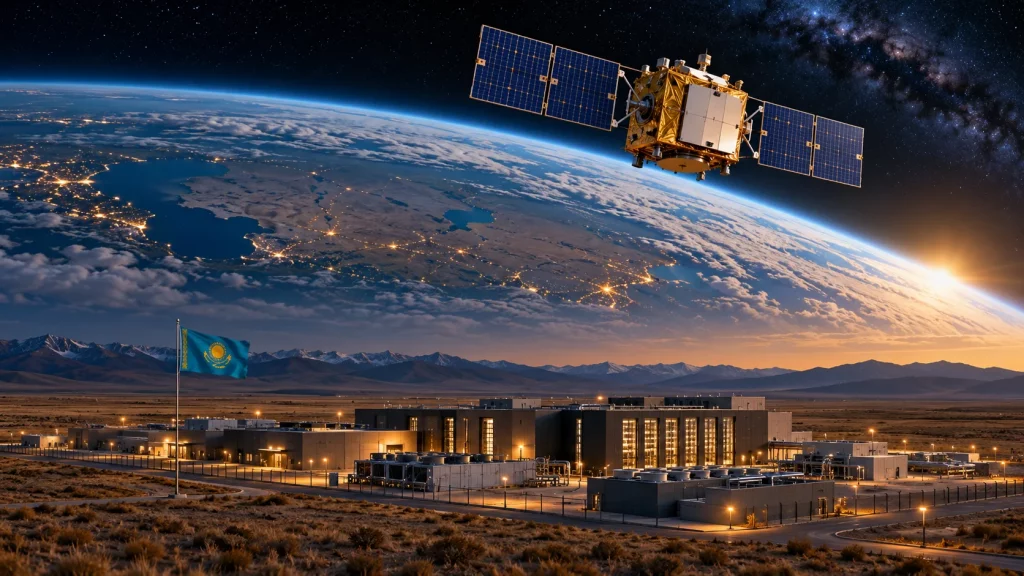
Early Uber venture investor Shervin Pishevar is taking part in Kazakhstan’s new Digital Silk Road initiative. The proposed scope encompasses artificial intelligence data centers, regional fiber-optic connectivity, and even orbital spaceborne computing. For now, the stakeholders have signed a preliminary memorandum of understanding: tangible commercial projects, contractual obligations, and capital deployment terms have yet to be finalized.
Behind the headline-grabbing space computing vision lies an entirely terrestrial question: Can Kazakhstan emerge as a competitive destination where international enterprises base compute workloads and scale commercial AI operations?
What Was Signed
The agreement was announced on October 7 by the Ministry of Artificial Intelligence and Digital Development of Kazakhstan. The memorandum connects the Astana International Financial Centre (AIFC), national telecom operator Kazakhtelecom, Balaji Srinivasan’s Network School, Pishevar, and associated private investment vehicles.
Investment holding Sofreh Capital is slated to participate in developing the Digital Silk Road, helping attract institutional international capital and leading technology companies. The infrastructure roadmap encompasses high-density data centers, satellite constellations, space computing hardware, and the Trans-Caspian subsea fiber-optic network.
The strategic intent is to integrate several components of a unified digital value chain: baseline electric power, high-density server clusters, low-latency data transit, and end-users demanding compute capacity.
Where Does Uber Fit In
In December 2011, Uber raised a landmark $32 million Series B round co-led by Menlo Ventures, where Pishevar served as managing director—a transaction heavily chronicled by TechCrunch at the time.
For Kazakhstan, Pishevar’s value lies in his Silicon Valley track record and established network across global technology syndicates. Such partners can facilitate introductions to prospective hyperscaler tenants and institutional debt markets. However, a prominent venture pedigree alone does not resolve core unit economics: capital construction expenditures, power costs, and sustained tenant demand.
Why Kazakhstan Needs Compute Infrastructure
Artificial intelligence operates on physical, energy-intensive hardware. Training state-of-the-art foundation models and serving high-throughput inference requests require enterprise accelerator chips, reliable electrical grids, advanced industrial cooling, and redundant high-bandwidth bandwidth pipes.
For Kazakhstan, the economic thesis revolves around commercializing digital infrastructure: hosting server farms domestically while international enterprise customers pay foreign currency to train neural networks and process transactional workloads.
Under this blueprint, the country transforms from an energy exporter into a value-added computing hub. Nevertheless, building bare-metal data centers does not guarantee customer queues: success depends strictly on per-megawatt compute pricing, uptime service-level agreements, and access to sanctioned silicon hardware.
The Genesis of Orbital Space Datacenters
Bagdat Mussin, Chairman of the Board of Kazakhtelecom, outlined the orbital vision during announcement briefings:
“Looking further ahead, we can even envision launching commercial data centers directly into orbit from Kazakhstan’s spaceports.”
The concept is currently undergoing preliminary prototyping in international aerospace labs. According to company releases, startup Starcloud deployed the Starcloud-1 satellite in November 2025 carrying an onboard NVIDIA H100 GPU accelerator, reporting successful fine-tuning of an edge LLM in low Earth orbit. That demonstration remains a separate venture unrelated to Kazakhstan’s memorandum.
Such experimental payloads prove orbital compute feasibility in microgravity. The unresolved hurdle is transforming high-risk aerospace experiments into economically viable, fault-tolerant commercial cloud services.
Why Deep Space Does Not Solve Thermal Challenges
A primary theoretical advantage cited for orbital data centers is solar generation: placed into sun-synchronous orbits, photovoltaic arrays can capture nearly uninterrupted solar irradiance without atmospheric attenuation.
However, high-performance accelerator chips generate extreme thermal heat flux, and the vacuum of space contains zero ambient atmospheric air for convective heat dissipation. Consequently, systems require complex closed-loop heat pipes and massive radiator panels that dissipate heat purely via infrared radiation.
Google explores these identical thermal physics in its Project Suncatcher initiative. Beyond radiative cooling, aerospace engineers must harden commercial silicon against solar radiation damage and establish high-speed inter-satellite laser communication links. Joint two-satellite constellation tests are scheduled for 2027.
Consequently, an orbital computing installation requires overcoming staggering engineering barriers: launch logistics costs, radiation degradation, payload weight limits, and massive downlink data bandwidth restrictions.
Interpreting the $100 Billion Target
The stated ambition announced by the signatories is creating an enterprise with enterprise market capitalization exceeding $100 billion. This figure represents an aspirational future market valuation metric, not an immediate upfront committed capital deployment.
Within 100 days following signing, the participating parties intend to draft a phased execution roadmap. Concrete financial commitments, equity ownership splits, and operational timelines must be established through subsequent binding bilateral pacts.
The immediate metric to scrutinize is the structural content of that upcoming 100-day roadmap: what physical terrestrial facilities break ground first, who finances construction capital, and which commercial clients sign anchor compute off-take agreements.
If these operational questions receive concrete answers, the Digital Silk Road could materialize into a transformative commercial asset. Until then, spaceborne computing remains the most visionary chapter in Kazakhstan’s digital ambitions.



