
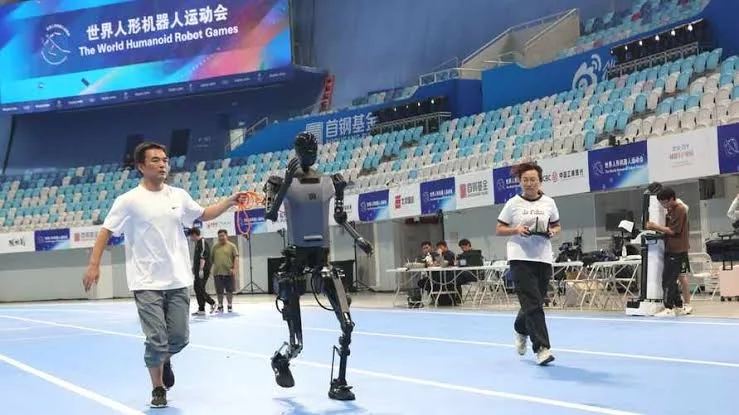
In late August 2026, Beijing hosted the second annual World Humanoid Robot Games (WHRG)—an unprecedented global spectacle assembling 2,056 bipedal and wheeled robotic platforms from 666 teams competing across 51 athletic and applied industrial disciplines. Often hailed as the “Robot Olympics,” the games generated international viral headlines—including a 100-meter sprint clocked at 8.64 seconds, officially surpassing Usain Bolt’s human benchmark. Yet beneath the viral sprints lies a sobering engineering reality: while robotic locomotion has achieved superhuman velocity, fine dexterous manipulation of everyday objects remains an immense technological bottleneck. RAEM.KZ conducted a complete technical, industrial, and economic audit.

Executive Summary: The Tournament in 30 Seconds
- Scale: 666 participating teams from 16 nations deploying 2,056 robots across 9 competition sessions over 5 full days (August 22–26, 2026).
- Sprint Record: Beijing Innovation Center’s Tiangong Ultra clocked 8.64 seconds in the 100-meter dash, smashing human speed limits.
- Discipline Split: 51 total medal events—9 athletic tracks, 21 applied service/industrial tasks, alongside soccer, racket sports, and combat exhibitions.
- Autonomy Caveat: In running and soccer, robots operated with full sensor autonomy. In fine manipulation, hotel service, and household chores, teleoperation (human remote control via VR/motion capture) was officially permitted.
- Industrial Landscape: Global shipments exceeded 20,000 units in H1 2026. However, up to 70% of shipments went to research laboratories, universities, and exhibition rentals rather than revenue-generating manufacturing lines.
- Geopolitical Shift: As the United States enacts strict import restrictions against Chinese robotics, manufacturers are pivoting toward Central Asia. In Astana, QAZBOT Technologies announced a $200 million manufacturing initiative partnered with AgiBot.
Tournament Schedule and Structure
| Date | Competition Schedule |
|---|---|
| August 22, Saturday | Opening ceremony, 7×7 robotic soccer exhibition, preliminary 100m and 400m sprint heats. |
| August 23, Sunday | High-intensity medal day: 12 gold medals awarded across gymnastics, obstacle courses, and table tennis. |
| August 24, Monday | Weightlifting finals, 1,500m endurance runs, industrial logistics sorting and assembly challenges. |
| August 25, Tuesday | Autonomous service operations: elderly care simulation, medication delivery, cleanroom handling. |
| August 26, Wednesday | Grand finals: 100m sprint championship, 4x100m relay, closing ceremonies, and technology forum. |
Who Participated: 2,056 Robots and One Vital Distinction
The headline metric of 2,056 robots requires technical nuance. The tournament categorized participants into two mechanical tiers:
- Large Humanoid Class: Full-sized bipedal systems standing 150–180 cm tall and weighing 45–75 kg, equipped with high-torque knee joints and harmonic drive actuators (e.g., Tiangong Ultra, Unitree H1, AgiBot Yuanzheng A2).
- Small Humanoid & Wheeled Class: Compact desktop bipedal units (under 60 cm) and hybrid wheeled-legged platforms designed for agility and collegiate programming research.
The Full Program: 51 Disciplines
| Competition Track | Key Disciplines |
|---|---|
| Athletics (9 Events) | 100m sprint, 400m dash, 1,500m endurance, 4x100m relay, steeplechase, hurdles. |
| Team Sports | 5×5 and 7×7 autonomous soccer matches. |
| Racket Sports (Debut 2026) | Table tennis and lawn tennis, benchmarking visual latency and trajectory prediction. |
| Heavy Power (Debut) | Olympic weightlifting (two weight classes), testing maximum actuator torque and balance recovery. |
| Martial Arts | Choreographed Tai Chi routines and controlled sparring matches. |
| Applied Industry (21 Events) | Logistics box sorting, automotive wire-harness plugging, surgical tool handover, precision assembly. |

Rules: Autonomous Agency vs. Human Teleoperation
Understanding what was truly autonomous is essential when interpreting tournament records:
- Track and Field & Soccer: 100% Autonomous. Once the starter gun fired, no human operator intervened. Robots utilized on-board LiDAR, stereo depth cameras, and high-frequency reinforcement learning models running on localized edge compute (e.g., NVIDIA Jetson Thor or local NPUs) to maintain posture and execute footfalls.
- Applied Service & Domestic Tasks: Teleoperation Permitted. In fine manipulation challenges—such as folding laundry, unscrewing jar lids, or sorting complex hospital instruments—rules permitted human pilots operating via VR headsets and haptic gloves. Points were deducted for teleoperation, but it highlights that true end-to-end cognitive autonomy in physical manipulation remains unsolved.
Tournament Results and World Records
| Discipline | Winning Model / Developer | 2026 Winning Mark |
|---|---|---|
| 100m Sprint (Large Category) | Tianjiao / Tiangong Ultra (Beijing Innovation Center) | 8.64 seconds |
| 100m Sprint (Small Category) | Tianxiao (Tsinghua University) | 11.98 seconds |
| 400m Run (Large Category) | Unitree H1 / Evolution Alliance | 38.15 seconds |
| 4x100m Relay | Zhiyuan Robotics (AgiBot Yuanzheng A2) | 42.30 seconds |
| Obstacle Course | Fourier Intelligence GR-1 | Flawless navigation, 1m 14s |
2025 vs. 2026: The Year-Over-Year Leap
| Metric | 2025 Games | 2026 Games |
|---|---|---|
| Duration | 3 days, 6 sessions | 5 days, 9 sessions |
| Registered Teams | 280 | 666 (+138%) |
| Participating Robots | Over 500 | 2,056 (+311%) |
| Medal Disciplines | 26 | 51 (+96%) |
| 100m Sprint Record | 21.50 seconds | 8.64 seconds (-59.8% time reduction) |

Why Hands Are Infinitely Harder Than Legs
While bipedal sprinting has matured rapidly through sim-to-real reinforcement learning, five-finger manipulation remains the grand unsolved frontier of physical artificial intelligence. Sprinting requires repeating coordinated cyclical footfalls against a rigid floor. Manipulating a flexible fabric t-shirt, grasping a delicate egg, or routing automotive wiring harnesses requires multi-modal tactile feedback, delicate force regulation, and continuous spatial re-planning.

Industry Economics: Market Size and Shipping Discrepancies
| Market Analyst | H1 2026 Global Humanoid Shipments |
|---|---|
| Smart Analytics Global | 19,100 units (+272% YoY) |
| Counterpoint Research | Over 22,000 units (~+300% YoY) |
| China Robot Industry Alliance | Over 30,000 units within domestic China |
Why do industry figures diverge? Analyst methodologies count shipments differently. Leading vendors frequently lease robots to corporate event promoters or deliver experimental development kits to university computer science faculties. Genuine industrial factory deployments—where humanoids perform deterministic shift labor—represent less than 20% of aggregate volumes.

US Market Lockout Drives China to Eurasia
As the United States enacts steep tariffs and national security restrictions barring Chinese autonomous robotics from entering North American industrial facilities, Chinese robotics leaders like AgiBot, Unitree, and Fourier are aggressively expanding into Eurasian trade corridors. Shut out from US ports, these manufacturers view Central Asia as an essential gateway for hardware localization and regional testing.
The Kazakhstan Connection: QAZBOT and the Astana Plant
This global transformation directly intersects with Kazakhstan. On August 19, 2026, the QAZBOT Robotics Forum convened at the alem.ai International AI Center in Astana. Forum organizers announced the groundbreaking of Kazakhstan’s first dedicated robotics and AI manufacturing facility, led by Qazbot Technologies CEO Vladislav Safarov.
The centerpiece of the forum was an official trilateral memorandum signed between JSC Astana Innovations, QAZBOT Technologies, and AgiBot. Kazakhstan is stepping into the humanoid robotics industry both as an institutional buyer and as a regional assembly partner at a pivotal moment when manufacturers must prove real commercial return on investment.

Author Analysis: Locomotion vs Commercial Reality
The engineering leap from 21.50 seconds to 8.64 seconds in a single year is indisputable. Yet the critical gap lies between what is demonstrated on sports tracks and what is sold to enterprises. Running a 100-meter dash is a solved motor problem; navigating a cluttered warehouse aisle, handling flexible textiles, and safely sharing confined spaces with human workers remains immensely difficult.
For Kazakhstan, the strategic imperative is assessing whether imported humanoid platforms serve as functional industrial tools or advanced educational testbeds. Both objectives have merit, but they demand vastly different capital budgets and performance milestones.
Frequently Asked Questions
What is the World Humanoid Robot Games?
An annual international robotics competition held in Beijing where hundreds of teams compete across athletics, soccer, martial arts, and industrial tasks.
What was the 100m sprint world record?
The Tiangong Ultra humanoid set a record of 8.64 seconds in the 100-meter sprint, surpassing the human record of 9.58 seconds.
Were all robots operating fully autonomously?
Athletic track events and soccer matches were 100% autonomous. In complex manipulation and household challenges, human teleoperation via VR and motion capture was permitted with scoring deductions.
How is Kazakhstan connected to this ecosystem?
Kazakhstan’s QAZBOT Technologies broke ground on a robotics manufacturing complex in Astana in partnership with AgiBot, one of China’s premier humanoid robotics developers.



