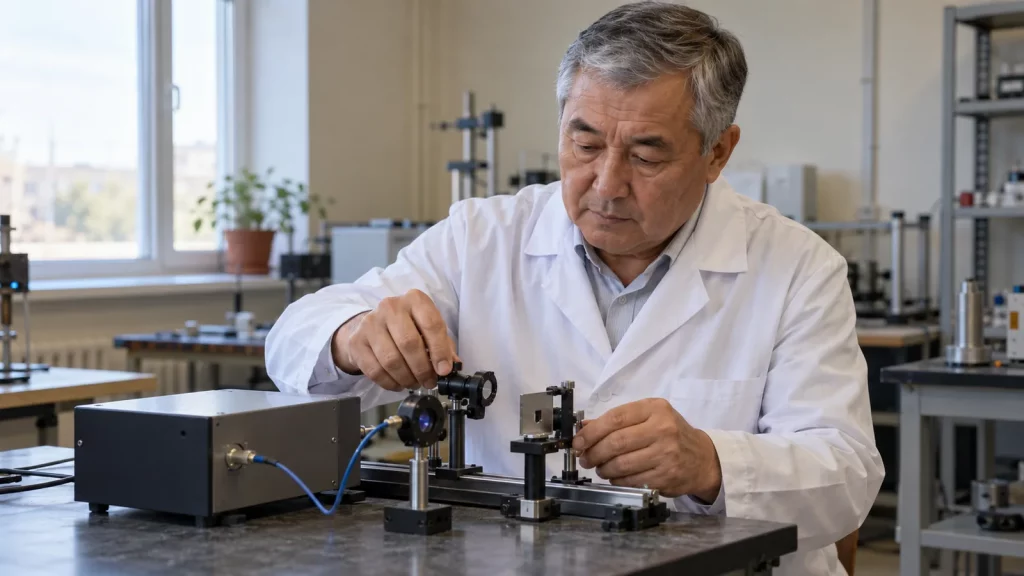
Scientists at K. Zhubanov Aktobe Regional University have developed a portable spectral instrument weighing 3 kilograms. According to Digital Business, it records a single spectrum in about a minute, compared with 20–30 minutes on the researchers’ previous setup.
Illustration: AI
What happened
The instrument was developed at the university’s Radiation Physics of Materials research centre under the direction of Kuanyshbek Shunkeyev, who holds a doctorate in physics and mathematics. He has been conducting nuclear physics research since the 1980s.
During development, the main components of the old equipment were adapted to a modern measurement system. Some of the necessary parts were supplied from Belarus and Japan. The instrument was tested at the Institute of Nuclear Physics’ DC-60 accelerator in Astana, and the scientists also conducted research at a laboratory in Hamburg.
The instrument records the faint glow of special crystals known as scintillators. When exposed to gamma rays, X-rays or ionising particles, these crystals emit brief flashes of light. Analysing these signals helps researchers study the characteristics of radiation and changes in the physical properties of materials after irradiation.
What this means
Shorter measurement times are particularly important for signals that fade quickly. According to the project leader, the previous equipment was bulky and designed to remain in one place. The new instrument is easier to move, opening up more opportunities for use outside a fixed laboratory.
“This is particularly important when recording weak signals that can disappear within a short time,” Shunkeyev said, explaining the advantage of faster recording.
The reported improvement in speed is relative to the researchers’ previous setup. Compact instruments for working with radiation already exist abroad, but they serve different purposes. Comparing them solely by weight or measurement time would therefore be misleading.
For example, a 2016 study published in Sensors by researchers at Myongji University in South Korea describes Personal-Spect, a prototype personal gamma spectrometer weighing 340 grams, including its battery. It could be accessed remotely via a mobile device and was developed for environmental radiation monitoring and security applications. The study documents an earlier compact spectrometer; it does not verify the performance of the Aktobe instrument.
Personal-Spect measures gamma radiation for monitoring applications, while the Aktobe instrument, according to the developers’ description reported by Digital Business, records faint light signals to study radiation effects on materials. These differences in purpose mean the devices cannot be treated as direct equivalents.
The team is currently conducting experiments with an X-ray machine manufactured in Aktobe and exploring further uses for the instrument. The researchers identify improvements to radiation sensors and the development of radiation-resistant materials as promising areas. They are also considering using the instrument in international research projects and presenting it to research organisations abroad.