Illustration: AI
From 10 November 2026, Kazakhstan’s threshold for tax scrutiny of mobile transfers rose to 1557000 tenge over three consecutive months. Banks will share details if transfers also come from at least 100 different senders in each of those months. The State Revenue Committee (KGD) announced the changes (kursiv.media). Receiving money on your card does not, by itself, mean you owe tax.
How much the transfer threshold has risen
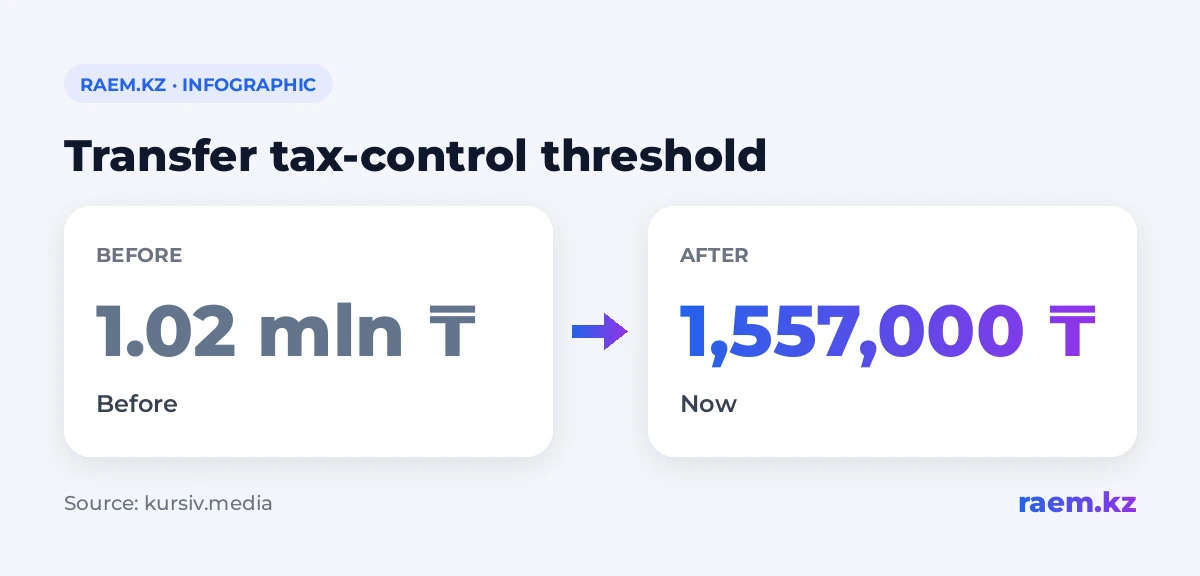
The previous threshold was 1.02 million tenge, or 12 minimum monthly wages. It is now calculated using the monthly calculation index (MCI). The new threshold is 360 MCI, which amounts to 1557000 tenge in 2026.
That is an increase of 537 thousand tenge. The change is set out in the finance minister’s Order No. 718 of 23 October. The calculation uses the MCI in effect on 1 January of the relevant financial year.
When banks will share payment details
Banks will report incoming payments to the tax authorities if both conditions are met:
- Transfers come from at least 100 different senders in each of three consecutive calendar months.
- Total incoming payments over those three months exceed 360 MCI.
The requirements for the number of senders and the period covered remain unchanged. These criteria apply to personal bank accounts that are not intended for business use.
Here is an important detail: exceeding the amount alone is not enough. A separate article explains which transfers come under scrutiny.
How much you can send in a single transfer
The new threshold does not limit the size of a single transfer. It applies to total incoming payments over three months when the condition on the number of senders is also met.
Nor does 1557000 tenge become a tax-free allowance. If the money is payment for goods or services, the higher threshold does not exempt the recipient from tax obligations.
Tax on gifts and debt repayments
Money from relatives, debt repayments and contributions towards a group gift do not become business income simply because they arrive on a card.
What the money is for determines the tax obligations. Revenue from selling goods or providing services remains revenue after the threshold increase.
Sharing details does not mean an account freeze
A bank sharing details with the tax authorities does not, by itself, mean the law has been broken. It also does not automatically trigger a tax charge or an account freeze.
We have separately explained what to do after receiving a notice from the tax authorities about mobile transfers.
Put simply
If you are reviewing your incoming payments, check both conditions: the total over three months and the number of different senders in each month. Comparing a single large transfer with the threshold is not enough.
If you accept payment for goods or services, keep your tax obligations in mind regardless of the new threshold.