
Photo: Picas Joe / Pexels
From January 1, 2027, Kazakhstanis will be able to choose from three strategies for investing their pension savings through their UAPF personal account. Access will depend on how many years are left until retirement, said Farkhad Okhonov, head of Halyk Finance, and Timur Salimov, head of Alatau City Invest (kursiv.media).
The risky portfolio is open to those with more than 13 years until retirement
The current conservative strategy will be joined by a moderate one and a risky one. Each will have its own limits on what the portfolio can hold. The periods over which a manager’s results are judged will differ too.
The changes are set out in Resolution No. 155, which the regulator adopted on October 30, 2026 (gov.kz). The Agency for Regulation and Development of the Financial Market said that as of October 1, 2026, private managers handled pension assets worth 205.8 billion tenge.
Not every contributor will be able to pick any strategy.
| Strategy | Who can choose it |
|---|---|
| Conservative | All contributors |
| Moderate | Those with more than three years until retirement |
| Risky | Those with more than 13 years until retirement |
Earlier, raem.kz explained who can choose the three strategies, how to switch portfolios and when a manager has to make up for weak returns.
The strategy is chosen through the UAPF, and savings can be split
According to Farkhad Okhonov, the procedure will be similar to how people now choose a management company. A drop-down list of the strategies offered by the chosen company will appear in the UAPF personal account. It won’t be possible to do this through the manager’s own app.
Information about the strategies will be posted on the UAPF website, on the managers’ websites and on their social media.
Timur Salimov said contributors will be able to split their savings between different managers and strategies. One part could go to a company with a conservative portfolio, another to a manager with a riskier approach. He said this option will be open to those with more than 13 years until retirement.
For background on choosing between company offers, see our piece on pension portfolios to choose from.
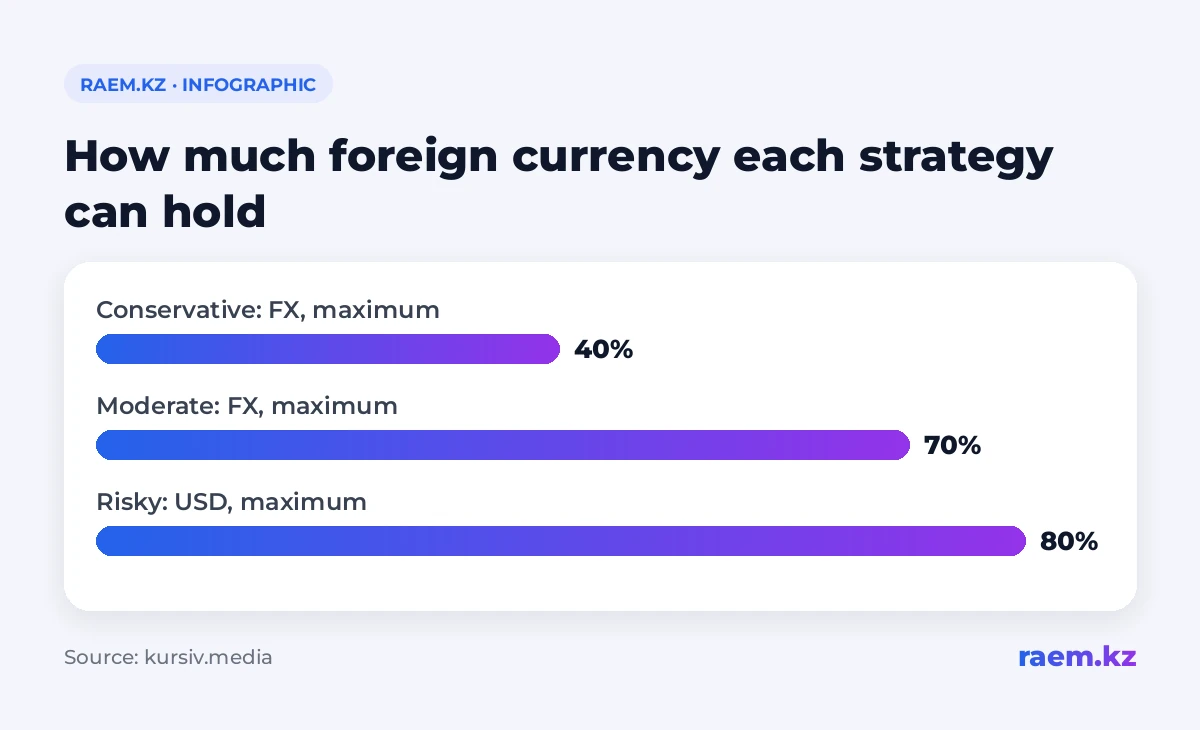
Foreign currency will go up to 70%, dollar holdings up to 80%
The conservative strategy means a bigger share of bonds and tenge instruments. Foreign currency investments will be capped at 40% of the portfolio.
The moderate strategy balances stocks and bonds. Foreign currency can make up to 70%. The risky one will hold more stocks, and its dollar component can reach 80%.
Managers will pick the specific securities themselves.
Okhonov explained that companies will keep to the permitted shares of stocks and bonds, as well as the currency mix of each portfolio. When choosing securities, they can look for undervalued assets, hoping to beat the market benchmark.
Salimov ties the choice of currency share to the contributor’s own expectations. In his words, someone who wants potential protection against a tenge devaluation might pick a portfolio with more dollars. Someone who has more faith in a strong tenge and current interest rates might pick a smaller share of foreign currency.
Returns will be compared with indices over one, three or five years
Each strategy will get a benchmark, a reference level of returns. It will be built from Kazakhstani and global stock and bond indices.
According to Okhonov, the benchmark for global stocks will be the S&P 500, and for Kazakhstani stocks the KASE index. Kazakhstani bonds will have a different KASE index.
The overall portfolio benchmark will combine the returns of the relevant indices, weighted by the share invested in each type of security. The manager’s actual result will be measured against it. The UAPF and the management companies will publish the figures.
| Strategy | Minimum result relative to the benchmark | Evaluation period |
|---|---|---|
| Conservative | 90% of the benchmark return | One year |
| Moderate | 85% of the benchmark return | Three years |
| Risky | 80% of the benchmark return | Five years |
The percentages in the table are shares of the benchmark return. They should not be read as a promised annual profit for the contributor.
The manager will cover any shortfall below the set threshold
According to Salimov, if the result falls below the minimum, the company will have to make up the shortfall in returns from its own funds. The obligation is tied to the threshold for the specific strategy and its evaluation period.
Okhonov and Salimov stressed that managers will not be able to guarantee or promise a particular return. Companies will be able to share forecasts and show benchmarks for one, three or five years.
Okhonov said Halyk Finance holds calls with clients every quarter. On them, the company discusses asset management results and benchmarks for the next period.
As retirement nears, the UAPF will move the money to a suitable portfolio
Under the regulator’s rules, when a contributor no longer meets the age conditions, the UAPF will automatically move the funds to a suitable portfolio at the same company.
If the manager has no such portfolio, the fund will notify the contributor in advance. They will need to choose another manager or return the funds to the National Bank.
A company can close a portfolio after its evaluation period ends, giving a year’s notice. The manager must still keep at least one portfolio.