Executive Snapshot & Valuation Triangulation
| KEY TAKEAWAY |
|---|
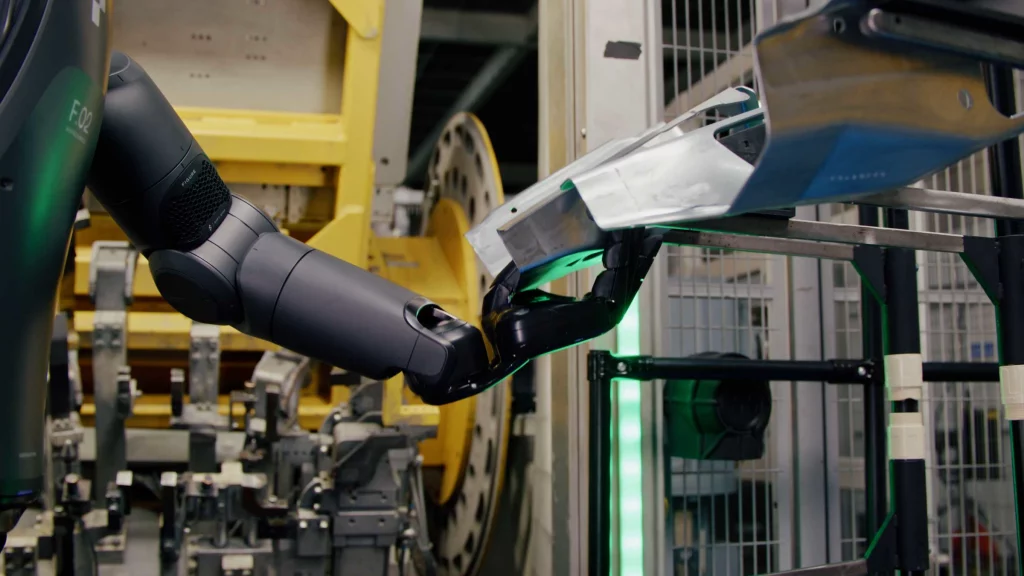
| Figure AI represents the world’s most aggressively capitalized and technically agile humanoid robotics enterprise, positioning itself as the leader in general-purpose physical labor automation. Founded by serial tech entrepreneur Brett Adcock and backed by an elite consortium including NVIDIA, OpenAI, Jeff Bezos, and Microsoft, Figure raised $675 million in its Series B round at a $2.6 billion valuation, with secondary market discussions pricing the platform between $10 billion and $39 billion based on long-term factory labor substitution models. With its Figure 02 robot deployed on active BMW manufacturing lines, the company is bridging the chasm from lab demos to commercial industrial output. |
1.1. Hardware Generations: From Figure 01 to Figure 02
- Figure 01: Proof-of-concept bipedal robot developed in just 12 months, demonstrating autonomous walking, object manipulation, and natural voice dialogue via integrated OpenAI multimodal models.
- Figure 02: Production-grade humanoid robot featuring custom high-torque electric actuators, 16-degree-of-freedom hands with human-equivalent tactile sensing, on-board 2.25 kWh battery delivering 5 hours of continuous industrial work, and 6 on-board RGB cameras paired with real-time neural vision models.
1.2. Valuation Triangulation Scenarios
| Valuation Scenario | Valuation Range | Core Operational Assumptions | Benchmark Multiples |
|---|---|---|---|
| Conservative (Industrial Pilot Floor) | $5.0 – $7.5 Billion | Specialized logistics and sheet-metal sorting pilots (500 units deployed) | Hardware deep-tech multiple (15× forward CapEx) |
| Base Case (Series C / Pre-IPO) | $12.0 – $18.0 Billion | Automotive assembly line adoption across BMW & 2 tier-1 OEMs (5,000 units) | Robot-as-a-Service (RaaS) recurring software model |
| Bull Case (Labor Substitution Horizon) | $25.0 – $39.0+ Billion | General-purpose warehouse and manufacturing labor penetration (50,000+ units) | Hyperscaler AI multiple (pricing physical labor TAM) |
Triangulated Comparable Transactions (Comps)
| Company | Valuation / Market Cap | Key Backers | Strategic Positioning |
|---|---|---|---|
| Tesla Optimus | Internal Tesla valuation ($100B+ TAM claim) | Tesla Inc. | In-house manufacturing scale, but proprietary closed ecosystem |
| Boston Dynamics (Hyundai) | Acquired at $1.1 Billion | Hyundai Motor Group | Pioneering hydraulic locomotion (Atlas), now transitioning to all-electric |
| 1X Technologies | ~$400M+ valuation | OpenAI, Tiger Global | Wheeled (EVE) and bipedal (NEO) humanoids for domestic and industrial care |
Why Investors Back Figure at Astronomical Multiples
Figure is not valued as a traditional mechanical machinery vendor, but as an embodied artificial intelligence platform addressing a massive global total addressable market (TAM):
- The Global Manufacturing Labor Deficit: Over the next decade, industrial economies face millions of unfilled manufacturing and logistics jobs due to aging demographics. Humanoid robots fit directly into existing factory architectures without requiring multi-million-dollar facility redesigns.
- Robot-as-a-Service (RaaS) Economics: Charging an effective hourly rate of $10 to $15 per operational hour undercut human manufacturing labor costs ($30–$45/hr in the US) while generating predictable high-margin recurring software revenues.
- The Data Flywheel Effect: Every hour Figure 02 operates on BMW factory floors generates rich multimodal sensor telemetry, continuously training foundation models on edge cases and cementing technological defensibility.
Risk Audit & Due Diligence Checkpoints
- Mean Time Between Failures (MTBF): Commercial factory floors demand continuous operation with failure rates below 1 in 10,000 cycles. Premature joint wear or motor overheating in real industrial shifts remains a critical engineering risk.
- Compute and Energy Density Bottlenecks: Running real-time vision-language-action (VLA) models on-board generates substantial heat and rapidly depletes battery reserves.
- Supply Chain Dependency for Actuators: Achieving mass-market unit economics ($30,000–$50,000 BOM cost per robot) requires establishing scaled automotive-tier domestic supply chains for high-precision harmonic drives and rare-earth magnets.