Executive Snapshot & Valuation Triangulation
| Physical Intelligence (π) is spearheading the fundamental breakthrough in Embodied AI: creating a single universal generalist foundation model for the physical world, analogous to what GPT models did for natural language. Co-founded by robotics luminaries Karol Hausman (ex-Google DeepMind), Sergey Levine (UC Berkeley), and Chelsea Finn (Stanford), the company secured $400 million in financing from Jeff Bezos, OpenAI, Thrive Capital, and Lux Capital at a post-money valuation of $2.4 billion, with secondary rounds pricing the asset up to $5.6 billion. By unveiling π0 (pi-zero) — a flow-matching visual-language-action (VLA) model capable of zero-shot robotic task generalization across radically diverse hardware morphologies — Physical Intelligence is positioning itself as the foundational software brain for the global robotics industry. |
1.1. Core Technological Paradigm: The π0 Foundation Model
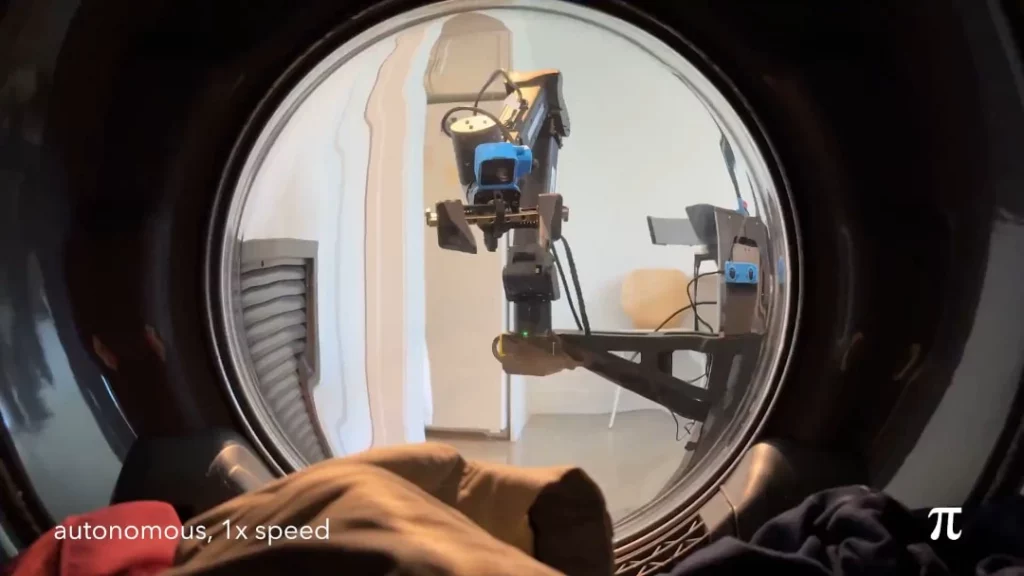
Unlike traditional industrial robots programmed with rigid, deterministic trajectory code, π0 treats physical manipulation as a multimodal sequence generation problem. Trained on diverse tele-operated demonstration datasets, the model ingests RGB camera video streams, natural language instructions (“fold the laundry”, “box the eggs”, “clear the table”), and proprioceptive joint states, outputting continuous multi-axis motor torques and velocities in real time.
1.2. Valuation Triangulation Scenarios
| Valuation Scenario |
Valuation Multiple |
Target Enterprise Value |
Underlying Milestone Triggers |
| Base Pre-Commercial Floor |
Research Lab Multiple |
$2.4 – $3.5 Billion |
Validation of π0 across academic benchmarks and early industrial developer SDKs |
| Enterprise Commercial Baseline |
Foundation Model Multiple |
$5.6 – $8.0 Billion |
Standardized runtime licensing across top-5 industrial robot manufacturers |
| Universal Android Operating System |
Platform Monopoly Multiple |
$15.0+ Billion |
Establishing the industry-standard “Android for Robotics” OS powering consumer and commercial bipedal fleets |
Triangulated Comparable Transactions (Comps)
| Company |
Valuation |
Backers |
Differentiation from Physical Intelligence |
| Skild AI |
$1.5 Billion |
SoftBank, Lightspeed, Jeff Bezos |
Developing omni-purpose robotics foundation models with focus on diverse hardware form factors |
| Covariant |
Acquired / License deal by Amazon |
Radical Ventures, Index |
Pioneered warehouse pick-and-pack foundation models before key founders joined Amazon |
| OpenAI (Robotics Team) |
Strategic Investor |
Microsoft, Khosla |
Partnering with Physical Intelligence to provide high-level cognitive LLM planning |
Why the Market Values a Pre-Revenue Lab at $5.6 Billion
Physical Intelligence decouples software intelligence from expensive physical robotics hardware. By adopting the “Microsoft Windows” or “Android” paradigm for robotics, π avoids capital-intensive manufacturing facilities, supply-chain bottlenecks, and warranty risks:
- Hardware-Agnostic Generalization: π0 operates seamlessly across dual-arm industrial manipulators, mobile bipedal humanoids, wheeled warehouse lifters, and dexterous multi-fingered hands.
- High-Margin Software Licensing: Robot manufacturers pay recurring runtime licensing and per-action API inference fees, generating 80%+ gross margin software revenues.
- Unmatched World-Class Research Density: The founding team includes the authors of the foundational academic papers in offline reinforcement learning, robot transformer architectures, and visual pre-training.
Risk Audit & Due Diligence Checkpoints
- Data Scarcity in the Physical World: Unlike text on the public internet, high-quality robotic physical interaction data is scarce, expensive to capture, and requires thousands of hours of manual human tele-operation.
- Inference Latency at the Edge: Controlling high-speed motors in dynamic environments requires 50 Hz to 200 Hz inference cycles. Compressing multi-billion parameter VLA models into embedded edge chips remains a critical hurdle.
- Competition from Tech Giants: Google DeepMind (RT-2, Gemini Robotics) and Tesla have vast internal computing clusters and captive hardware fleets to train rival foundation models.