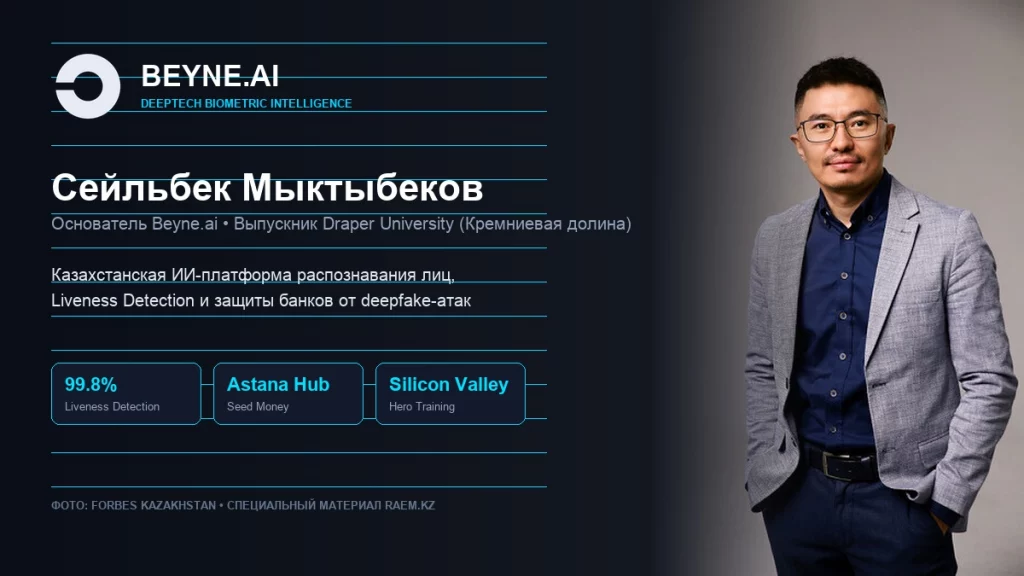
As biometric verification becomes the universal security gateway for mobile banking, digital public services, and fintech applications, cybercriminals are rapidly turning to synthetic identities, high-resolution generative deepfakes, and 3D silicon face masks. Kazakhstani AI deep-tech startup Beyne.ai was engineered specifically to solve this critical vulnerability, providing tier-one banks and enterprise platforms with neural liveness detection and facial biometric authentication.
The Technological Challenge: Beating Generative Deepfakes
Traditional biometric systems evaluate static photographic landmarks, which modern diffusion models and deepfake software can easily replicate. Beyne.ai develops proprietary computer vision neural networks capable of executing sub-second multi-spectral liveness detection directly on consumer smartphones.
The algorithms analyze micro-expressions, skin light scattering (photoplethysmography), pupil reflections, and depth anomalies in real time, instantly discerning between a living human being and an illuminated smartphone screen, paper photograph, video replay, or generative AI stream.
Banking-Grade Security and Compliance
- Sub-second verification: Onboarding authentication completed in under 400 milliseconds with minimal server latency;
- High accuracy thresholds: False Acceptance Rates (FAR) exceeding 99.99% compliant with international ISO/IEC 30107-3 presentation attack detection standards;
- On-premise and private cloud deployment: Ensuring complete data residency and regulatory compliance with strict national banking secrecy legislation.
Commercial Traction and Market Expansion
Graduating from Astana Hub accelerator programs, Beyne.ai has integrated its biometric verification engines into major financial institutions, microfinance organizations, and enterprise KYC platforms across Central Asia, preventing millions of dollars in attempted fraudulent account takeovers and illegal credit originations.