
Kazakhstan has executed its inaugural sovereign Panda bond issuance: placing 3.4 billion Chinese yuan (approximately $500 million) across a three-year maturity at a 1.9% coupon yield. Investor demand outstripped supply by more than twofold. While securing capital at ultra-low headline interest rates is a major fiscal win, debt servicing must be executed in a foreign currency whose exchange valuation Kazakhstan cannot control.
Panda bonds represent debt instruments issued by foreign sovereigns or corporations denominated in onshore Chinese yuan and sold to Chinese institutional investors. Beyond the exotic moniker lies a standard sovereign debt mechanism: the state secures liquidity today and commits to repaying principal and accrued coupon interest in Chinese currency.
Why a 1.9% Interest Rate Proved Uniquely Attractive
On June 5, 2026, Kazakhstan’s debut sovereign Panda bonds officially listed on the Astana International Exchange (AIX). The Ministry of Finance noted that the 1.9% coupon represented the lowest borrowing cost achieved by any BBB-rated sovereign issuer globally, matching terms typically reserved for AA-rated credits.
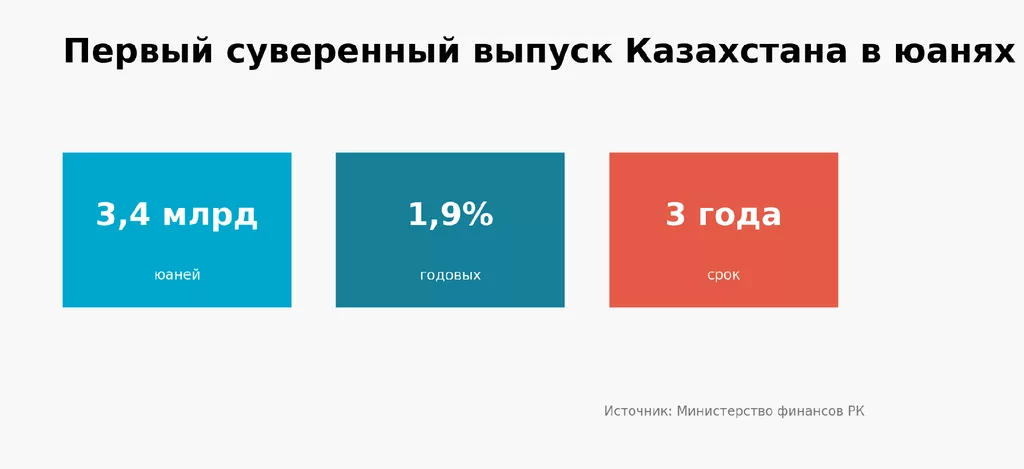
Core financial terms of Kazakhstan’s landmark sovereign debt debut in Chinese yuan.
Institutional oversubscription reached over 200%. For the Ministry of Finance, this demonstrated strong appetite: international and Chinese asset managers are eager to hold Kazakhstani sovereign paper on competitive terms. The issuance strategically broadens Kazakhstan’s creditor base and reduces over-reliance on traditional U.S. dollar Eurobonds.
However, mechanically comparing a 1.9% yuan coupon against a 5.5% U.S. dollar rate is fundamentally flawed. True borrowing costs depend on currency fluctuations between the yuan and the tenge, issuance underwriting fees, cross-currency swap hedging costs, and the currency mix of state budget revenues utilized for ultimate debt redemption.
Quasi-Sovereign Giants Preceded the Government into Yuan Debt
Prior to the sovereign issuance, major Kazakhstani state-owned enterprises pioneered corporate borrowing in the Chinese market. The Development Bank of Kazakhstan (DBK) placed 2 billion yuan in September 2025; national oil champion KazMunayGas issued 1.25 billion yuan in October; and sovereign wealth fund Samruk-Kazyna raised 3 billion yuan in April 2026.
Combined with the Ministry of Finance placement, Chinese capital markets have emerged as a primary liquidity channel for Kazakhstan. This debt architecture is especially logical for enterprises procuring industrial machinery from China or generating direct export revenues in yuan: currency denominations between debt obligations and operating expenses align naturally.
Total External Debt to China: Reconciling $10.3B vs. $12.87B Estimates
Public analytical reports frequently quote two disparate debt totals. According to the National Bank of Kazakhstan, gross external debt to Chinese creditors stood at $10.3 billion as of July 1, 2025. Conversely, an assessment published by Eurasianet cited $12.87 billion by early 2026.
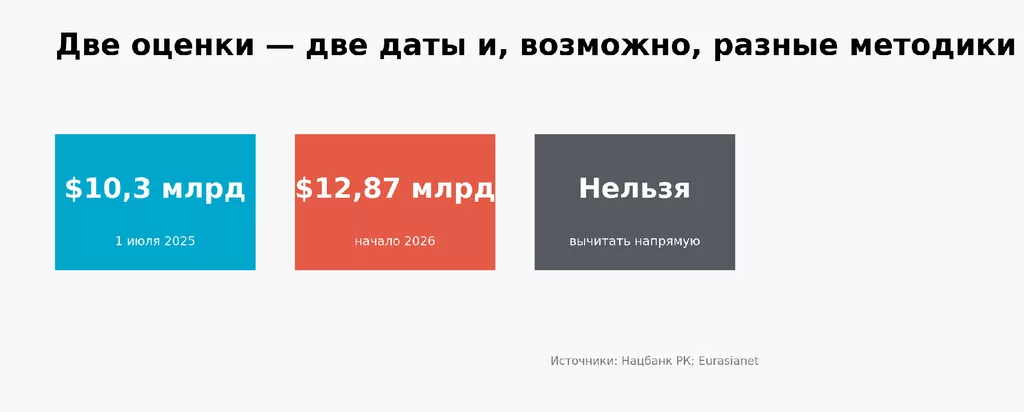
Published debt valuations reflect disparate reporting cut-off dates and distinct statistical methodologies.
It is tempting to subtract the lower figure from the higher and claim Kazakhstan’s debt to Beijing escalated by $2.57 billion within six months. However, rigorous macroeconomic analysis prohibits such simplistic math. Reporting dates differ, and non-governmental estimates often aggregate intercompany loans, trade credits, and bond liabilities differently from the central bank’s official balance of payments balance sheet.
While recent Panda bond placements expanded exposure to Chinese capital, they do not solely explain the discrepancy. Bondholders can reside globally, statistical filings operate on a quarterly lag, and sovereign liabilities are cataloged separately from corporate debt.
Inherent Risks: Cheap Debt Is Never Free Money
Panda bond borrowing carries three distinct systemic risks:
- Foreign exchange volatility: if the yuan appreciates against the tenge over the three-year maturity, nominal debt service costs in domestic currency will rise sharply;
- Refinancing risks: rolling over principal upon maturity in three years could take place under significantly higher global benchmark rates;
- Fiscal transparency erosion: rapid accumulation of bilateral non-dollar issuances obscures comprehensive debt sustainability metrics if data is fragmented across different methodologies.
Bilateral borrowing from China is not inherently problematic. What matters decisively is how proceeds are allocated: do funded projects generate sustainable commercial revenues and productivity gains to service the debt? For the sovereign Panda issue, detailed line-item expenditure allocations have not been disclosed in the public domain.
The Capital Highway Operates in Both Directions
Financial ties extend beyond Kazakhstani borrowing. Chinese corporate issuer Jiaxin completed the first dual cross-listing between mainland China and Kazakhstan, becoming the inaugural issuer inside AIX’s Belt and Road market segment. Astana is actively positioning itself not merely as a borrower, but as a regional capital gateway for Chinese institutional investors.
Furthermore, the Development Bank of Kazakhstan executed a bilateral memorandum with China Central Depository & Clearing (CCDC) to establish offshore bond clearing infrastructure. While commercial terms remain proprietary, the strategic goal is unambiguous: transitioning Kazakhstani access to Chinese debt capital from one-off placements into a permanent institutional corridor.
Transparency Standards Required for Future Placements
To enable the public and institutional investors to gauge the genuine fiscal burden of yuan borrowings, headline rates must be accompanied by comprehensive disclosures:
- The concrete infrastructure or fiscal allocations financed by borrowed funds;
- The all-in cost of capital factoring in underwriting fees, legal expenses, and cross-currency swaps;
- FX risk mitigation mechanisms and designated revenue streams for debt amortization;
- A unified public registry decomposing sovereign and quasi-sovereign debt by lender origin;
- A multi-year debt redemption amortization schedule across all yuan-denominated liabilities.
A 1.9% borrowing rate unquestionably renders Chinese capital markets enticing. Yet the apparent interest savings hold true only so long as currency depreciation and refinancing spikes do not consume the margin. Sovereign Panda bonds equip Kazakhstan with vital financial diversification—while simultaneously demanding heightened vigilance and transparency over public debt governance.