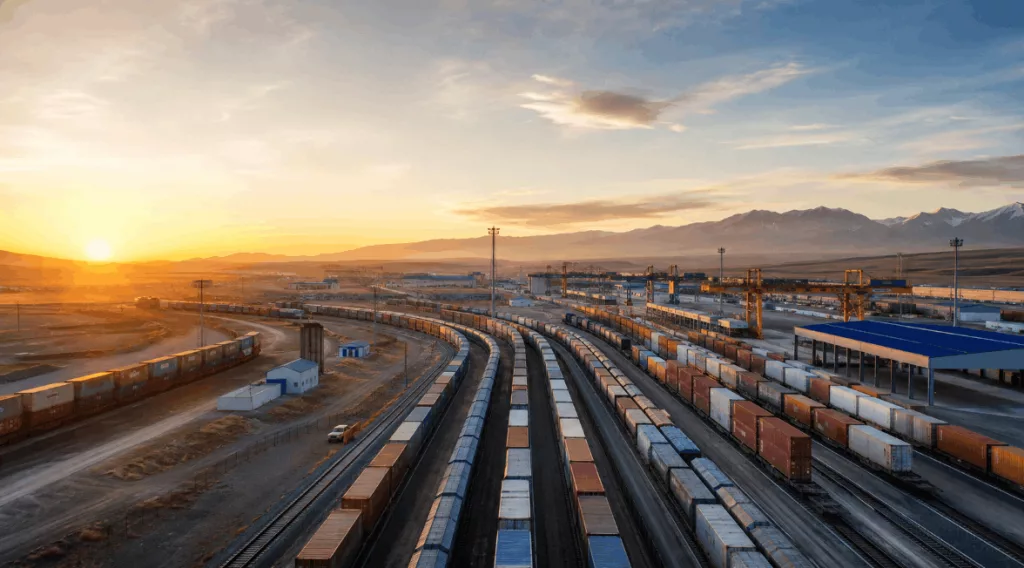
Over the first six months of 2026, rail freight transit between Kazakhstan and China reached a historic 18.7 million tons—a 9% expansion year-over-year. The newly commissioned Dostyk–Moyinty second track has substantially accelerated trunkline throughput. However, unprecedented traffic volumes are rapidly consuming this new capacity margin, underscoring that long-term logistics growth hinges on constructing additional border crossings.
Logistics forms the operational backbone of Kazakhstan-China economic bilateralism. Success is quantified not by signed ceremonial protocols, but by the physical volume of rail cars, container blocks, and cargo tonnage crossing customs checkpoints around the clock.
Trade volumes continue their exponential climb: in 2024, bilateral rail transport reached a milestone 32 million tons. The 18.7 million tons recorded in H1 2026 indicates that annual freight is pacing toward another record high exceeding 35 million tons.
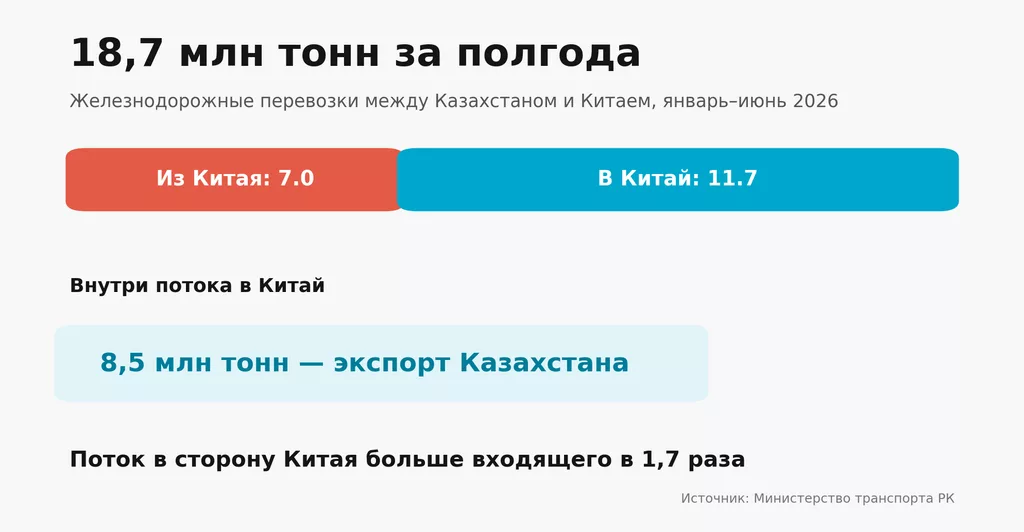
China Ingests Far More Freight Than It Dispatches
Outbound flows from Kazakhstan to China reached 11.7 million tons (including 8.5 million tons of domestic Kazakhstani commodities and processed exports), whereas inbound freight from China totaled 7.0 million tons. By total tonnage, eastward flows toward China outweigh westbound cargo by a ratio of 1.7 to 1, heavily weighted toward metallurgical ores, refined metals, chemicals, and grain.
Dostyk–Moyinty Double-Tracking Reshapes Transit Flow
The completion of the 836-kilometer second track along the Dostyk–Moyinty corridor eliminated Kazakhstan’s primary rail bottleneck, quintupling the line’s theoretical throughput capacity and boosting transit speeds between China and Europe. However, physical bottleneck constraints have now shifted directly to border gauge-transfer stations and marshalling yards.
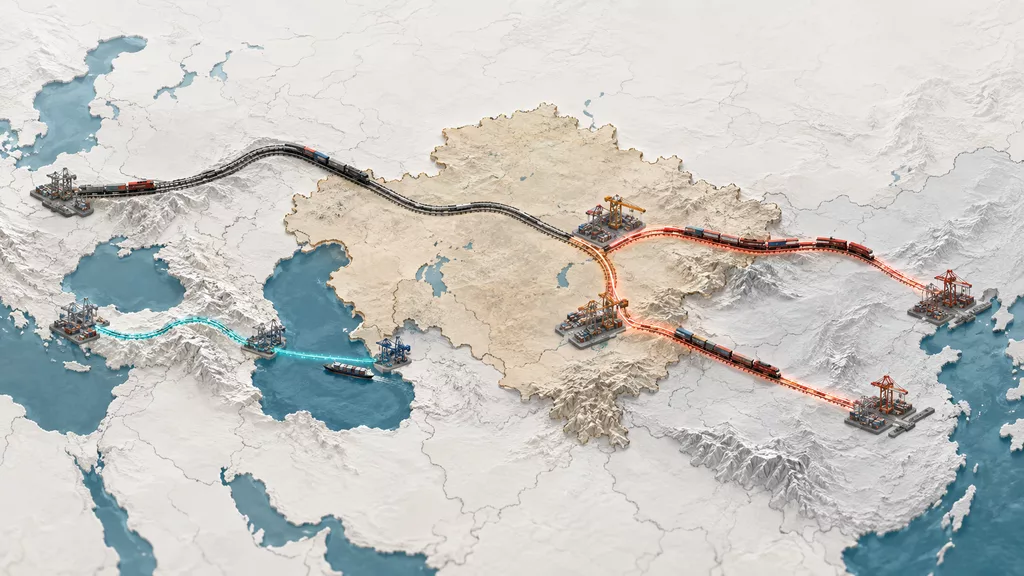
The Two Primary Gateways and the Middle Corridor
Kazakhstan’s cross-border logistics remains reliant on two primary gateway corridors: Dostyk–Alashankou and Altynkol–Khorgos. While the Trans-Caspian International Transport Route (Middle Corridor) continues to register strong percentage growth, handling multimodal transit across the Caspian Sea to Europe, the sheer scale of direct bilateral rail trade between Kazakhstan and China represents the overwhelming majority of daily rail movements.
Next Generation Infrastructure: Bakhty–Ayagoz
To sustain volume growth through 2030, Kazakhstan is expediting construction of a third railway border crossing at Bakhty–Tacheng coupled with the new Ayagoz rail link. Without a third dedicated gateway, the burgeoning export flows from Central Asia and transit flows across Eurasia will inevitably collide with structural border capacity ceilings.