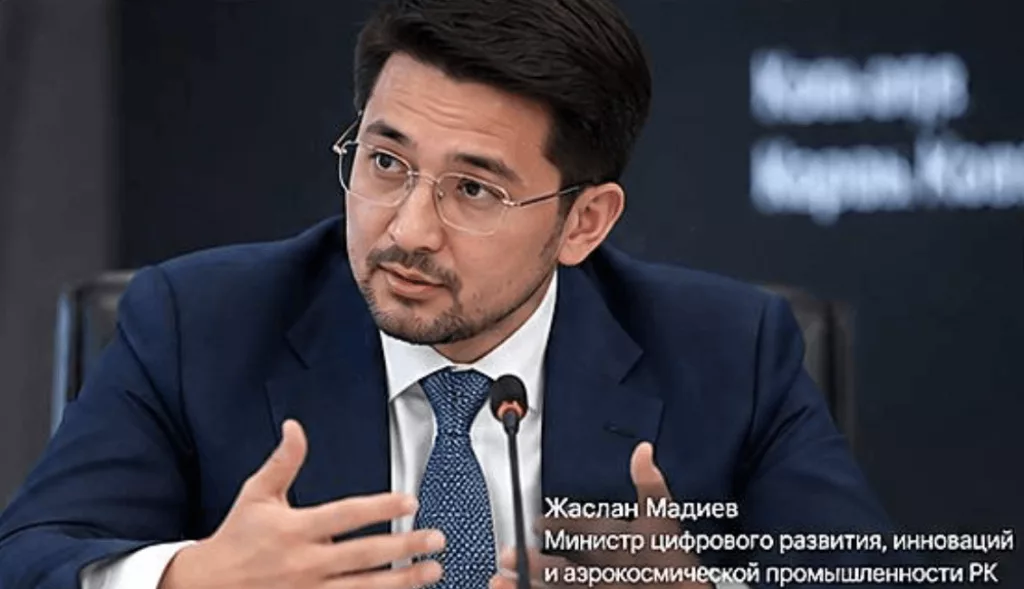
Kazakhstan’s digital landscape recently registered three defining institutional shifts: Zhaslan Madiyev retained his ministerial portfolio in the reformed Cabinet of Ministers, the National Security Committee (KNB) codified technical specifications governing subscriber telemetry collection and export for telecom operators, and President Kassym-Jomart Tokayev designated technological modernization as the premier anchor of relations with China.
Zhaslan Madiyev Reappointed Deputy Prime Minister and Minister of Artificial Intelligence and Digital Development
Zhaslan Madiyev during bilateral discussions with Changpeng Zhao on September 4, 2026. Photo: Press Service of the Prime Minister of the Republic of Kazakhstan (CC BY 4.0).
On September 3, 2026, President Kassym-Jomart Tokayev signed a presidential decree reappointing Zhaslan Madiyev as Deputy Prime Minister and Minister of Artificial Intelligence and Digital Development. Madiyev retains the executive mandate he has steered since the ministry’s reorganization on September 29, 2025.
In accordance with statutory protocols, his nomination underwent formal review by the Kurultai Standing Committee on Digitalization, Innovation, and Science pursuant to Article 30 of the Constitutional Law «On the Kurultai of the Republic of Kazakhstan». The legislative committee rendered a favorable recommendation prior to the presidential decree.
Background and Executive Track Record
Born June 13, 1983, in Almaty, Madiyev graduated from Al-Farabi Kazakh National University, earned a Master of Public Administration from Columbia University, and completed his MBA at the MIT Sloan School of Management.
Prior to assuming leadership of the dedicated AI ministry, Madiyev served as Minister of Digital Development, Innovations, and Aerospace Industry from May 2024. Following the September 2025 decree creating the standalone Ministry of Artificial Intelligence and Digital Development, he was elevated to Deputy Prime Minister, reflecting the state’s strategic prioritization of machine learning infrastructure, sovereign compute clusters, and algorithmic governance.
National Security Committee Codifies Telecommunications Data Collection and Export Mandates
On August 27, 2026, an official order from the Chairman of the National Security Committee (KNB) was enacted, establishing updated technical specifications for equipment deployed across commercial telecommunications networks to collect, record, and export technical subscriber data.
What the Regulatory Specifications Require
Under the order, licensed internet service providers and telecom operators must ensure their routing and monitoring hardware supports the systematic collection, recording, storage, retrieval, and structured export of operational telemetry. For internet access networks, metadata parameters encompass subscriber network addresses, IP destination records, resource identifiers, timestamps, and data transfer protocol metadata.
The regulation strictly standardizes automated data offloading to authorized external state storage systems. Exported datasets must conform to the CSV standard, with the full telemetry volume for a continuous 24-hour cycle required to export within four hours or less.
Importantly, the administrative order does not equate to the real-time automatic mirroring of all end-user internet browsing directly to intelligence servers. Legally and architecturally, the document standardizes technical compliance criteria and formalizes bilateral service-level agreements between telecom infrastructure owners and authorized security divisions governing structured access under statutory investigative warrants.
Tokayev Designates Frontier Technology as the Keystone of Partnership with China
Kassym-Jomart Tokayev and Xi Jinping during summit proceedings in Shanghai. Photo: Kazinform.
In a comprehensive written interview published by Xinhua News Agency on September 2, President Tokayev characterized technological collaboration as one of the most transformative pillars of modern Kazakhstani-Chinese relations.
Recalling his high-level participation at the World Artificial Intelligence Conference (WAIC) in Shanghai, Tokayev emphasized bilateral synergy across intelligent manufacturing, digital logistics, cross-border e-commerce, cloud compute hubs, and joint engineering R&D. He explicitly characterized China as a preeminent global powerhouse in artificial intelligence, humanoid robotics, clean tech, and advanced hardware manufacturing.
Digital Initiatives Proposed at the SCO Summit
During the Shanghai Cooperation Organisation (SCO) Summit in Bishkek, Tokayev articulated concrete multilateral technological initiatives:
He proposed the creation of a Unified SCO Digital Transit Platform to manage and track cross-border freight from origin to final destination across member states. Kazakhstan also championed electronic customs harmonization, mutual recognition of digital bills of lading, algorithmic green customs corridors, and the formulation of the SCO Transport Interconnectivity Strategy through 2035.
On artificial intelligence, Tokayev advocated for a multilateral network of SCO AI Centers uniting leading regional universities, research institutes, and technology conglomerates. Furthermore, Kazakhstan became one of the 29 founding signatory nations of the World Artificial Intelligence Cooperation Organization (WAICO), spearheaded by China.
Kazakhstan’s technological strategy is thus operating on dual tracks: domestically, institutional control over AI infrastructure, sovereign data residency, and telecommunications security is tightening; externally, cross-border digital trade and compute partnerships are anchoring deep diplomatic ties with China and the wider Eurasian region.