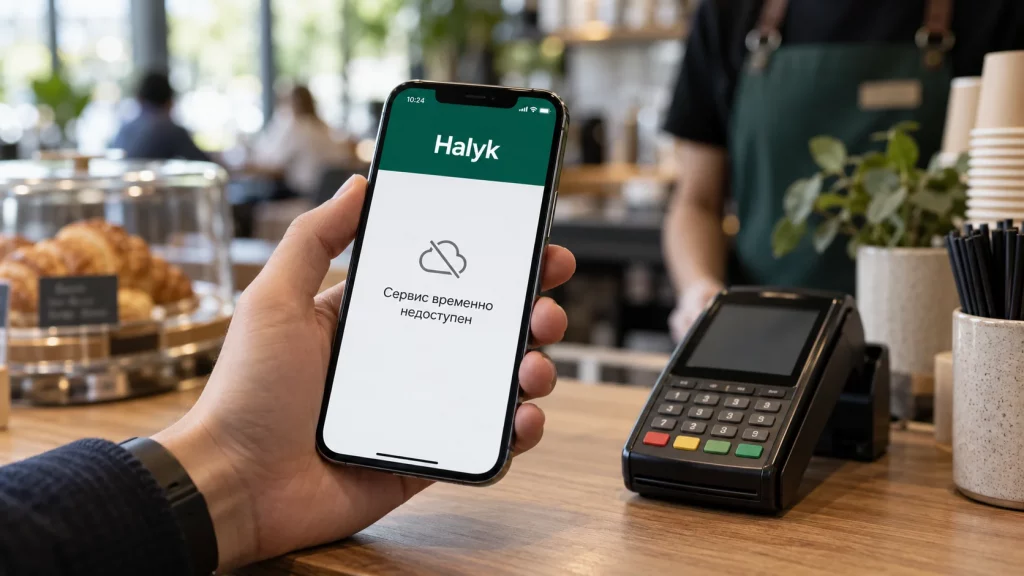
On October 6, Halyk users encountered difficulties logging into the mobile application, processing payments, and executing money transfers. The bank subsequently confirmed technical disruptions across two core services simultaneously — Halyk for retail clients and Onlinebank for businesses. Technical teams restored operational functionality incrementally throughout the evening.
The incident directly impacted habitual money management practices. For users accustomed to carrying out daily transactions via smartphone, the unavailability of the application means being unable to perform an essential operation when needed — even when account balances remain fully intact.
The scale of this dependency is clearly reflected in National Bank of Kazakhstan statistics. In August 2026, internet and mobile banking channels accounted for 77.3% of the total volume by count and 89% by monetary value across all cashless card payments issued by Kazakhstani institutions. These metrics characterize the national banking landscape as a whole, rather than Halyk’s isolated market share.
What Happened on October 6
According to reporting by Profit.kz, widespread application access issues surfaced around 3:50 PM Almaty time. During authentication attempts, users encountered automated notices citing temporary login restrictions and high system load.
Kazinform reported at 5:10 PM that user profile data retrieval errors were also occurring. Due to login failures, clients were unable to access essential online services, including payments and peer-to-peer transfers. The bank acknowledged the temporary disruptions and announced ongoing technical maintenance.
In a statement published by Profit.kz at 6:13 PM, Halyk clarified that operational irregularities also affected Onlinebank. Access to specific corporate products and interfaces was constrained, with system recovery proceeding in stages. The bank did not provide a definitive timeline for full restoration.
At the time this report was prepared on the morning of October 7, available media disclosures did not include an independent confirmation that both applications had achieved full operational recovery. This does not imply that the downtime persisted continuously; rather, public communications did not pinpoint the exact moment of complete resolution.
Detailed root-cause specifics were likewise not disclosed. A generic system alert citing high traffic loads does not constitute a formal post-incident analysis and leaves unclarified which architectural components failed.
Why an App Outage Extends Beyond Money Transfers
Halyk positions its consumer platform as a SuperApp. Through this single hub, users can open cards and deposit accounts, apply for credit, pay utility bills, shop, and navigate integrated public services. The bank also provides integrated access to official digital identity documents.
This unified architecture delivers convenience: individuals do not need to seek separate portals or undergo repeated authentication workflows. However, as more daily utilities converge into one app, an expanding array of personal tasks hinges on the singular ability to log in.
Crucially, the unavailability of government services within a banking application must not be conflated with an outage of the central eGov infrastructure itself. Similarly, an authentication error in Halyk does not indicate that physical payment cards, ATMs, and POS terminals ceased operating concurrently. No published statements indicated hardware-level failures.
For the end user, however, functional boundaries between disparate backend systems remain largely invisible. Confronted with a single error screen, customers frequently cannot discern what alternative transaction pathways remain operational.
Predictable Settlement Is Essential for Business
Disruptions in Onlinebank extended the consequences well past individual consumer payments. When commercial enterprises lose access to their banking portal, the timely execution of corporate cash-management operations becomes precarious.
Depending on the duration and scope of constraints, outages can delay supplier settlements or real-time payment reconciliations. These represent potential operational vulnerabilities rather than a quantified assessment of damages from the October 6 incident. The bank’s reviewed disclosure cited no figures on affected enterprises, delayed batch runs, or financial losses.
RAEM previously published an analysis comparing payment gateways and internet acquiring in Kazakhstan. The Halyk incident introduces an essential criterion alongside pricing tariffs: the capability to maintain transaction continuity when primary banking channels become unreachable.
In this context, offering two separate mobile applications does not inherently ensure architectural redundancy. Assessing institutional resilience requires clarity on which payment channels survive when an interface fails, and how rapidly customers are notified of service degradations.
What This Episode Reveals About SuperApp Dependency
A single outage cannot quantify Kazakhstan’s systemic reliance on key banking institutions or justify sweeping conclusions regarding national financial stability. However, it highlights the structural risk of functional concentration: the downtime of a single user interface can disrupt multiple critical workflows simultaneously.
National Bank data confirms that remote digital channels have become the dominant vector for cashless card payment volume. Consequently, application uptime is no longer merely a user experience consideration, but a prerequisite for broader economic transaction continuity.
Following disruptions of this nature, a substantive post-mortem must address concrete benchmarks: downtime duration, specific impacted operations, active backup channels, and remediation workflows for interrupted payments.
For Halyk, the next tangible milestone is definitive proof of comprehensive system recovery paired with transparent post-incident disclosures. For the wider market, the priority remains maintaining baseline payment continuity when dominant superapps experience unplanned downtime.