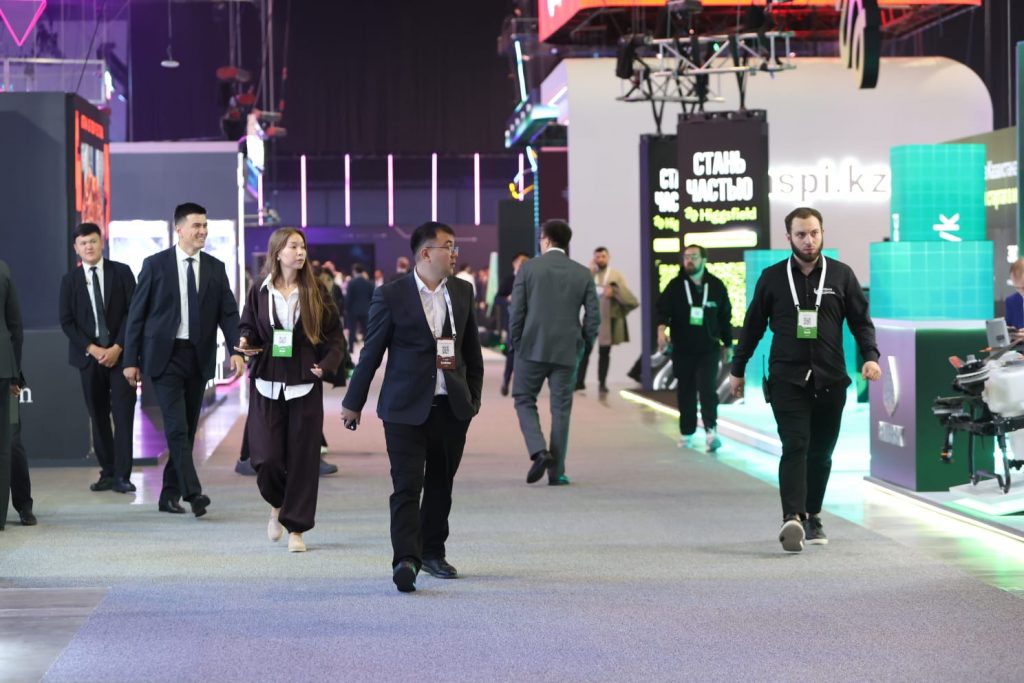
Astana is hosting AI & Digital Bridge 2026 — an international technology summit convening public sector bodies, institutional investors, technology enterprises, and startups. Preliminary figures from organizers indicate over 17,000 visitors attended during the initial two days. Key headlines include a landmark $50 million AI venture fund memorandum, cross-border commercial acceleration channels, conversational e-government deployments, and the launch of Central Asia’s first AI-Enabled university.
Taking place October 1–3 at the EXPO International Exhibition Center, the forum’s agenda addresses foundational artificial intelligence, computing and telecom infrastructure, venture capital, fintech, cybersecurity, education, and creative industries. Below is a strategic synthesis of milestones from the opening two days, where major institutional partnerships were finalized ahead of the flagship startup pitch finals.
Artificial Intelligence in Heavy Industry and the Real Economy
A central theme centered on deploying machine learning across Kazakhstan’s industrial base. During the third session of the National AI Development Council chaired by President Kassym-Jomart Tokayev, leaders examined deep digital transformation across heavy manufacturing and resource sectors.
The President emphasized transitioning beyond exploratory pilot projects toward comprehensive, enterprise-wide deployments delivering measurable balance-sheet productivity gains. Strategic imperatives include tightly synchronizing technical workforce training with industrial plant requirements, specifically highlighting the AI-Sana talent initiative to solve applied engineering bottlenecks.
For enterprise operators, this directive dictates that AI software value will be benchmarked directly against throughput gains, opex reduction, and error rate remediation. Model training or sandbox pilots represent merely Phase 1; operational integration and bottom-line auditing represent the definitive test.
Tolqyn AI Venture Fund Targets $50 Million Capital Pool
Dasco Capital and Qazaqstan Investment Corporation (QIC) signed a strategic partnership framework outlining QIC’s planned equity participation in the Tolqyn AI Venture Fund. QIC operates as the specialized private equity arm of national investment holding Baiterek.
The investment fund establishes a target capital capitalization of $50 million, focused on startups operating at the intersection of generative AI and creative industries. The agreement was executed by QIC Board Chairman Didar Karymsakov and Dasco Capital CEO Darmen Sadvakasov.
Official disclosures characterize QIC’s involvement as a planned allocation. The $50 million target represents an aggregate fundraising objective rather than fully deployed capital.
This initiative links two prominent summit tracks: algorithm engineering and digital media synthesis. For regional technical founders, a dedicated sectoral vehicle expands growth capital access, though realization depends on specific investment mandates and ticket sizes.
Astana Hub and Freedom: Generative Content and IP Rights Protection
Astana Hub and Freedom Cinema & Television executed a cooperation memorandum spanning technological innovation and digital media rights. The document was signed by Astana Hub CEO Magzhan Madiyev and Freedom Media CEO Timur Bairov.
A primary pillar centers on generative video content workflows leveraging technical expertise from Higgsfield AI. The partners also established operational protocols for intellectual property enforcement and rapid mitigation of unauthorized pirated distribution.
Implementation involves deepened technical coordination with major distribution platforms including Telegram and TikTok. The agreement outlines the incubation, commercialization, and production rollout of collaborative digital assets.
This alliance addresses twin media industry challenges: adopting automated content generation tools while securing defensive copyright enforcement across decentralized channels. Detailed platform enforcement APIs remain subject to subsequent disclosure.
Bilateral Acceleration for Kazakhstani and Uzbek Tech Ventures
Astana Hub, IT Park Uzbekistan, and Eurasia Growth Hub formalized a trilateral alliance to broaden international commercial pipelines for tech firms across both Central Asian nations.
The framework encompasses collaborative tech summits, trade delegations, and structured B2B matchmaking. Through Eurasia Growth Hub, regional startups will access soft-landing infrastructure when entering the United Kingdom and adjacent Western jurisdictions, facilitating entity formation and customer acquisition.
Operational verticals include international customer sourcing, institutional investor matching, cross-border pilot deployments, and technical mentoring across AI and applied enterprise software.
In parallel, Astana Hub executed an agreement with MOST Holding to co-develop the Central Eurasian Capital Bridge program. The accord was formalized by Magzhan Madiyev and MOST Holding CEO Pavel Koktyshev.
Both initiatives reinforce the international connectivity of Central Asia’s tech ecosystem. Concrete impact will be measured by downstream cross-border venture financings, commercial pilots, and international revenue.
Astana Hub Battle: 14 Finalists and $100,000 Prize Purse
The semi-final stage of Astana Hub Battle 2026 concluded during the forum. From an applicant pool of 50 semi-finalists, an expert judging committee selected 14 teams to pitch on the grand stage on October 3 for a $100,000 non-dilutive prize purse.
The finalist roster features CYBERPACK.AI, Aman, MYupgrade, Hi Doctor, Astana Dynamics, BEST Vision, Spacelab, Welcome Video AI, NCSpeech, Pulsar AI, AuaSense, M3TRIQ, Behype, and Resti.
Founding teams M3TRIQ and Spacelab secured a specialized award from Khan Tengri Innovation Hub: full sponsorship for the AI Capacity Building Training Program hosted in Shanghai.
Organizers also confirmed extensive computing grants: $25,000 in GPU infrastructure from Kazakhtelecom and 10 million KZT in cloud compute credits provided by Yandex Qazaqstan.
For early-stage AI ventures, compute access represents crucial capital efficiency, accelerating model fine-tuning and customer trials. Contest winners will be named at the conclusion of Day 3.
AI Senim Resolves 40% of Citizen Inquiries Autonomously
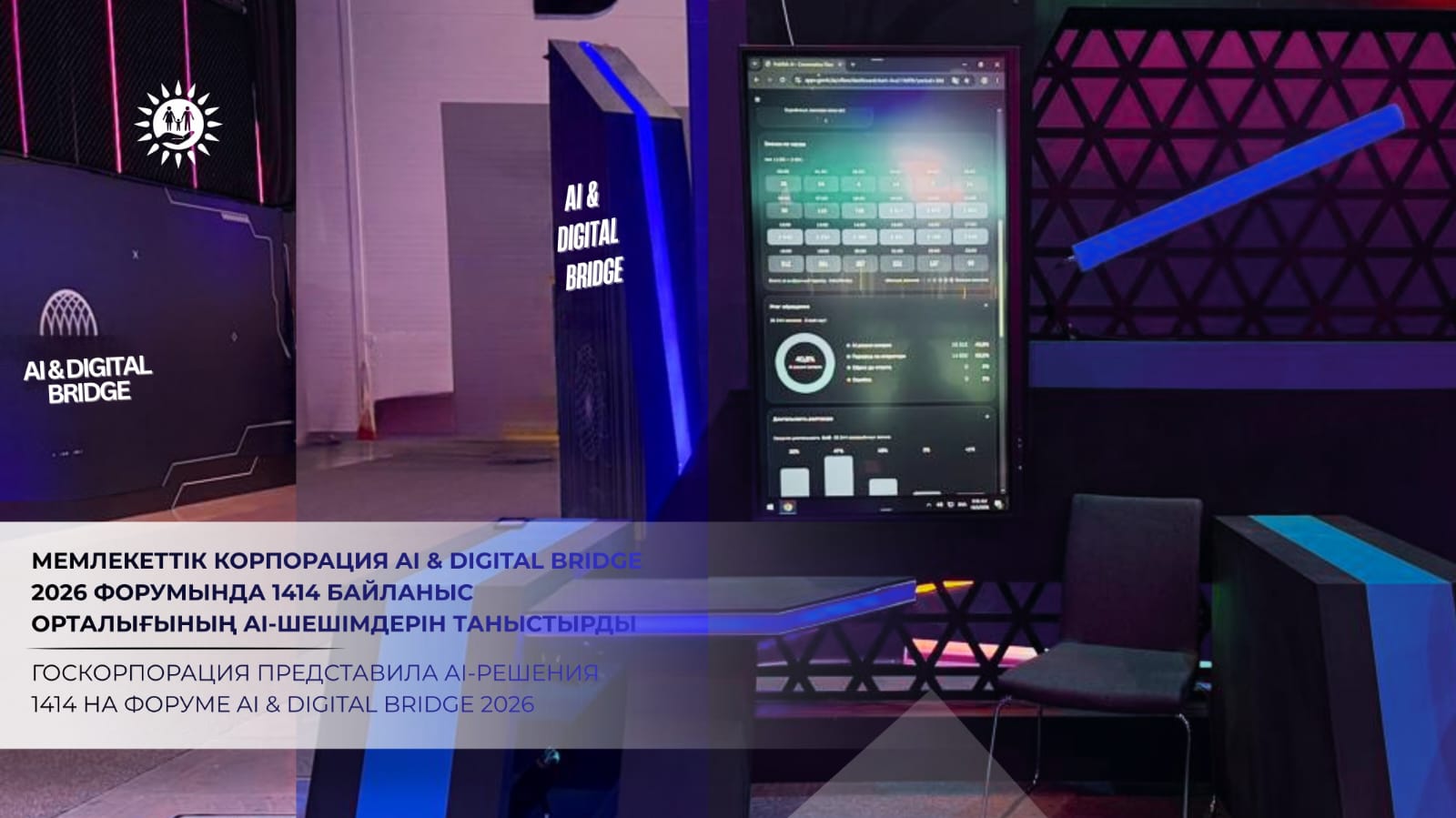
State corporation “Government for Citizens” showcased automated citizen interaction workflows deployed across the national Unified Contact Center 1414.
The primary conversational tool is conversational voice agent AI Senim. Official data indicates the assistant advises citizens across more than 100 high-frequency public services, processing 25,000 to 30,000 incoming calls monthly.
AI Senim successfully resolves approximately 40% of citizen queries end-to-end without human intervention. The remaining 60% are routed to human operators for specialized handling.
These statistics measure AI Senim’s dedicated call traffic rather than aggregate 1414 call center volume. The hybrid architecture demonstrates standard triage automation combined with human fallback for complex cases.
Digital public service transformation was additionally explored during the “eGov 3.0” panel featuring leadership from the Ministry of Digital Development, National Information Technologies (NITEC), the Eurasian Development Bank, and international technology consultants.
Qazaq AI Research University: AI Integrated Across Academics and Governance
The opening day marked the official inaugurating ceremony of Qazaq AI Research University, led by Deputy Prime Minister and Minister of Artificial Intelligence and Digital Development Zhaslan Madiyev.
Organizers position the institution as Central Asia’s inaugural university designed around an AI-Enabled operating model. In this pedagogical architecture, machine learning systems are embedded across curricula, academic research, faculty productivity, and administrative operations.
This structure aims beyond standalone computer science courses toward comprehensive systemic digitization. Practical outcomes will depend on curriculum rigor, lab infrastructure, and industry research partnerships.
Dr. Kai-Fu Lee Mentors Kazakhstani AI Founders
Astana Hub, Q.AI, and foundational model lab 01.AI entered a strategic memorandum covering artificial intelligence research and commercialization.
An initial deliverable is an executive mentorship cohort for 20–25 elite AI/ML engineers and tech founders. Participants will collaborate in small-group masterclasses with 01.AI founder Dr. Kai-Fu Lee and his engineering leaders to refine products for global scale.
Under the agreement, the alem.ai International AI Center opened the Q.AI Research Lab to serve as an engineering incubator for domestic Kazakhstani AI projects.
The curriculum combines algorithmic rigor with go-to-market execution, assisting founders in stress-testing models for competitive international software markets.
17 Startups Showcase Smart City Technologies for Astana
The forum served as the stage for Demo Day under the Astana Innovations Accelerator, where 17 participating startups pitched applied technologies.
Projects spanned digital healthcare, educational platforms, municipal utility infrastructure, urban transit optimization, public safety, and accessibility tech.
For municipal technology vendors, demo presentations represent a stepping stone toward field validation. Subsequent pilots must demonstrate whether solutions meet capital city demands and integrate smoothly into municipal workflows.
Telecom Infrastructure and Next Major International Summit
At the “Telecom Infrastructure in the Era of AI” panel, senior executives from national telecom carriers, international analysts, and regulatory bodies examined national data transport networks.
Convened by the Telecommunications Committee of the Ministry of Digital Development, discussions focused on physical bandwidth: pervasive AI applications substantially increase bandwidth demand and data transit loads.
Furthermore, the Ministry and the GSMA global industry association executed an official memorandum confirming that Astana will host the international M360 Eurasia summit in autumn 2027.
The upcoming summit will convene global telecom leaders to examine artificial intelligence, digital inclusion, cross-border regulation, and next-generation connectivity infrastructure.
What Subsequent Execution Milestones Will Reveal
The opening days of AI & Digital Bridge 2026 combined venture capital announcements, academic foundations, cross-border partnerships, and live operational services. Maturity levels naturally vary: AI Senim actively resolves citizen tickets, finalists prepare for pitch decisions, while investment funds remain in formalization stages.
Upcoming milestones will involve concrete fund admission criteria, deployment of joint international acceleration tracks, and municipality field pilots. These measurable proof points will define the forum’s genuine impact on Kazakhstan’s tech sector and AI ecosystem.