American defense tech enterprise Shield AI raised $2 billion in aggregate capital and closed its acquisition of aviation simulation developer Aechelon Technology. The transaction pegs the post-money valuation of the firm at $12.7 billion. Investors are betting on an operating model that bundles proprietary autonomous airframes with its Hivemind autonomy pilot software stack.
Shield AI’s most prominent current integration connects directly with an industry peer. Hivemind is deployed on the YFQ-44A Fury, an uncrewed air vehicle engineered by Anduril Industries for the US Air Force. Within this collaborative initiative, the airframe manufacturer and the autonomous software provider partner operationally, despite directly competing for long-term prime defense contracts.
What Shield AI Currently Sells into the Defense Market
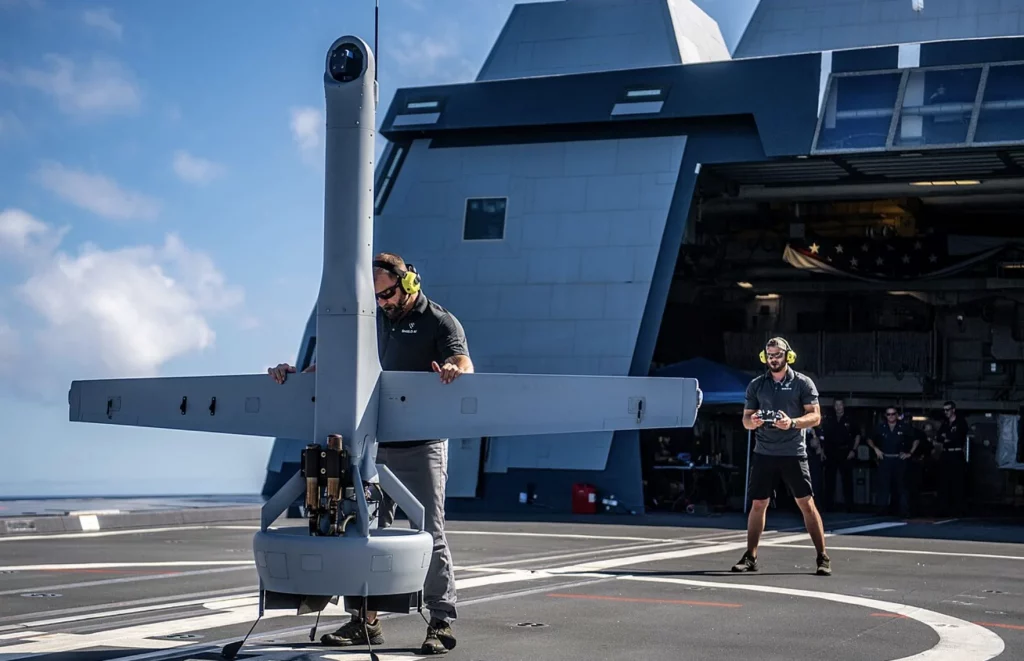
The company’s primary deployed hardware asset is the V-BAT tactical reconnaissance drone. Designed with vertical take-off and landing (VTOL) mechanics transitioning into fixed-wing horizontal cruise, the airframe operates from naval vessels and expeditionary sites lacking dedicated runways.
The US Coast Guard has evaluated shipboard V-BAT systems for maritime domain awareness missions. Alongside field-proven airframes, Shield AI develops Hivemind — autonomy software enabling uncrewed platforms to execute tactical objectives within mission parameters set by human commanders.
Strategically, Hivemind is built hardware-agnostic for third-party integration. In February 2026, the company confirmed the initial test flight of its autonomy software on Anduril’s Fury airframe. In June, the US Air Force awarded Shield AI a development contract under the Collaborative Combat Aircraft (CCA) initiative.
This milestone does not establish Hivemind as the sole software standard for all CCA airframes. The Air Force established a six-vendor software pool undergoing competitive live-fly evaluations, with primary autonomy software selections targeted for summer 2027.
Strategic Rationale Behind the Aechelon Acquisition
Of the capital infusion, $1.5 billion reflects Series G equity with $500 million in structured debt. In June, Shield AI formalized the acquisition of Aechelon Technology.
Aechelon designs high-fidelity synthetic training environments and image generation systems for military flight crews. For Shield AI, this provides synthetic simulation engines to train and stress-test autonomous flight behaviors prior to live range flights on physical aircraft.
Shield AI maintains private financials, without public disclosures detailing revenue segment splits between V-BAT, Hivemind licensing, and simulation services. Standalone market capitalizations for Hivemind or gross margin assumptions remain venture estimates.
X-BAT Development and Market Diversification
The company’s most ambitious hardware roadmap item is the X-BAT, a stealthy jet-powered uncrewed VTOL aircraft. Ground and flight trials are scheduled for 2026, with serial manufacturing projected for 2029. Currently, X-BAT represents an active R&D platform rather than a serialized defense product.
In September, Shield AI executed a letter of intent with Polish defense groups PGZ and WZL-2 exploring potential European co-development and industrial assembly. Definitive procurement commitments remain subject to formal intergovernmental treaties.
Concurrently, Hivemind is testing non-aerial autonomy domains. On September 28, Shield AI and the UK’s Kraken Technology Group conducted demonstrations coordinating two autonomous uncrewed surface vessels (USVs) during maritime patrol missions. Tactical trials validate integration feasibility, but do not constitute series procurement contracts.
Today, Shield AI’s enterprise valuation reflects field-proven V-BAT deployments, CCA program progress, and growth expectations across uncrewed platforms. The share of these projections that translates into recurring sovereign revenue will depend on upcoming CCA program decisions and X-BAT development milestones.