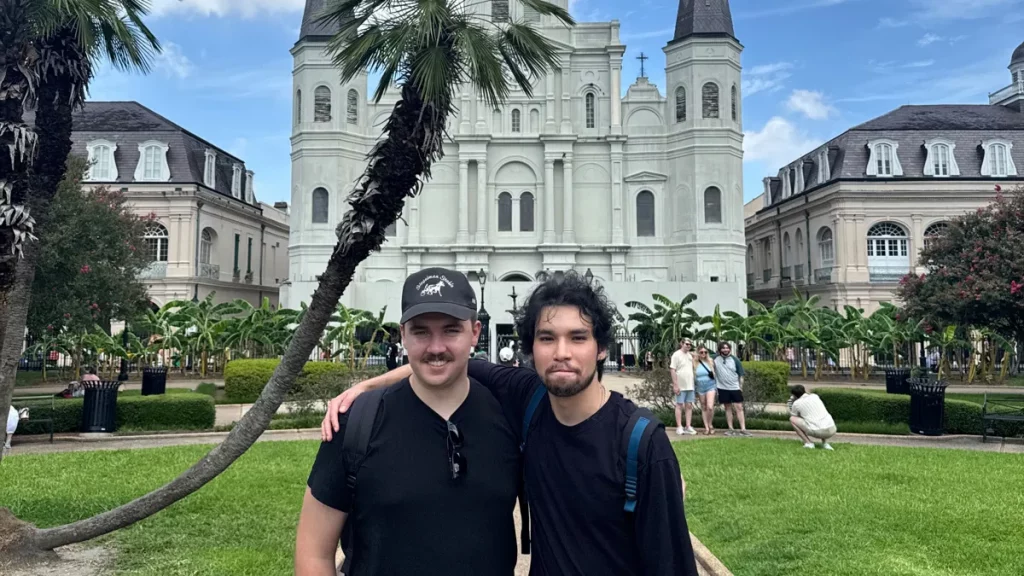
24-year-old Alimkhan Kassymov, who was raised in Almaty, co-founded secondary ticketing analytics platform Ticker alongside American software engineer Aidan Giordano. The founding team won the international Perplexity Billion Dollar Build competition and raised venture capital from the Perplexity Fund. Behind that milestone lies years of academic study, an arduous US job search, and an idea born from college roommate camaraderie.
2,800 Applications Yielded Roughly 50 Interview Invitations
In a feature published by Forbes Kazakhstan on September 29, Kassymov detailed his technical job search across the United States: roughly 2,800 job applications produced approximately 50 technical interview rounds. Beyond coding screens, candidate vetting collided with employer willingness to sponsor US H-1B specialty work visas.
He landed his first software role at Framework in Cincinnati, building data pipelines in healthcare and insurance analytics. He later transitioned to EdTech company Schools PLP.
Born in Bishkek and raised in Almaty, Kassymov graduated from Tamos Education. A high school excursion to Silicon Valley sparked his passion for computer engineering. He subsequently studied in the Czech Republic before matriculating at Stevens Institute of Technology in New Jersey.
Future Co-Founder Was Randomly Assigned Roommate
In an interview with The Tech, Kassymov shared that university dormitory housing algorithms paired him randomly with Aidan Giordano. What began as campus friendship evolved into technical collaboration and startup co-founding.
Giordano had actively brokered secondary event tickets and introduced his roommate to the structural intricacies of ticket exchanges. Both pursued computer science degrees and brainstormed startup concepts. Gradually, they recognized the opportunity to combine engineering skills with specialized domain insight from Aidan’s ticketing background.
This dynamic explains their focus on an unusual vertical. The engineering team possessed immediate access to domain power users and direct visibility into workflow bottlenecks that consumed hours of manual labor.
Why Event Ticketing Requires Dedicated Bloomberg-Grade Analytics
The analogy to the Bloomberg terminal illustrates Ticker’s core objective: aggregating disparate secondary market liquidity into a unified real-time dashboard. Commercial ticket brokers must constantly compare listings across competing marketplaces, track velocity, and calculate price elasticity.
Ticker ingests historical pricing, bid-ask depth, and inventory metrics from integrated exchanges, indexing them against specific tour dates and venues. The software enables brokers to benchmark comparable concerts and isolate primary face-value drops from speculative secondary listings.
For professional brokers, this represents real-time inventory risk management: is an allocation viable, and what occurs if consumer demand falters? Unlike equities, an event ticket possesses a fixed expiration timestamp; pricing miscalculations quickly result in total inventory write-downs.
The utility lies in visualizing price trajectories. Spot prices reveal little in isolation: brokers need liquidity velocity, remaining row inventory, and market momentum.
How Artificial Intelligence Powers the Ticker Engine
Ticker features natural language query filters, interactive charts, programmatic alerts, and an embedded AI agent. Through Model Context Protocol (MCP) integrations, platform telemetry connects directly into ChatGPT, Claude, and compatible LLM environments. A developer API supports automated inventory systems.
Operators can query market conditions in plain English to extract actionable market intelligence. For example, brokers can prompt the system to identify upcoming shows demonstrating accelerating price spreads.
This structure collapses workflow latency: rather than manually auditing fragmented marketplaces, brokers rely on an algorithmic engine that continuously normalizes exchange data.
However, product value depends entirely on data reliability: marketplace coverage, scraping refresh rates, and accurate seating tier matching. Conversational interfaces deliver real value only when backed by low-latency ground truth.
Victory in the Perplexity Build Competition
Ticker clinched first place in the Billion Dollar Build hackathon against more than 1,500 global applicants. The program challenged startups to construct scalable companies powered by Perplexity Computer over an eight-week sprint.
The finals took place on June 9, 2026. The judging committee included Perplexity CEO Aravind Srinivas, Android co-founder Rich Miner, and seven-time Formula 1 world champion Lewis Hamilton.
Contest sponsors offered up to $1 million in venture investments alongside $1 million in compute infrastructure credits distributed among category winners.
According to Forbes Kazakhstan, Ticker secured over $500,000 in combined equity capital and compute support. The Perplexity Fund inducted the startup into its public venture portfolio.
While the competition’s moniker reflects ambitions to build a billion-dollar venture, Ticker has not announced reaching that milestone valuation.
Next Objective: Securing Enterprise Customer Retention
In his September interview, Kassymov referenced roughly 20 professional brokerage accounts utilizing Ticker in production. Both founders left their engineering day jobs over the summer to commit full-time to the venture.
He characterized shifting legacy broker workflows as their primary challenge. Seasoned brokers rely on proprietary operational habits, requiring verified ROI before embedding external software into their daily trading stack.
For Ticker, this requires proving that automated telemetry accelerates inventory discovery, mitigates holding risk, and drives trade execution. Tournament victories establish industry visibility; sustained utility drives SaaS net retention.
Ticker’s trajectory illustrates the leverage gained from deep operational immersion in a niche domain. The founders identified recurring market friction, secured early user access, and engineered software around real workflow needs. Long-term enterprise success now rests on daily customer stickiness and willingness to pay for data subscriptions.