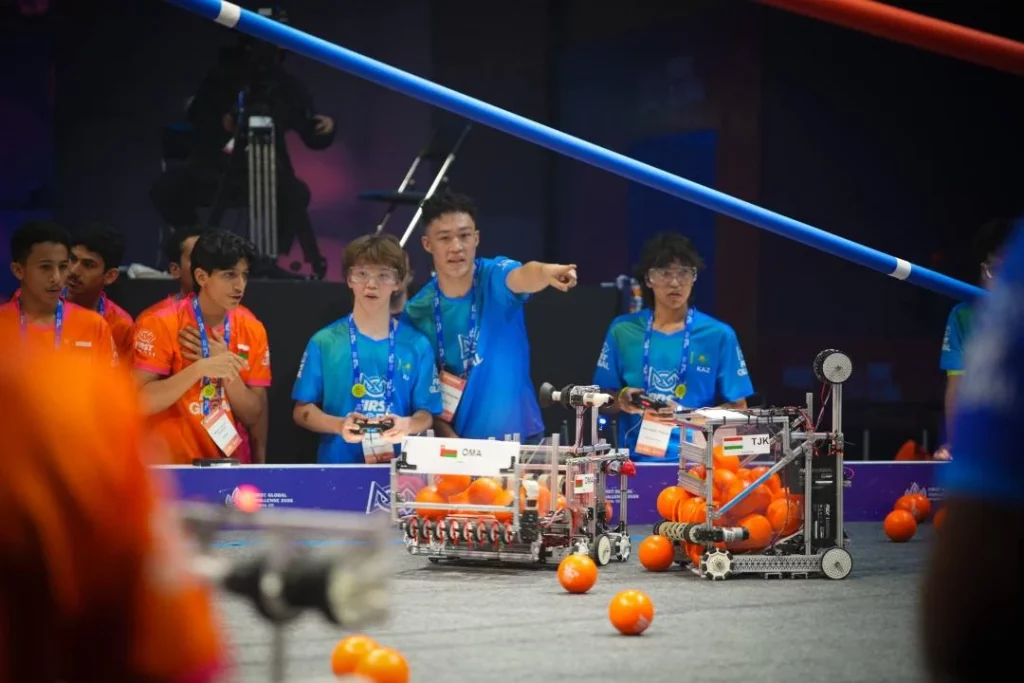
Kazakhstan’s national robotics team achieved a clean sweep in all 11 qualifying matches at the FIRST Global Challenge 2026 in Incheon, South Korea. However, the squad was unable to extend its four-year consecutive championship gold streak.
According to the Ministry of Education, the Kazakh students advanced through the playoffs and completed the global tournament ranked fourth overall. The nation was represented by five secondary school students from Almaty, competing among national delegations from 185 countries.
The FIRST Global competition incorporates multiple distinct award classifications. Kazakhstan’s historic winning streak pertained specifically to the Grand Challenge Award—presented to the highest total cumulative scoring team of the tournament. In 2026, the gold honor was claimed by Uzbekistan, with China securing silver and Mexico earning bronze. Consequently, winning all 11 qualifying ties did not by itself ensure retention of the grand championship title.
Kazakhstan’s National Team Roster
The national roster featured four students from Grades 9–11 of School-Lyceum No. 92 named after Mahatma Gandhi: Khuseyn Maksut, Nurtas Serik, Aspandiyar Berdali, and Arnur Abdulla. The fifth team member was Yerasyl Yendibay from Gymnasium No. 159 named after Ibyray Altynsarin.
The team was selected through rigorous national qualifying trials organized by the Daryn Center of the Ministry of Education alongside the public USTEM Foundation. Institutional preparation was supported by the Ministry of Artificial Intelligence and Digital Development and Astana Hub. Corporate backing was provided by automotive brands OMODA & JAECOO, part of the Astana Motors group.
Why 11 Match Victories Did Not Yield Gold
The FIRST Global competition format is more intricate than conventional elimination sports where victor status hinges purely on win-loss match ratios. On the competition floor, national delegations collaborate within multinational alliances. The organizers separately award match-play playoff champions, ranking point aggregate leaders, and engineering innovation excellence.
In Incheon, tournament playoff gold was claimed by the multinational alliance comprising Uzbekistan, Moldova, Venezuela, and El Salvador. Uzbekistan simultaneously captured the Grand Challenge Award. The preeminent all-around Albert Einstein Award, celebrating holistic team engineering and sportsmanship, was awarded to Mexico.
A similar award bifurcation occurred in the previous tournament. In Panama, Kazakhstan claimed gold in both the Grand Challenge Award and the Albert Einstein Award, while its field alliance with Aruba, Bolivia, and Jamaica finished third in the playoff rounds. Officials noted at the time that Kazakhstan had maintained four consecutive years as the global scoring leader.
Thus, the Incheon tournament marked the conclusion of Kazakhstan’s dominant four-year streak specifically in the Grand Challenge ranking points category.
Wildfire Mitigation: Igniting Innovation Challenge
Staged between October 7 and 10 under the theme Igniting Innovation, the 2026 championship focused on robotic engineering solutions for wildfire prevention, disaster mitigation, and ecological restoration.
Competitors designed and teleoperated custom robotic mechanisms performing technical field assignments aligned with environmental defense scenarios. Because multinational alliance compositions rotated continuously across rounds, participants were required to rapidly align strategies and codebases with newly paired international teams.
Success necessitated a harmonious blend of multidisciplinary capabilities: custom mechanical fabrication, embedded systems programming, structural stress testing, and real-time alliance tactical communication. Overall standing reflected total systems reliability and agile inter-team coordination.
Four Years of Global Dominance and Madrid 2027
Prior to Incheon, Kazakhstan defended an unbroken dominance sequence initiated in Geneva in 2022. Across four successive global championships, the national team stood as the undisputed top-scoring powerhouse worldwide, complemented in 2025 by the prestigious Albert Einstein Award.
While the fifth consecutive Grand Challenge title proved elusive, the Almaty delegation maintained an undefeated regular season record and affirmed its status among the world’s top four robotics programs.
The next FIRST Global Challenge will convene in Madrid in 2027, where Kazakhstan’s robotics pioneers will seek to reclaim the global summit in points supremacy.