
Airbnb shares surged 14% in a single trading session after quarterly earnings revealed that artificial intelligence has reduced customer support expenses per booking by 16%. In an era dominated by multi-billion-dollar data center expenditures and theoretical AI promises, Airbnb delivered one of Silicon Valley’s most tangible commercial demonstrations of generative automation boosting bottom-line corporate profitability.
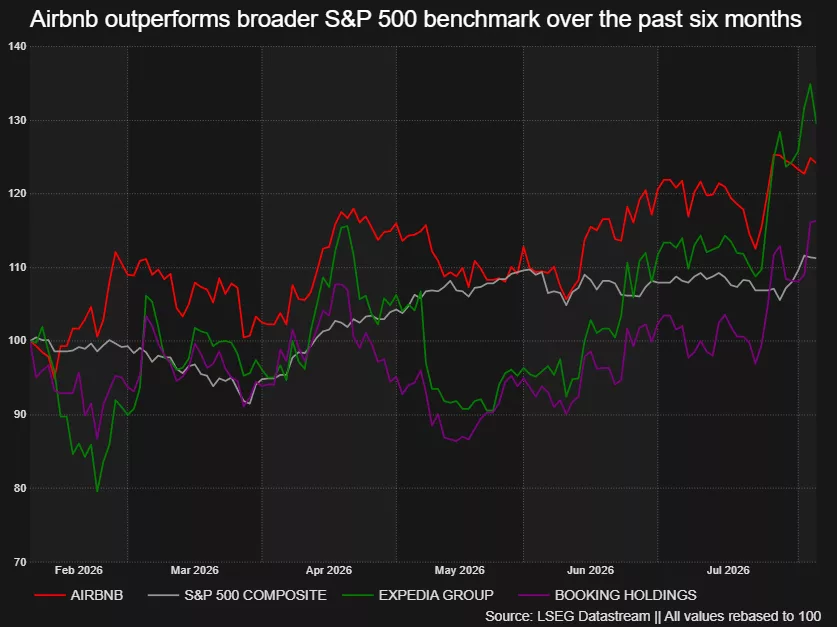
Airbnb Stock Surges 14% in a Single Day to Four-Year Highs
Following the release of its Q2 2026 financial report, Airbnb (NASDAQ: ABNB) equity experienced its strongest single-day rally since early 2022. Wall Street reacted with aggressive buying after the short-term rental giant surpassed consensus forecasts across gross booking value, net income, and operational margins.
While overall travel demand remained resilient, the primary catalyst captivating institutional investors was a structural operational breakthrough: the aggressive, highly profitable deployment of conversational AI across customer service workflows.
AI Helps Airbnb Slash Customer Service Costs per Booking by 16%
Customer support represents one of the most resource-intensive cost centers in digital platform economics. For a marketplace handling hundreds of millions of room nights across 220 countries and dozens of languages, handling cancellations, disputed cleaning fees, lockbox malfunctions, and emergency re-accommodations requires a massive global human workforce.
Speaking on the quarterly earnings call, Airbnb Chief Executive Brian Chesky revealed that conversational AI agents now handle and fully resolve a substantial percentage of guest and host inquiries without routing tickets to human representatives. On a unit-economic basis, the integration of generative AI reduced customer support cost per booking by approximately 16% year-over-year.
In high-volume platform businesses, a 16% efficiency dividend in core support workflows flows directly into EBITDA expansion, liberating hundreds of millions of dollars in operating cash flow.

A Dramatic Leap from Early 2025 Experiments
Just twelve months earlier, Airbnb’s AI initiatives yielded modest, incremental improvements. Initial bot deployments struggled with multi-turn context, ambiguous property refund disputes, and localized hospitality nuances.
Throughout late 2025 and 2026, Airbnb re-engineered its support pipeline around fine-tuned retrieval-augmented generation (RAG) models, granting agents direct programmatic access to booking databases, payment gateways, and localized hosting regulations. Rather than acting as glorified FAQ search bars, the updated agents now issue refund credits, modify dates, and verify photo evidence autonomously.
«AI is the Best Thing That Ever Happened to Airbnb»
Brian Chesky did not mince words when articulating the strategic impact of automation, publicly declaring that «AI is the single best thing that has ever happened to Airbnb.»
Beyond back-office cost reduction, Airbnb is transforming its core mobile application from an episodic vacation rental directory into a comprehensive AI-powered concierge. The company is actively integrating personalized itineraries, boutique hotels, dynamic service offerings, and local experiences into a unified travel platform.
Crucially, Airbnb is expanding aggressively into conventional hotel inventories. According to Reuters, citing Morningstar senior equity analyst Dan Wasiolek, hotel room nights booked via Airbnb are growing approximately three times faster than traditional private home rentals.
Wasiolek projects that this inventory diversification could unlock billions in incremental gross booking volume for Airbnb through the end of the decade, directly challenging legacy online travel agencies (OTAs) such as Booking Holdings and Expedia Group.

For Airbnb, Generative AI is Simultaneously a Threat and a Weapon
When ChatGPT and frontier multimodal models first captured consumer mindshare, tech analysts warned of a looming existential threat to digital aggregators. If an autonomous agent can interpret a prompt such as: «Book a boutique four-night apartment in central Istanbul under $500 with high-speed fiber internet,» why would a consumer ever open Airbnb or Booking.com?
Autonomous AI agents threaten to disintermediate classic consumer web portals, positioning themselves as the new tollbooth between end users and travel inventory.
Rather than attempting to resist the transition, Airbnb is coopting the threat. By embedding conversational intelligence directly inside its proprietary walled garden, Airbnb ensures it captures user intent before external search agents intervene. Booking.com has mirrored this strategy, similarly reporting positive capital efficiency dividends from embedded machine learning to institutional shareholders.
Shareholders are Thrilled — But What About Guests and Hosts?
A critical tension remains beneath the stellar financial metrics. What Wall Street celebrates as operational efficiency can easily degrade into customer frustration if automation is mishandled.
In online host communities and consumer review forums, complaints regarding automated support have proliferated. Users report cyclical chatbot loops, abrupt ticket terminations without resolution, and difficulty escalating complex disputes to empathetic human supervisors.
While these anecdotes do not negate overall net-promoter improvements, they highlight the primary risk of corporate automation: for an equity analyst, a 16% unit-cost reduction is a triumph; for a traveler stranded outside a foreign apartment at midnight, an unhelpful AI assistant is a catastrophe. Airbnb’s long-term brand equity depends on striking an enduring equilibrium between automated triage and accessible human intervention.
The Real Silicon Valley Blueprint for Commercial AI Monetization
Much of the contemporary discourse surrounding artificial intelligence centers on astronomical GPU clusters, frontier foundation model benchmarks, and sovereign semiconductor subsidies. Yet Airbnb’s quarterly triumph demonstrates the most pragmatic commercial playbook for real-world enterprise AI ROI:
- Identify an expensive, friction-heavy operational process with massive transactional scale.
- Deploy specialized AI models to deflect routine inquiries and resolve standard disputes autonomously.
- Reap substantial per-transaction margin expansion and redeploy capital toward strategic product expansion.
Airbnb did not need to build a frontier LLM from scratch. By applying practical automation to core business mechanics, the company expanded profit margins, pushed its stock to four-year highs, and proved that real AI value is won through operational execution. For related insights on corporate automation, explore our deep dive into enterprise automation and AI-driven workflow transformation.
Sources: Reuters; Airbnb Investor Relations; Airbnb Newsroom; TechCrunch; Q2 Financial Disclosures and Executive Conference Calls.