Nine specialists work at Social Change Kazakhstan. Their inaugural commercial contract generated 360,000 KZT, while comprehensive turnkey marketing retainers start from 600,000 KZT. Yet the project’s true operational experiment is only just beginning.
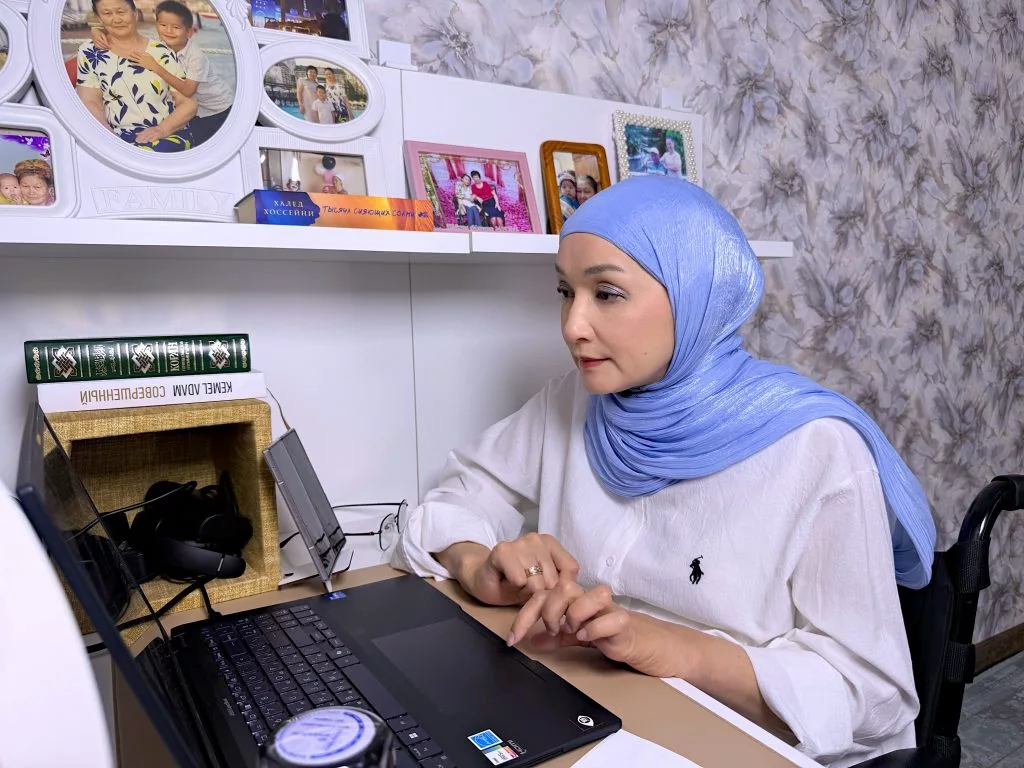
Aislu Asan working at her laptop. Photo courtesy of the founder.
Aislu Asan types using the thumb of her left hand. Following a severe cervical spinal cord injury, her arms maintain mobility while her wrists and fingers remain partially paralyzed. She avoids traditional computer mice, navigating efficiently via a laptop touchpad and typing at impressive operational speeds.
For paying corporate clients, this personal reality is irrelevant: what matters is clean typography, functional website code, engaging SMM copy, and measurable return on ad spend. That is precisely the founding philosophy of Social Change: competing on market quality rather than appealing for charitable patronage. If the deliverable is professional, it makes no difference whether it was produced with two hands, one thumb, adaptive pedals, or eye-tracking sensors.
Nine Specialists Working Across Five Cities and One Remote Village
Social Change Kazakhstan produces multi-format digital content: in-depth corporate stories, photography, commercial video, Instagram Reels, and web portals. The core team comprises nine specialists, six of whom live with disabilities. Team members collaborate remotely from Karaganda, Petropavlovsk, Ridder, Akmola Region, Astana, and Station Zharyk in the Shetskiy District.
Content specialist Irina Belousova authors feature stories and corporate interviews. Yevgeniya Belousova oversees web layout and publication formatting, Arina Ott leads graphic design, and Aigerim Rakhimzhanova directs photo and video production. Translator Khadizha Muslim from Astana adapts all materials from Russian into Kazakh (her name has been changed at her request; she is officially employed through the state employment center).
Ruslan Valiullov is an integral advisor to Social Change Kazakhstan, providing digital accessibility audits. His primary position is as a senior web development director in Russia. For the Kazakhstani venture, Ruslan consults on web accessibility standards (WCAG) for visually impaired users. Ruslan controls his computer entirely using an eye-tracker, having previously typed using a mouth stick. For Aislu, his journey stands as living proof: a person with severe motor disabilities can become an elite digital professional earning competitive compensation.
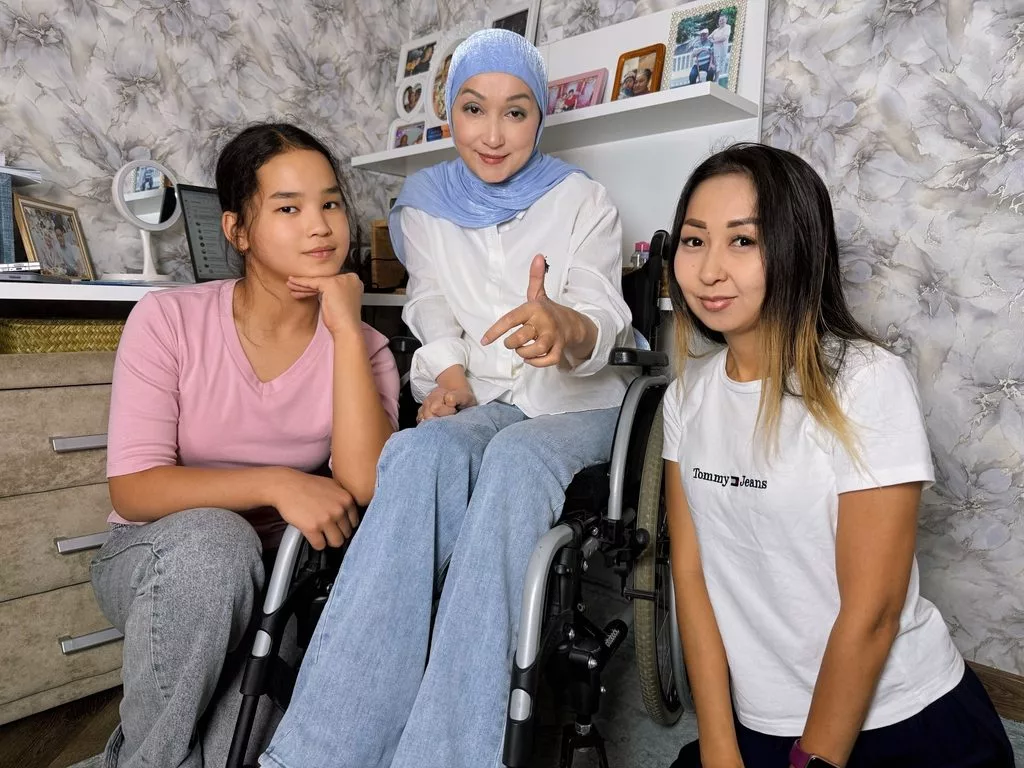
Aislu’s daughters also contribute directly: Merey accompanies her mother on field video shoots as a second camera operator, while Ayym manages digital marketing from Venice, where she lives and studies.
The First Commercial Contract: Proving Professional Competency
The agency’s first paying customer was an Almaty-based legal consulting firm. The scope included brand identity design, social media marketing, and SEO-optimized legal articles. The contract was delivered on schedule, generating 360,000 KZT in gross agency billings.
«Our pricing is strictly anchored to market averages in Almaty and Astana,» notes Aislu. «A basic SMM retainer starts at 360,000 KZT per month, while a comprehensive content package—including longform brand journalism, video production, and advertising management—ranges between 600,000 and 1,200,000 KZT. We deliberately reject the race to the bottom. Underpricing services reinforces the false stereotype that people with disabilities produce inferior work.»
Why Traditional Quotas and Charity Schemes Fail
In Kazakhstan, legislation formally establishes a 2% to 4% hiring quota for persons with disabilities among enterprises employing over 50 workers. In practice, however, this regulatory mandate functions largely as a formality. Major corporations frequently find it more convenient to pay minor administrative penalties or hire individuals on paper for nominal janitorial roles without integrating them into genuine corporate workflows.
Asan identifies three systemic structural hurdles hindering true professional integration:
- Physical Inaccessibility and Urban Isolation: While remote digital work eliminates the daily barrier of inaccessible buses and stairs, it creates deep professional isolation. Candidates often lack basic workplace etiquette, Slack/Telegram communication norms, and deadline discipline simply because they were excluded from office environments.
- The Motivation Trap: Asan challenges the comfortable assumption that every individual with a disability is inherently motivated to enter the grueling competitive labor market. When someone has spent decades confined indoors surviving on state disability benefits, navigating workplace stress and constructive client criticism requires immense psychological resilience.
- Unequal Starting Points: An individual who sustained a traumatic injury as an adult often retains higher education, professional networks, and prior career experience. Conversely, someone who grew up with congenital disabilities frequently faced systemic educational segregation and overprotective family dynamics, preventing them from developing self-reliance.
The Second Pilot: Reverse Recruitment for Corporate Partners
Having established the agency’s baseline production capability, Asan is launching a second operational model: reverse inclusive headhunting. Rather than enrolling broad cohorts into generic IT training courses with uncertain employment outcomes, Social Change is selecting three forward-thinking Kazakhstani partner enterprises.
The agency analyzes each enterprise’s concrete operational openings—in SMM, visual design, outsourced bookkeeping, or content moderation. Social Change then sources, tests, and upskills one dedicated candidate specifically tailored to that company’s software stack and internal workflow.
During a three-month paid probation period, Social Change provides peer mentorship, assisting the employer in adapting internal documentation while ensuring the employee meets strict performance benchmarks. The employer pays the specialist standard market wages, while compensating Social Change for recruitment and mentoring services.
«Years ago, someone believed in me, gave me a laptop, and offered me the opportunity to work and make mistakes,» concludes Aislu Asan. «Today, I have reached the stage where I can create real jobs for other people.»
To learn more about the initiative, visit the official Social Change Kazakhstan portal and their Instagram @socialchange_kz. You can follow Aislu Asan’s work via her personal Instagram @aisluasan.