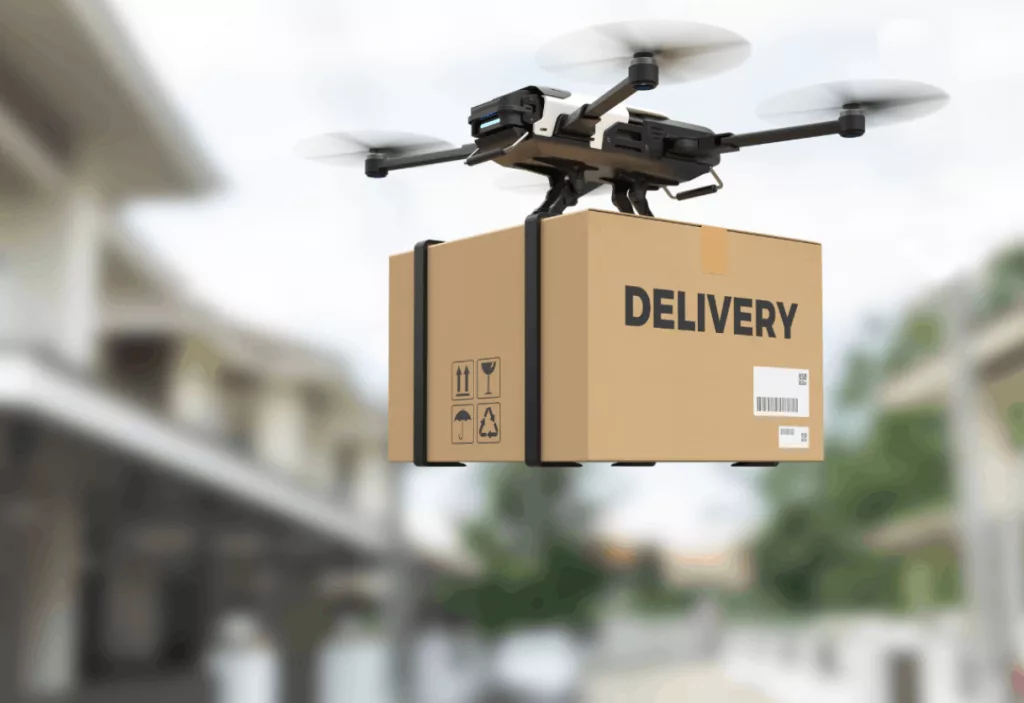
Amazon recently announced that its Prime Air drone delivery network will expand to nearly 500 cities and municipalities across the United States by year-end—a sixfold scaling compared to its previous footprint of 11 testing zones. New aerial fulfillment hubs are deploying across suburban Chicago, Atlanta, Cleveland, Syracuse, and Boise. The service promises package drops under 30 minutes for payloads up to 2.3 kg, priced at $2.99 for Prime members and $4.99 for non-subscribers.
For the American logistics ecosystem, this marks a hard-fought milestone. Jeff Bezos first promised consumer drone deliveries in 2013; Amazon subsequently weathered over a decade of crashed prototypes, regulatory battles with the FAA, and constrained suburban pilots before establishing standardized consumer pricing. To learn how Kazakhstani engineers contribute to global infrastructure at top tech firms, read our profile on Gaini Kusainova, Amazon software engineer and Forbes 30 Under 30 honoree.
A Catch-Up Effort Rather Than an Unprecedented Breakthrough: While Amazon transitions from pilot trials to commercial rate cards, commercial drone delivery in China has long ceased being an experiment. It is a mature, profitable industrial sector supported by national low-altitude airspace directives.
Chinese delivery titan Meituan alone logged over 2 million commercial drone deliveries in 2025. In the Greater Bay Area (Hong Kong–Guangzhou–Shenzhen), logistics giant SF Express operates between 800 and 2,000 drone sorties daily, executing more than 12,000 package deliveries every 24 hours. E-commerce giant JD.com, which initiated drone testing in 2016, has deployed its lightweight urban JDX20 platform across major metropolitan districts.
Per-delivery operational costs in China drop by 40% to 50% annually. The emergency medical transport segment has achieved operating profitability, although high-density fast-food delivery continues to compress margins. Formally, this expansion is fueled by Beijing’s “Low-Altitude Economy” national master plan—a government strategy enacted in early 2025 creating harmonized low-altitude flight regulations for drones and eVTOL aircraft, designed to cultivate a trillion-yuan market.
While American regulators deliberate suburban overhead flight permissions, Chinese operators are optimizing unit margins across distinct delivery verticals.
Furthermore, Chinese operators are expanding globally. Meituan’s international arm—Keeta Drone—has completed over 740,000 deliveries across 65 urban corridors in Beijing, Shenzhen, Shanghai, Guangzhou, Hong Kong, and Dubai. In Saudi Arabia, Keeta quickly climbed to the #1 most downloaded delivery app.
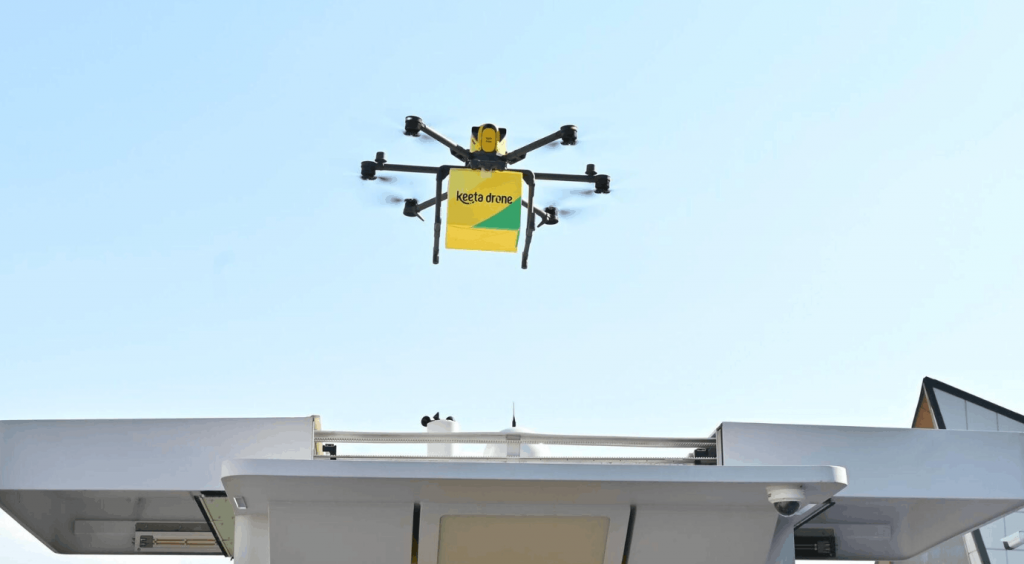
The Connection to Central Asia: In August 2026, Keeta Drone established a pilot drone-port during the “Games of the Future” in Astana in collaboration with Kazakhstan’s Alatau Advance Air Group. Consequently, Kazakhstan’s first exposure to mass autonomous drone delivery arrived not from Seattle, but via technology proven in Shenzhen and Riyadh.
While Western tech media frames Amazon’s announcement as a breakthrough, it is primarily a race to catch up with a high-density operational paradigm that China established years ago. For insights into regional parcel infrastructure and rapid logistics networks, explore our analysis on Kaspi Postomat and Kaspi Delivery scaling.