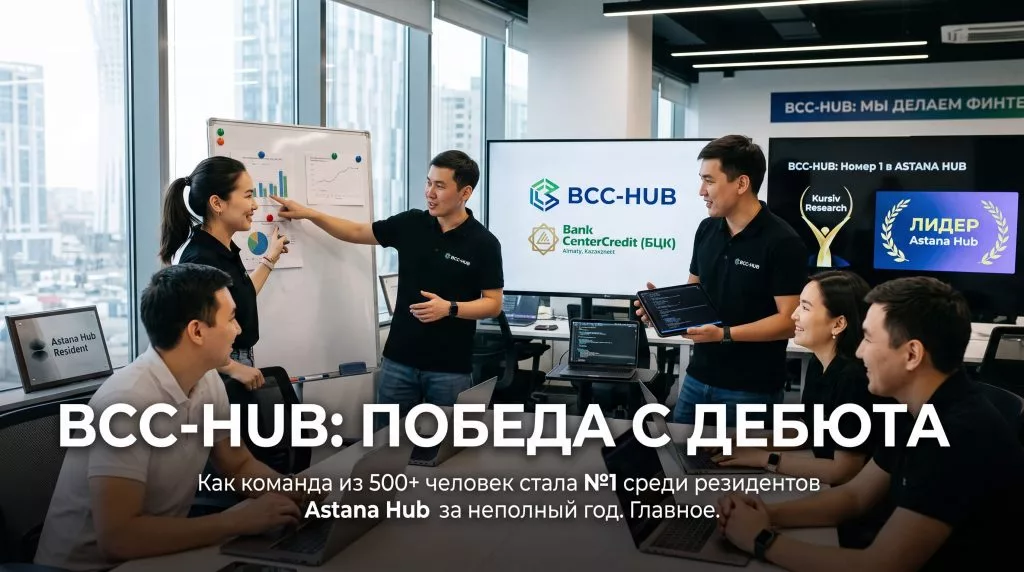
BCC-HUB was established in February 2024. By the conclusion of that same inaugural, incomplete operating year, the enterprise paid 1.8 billion tenge in taxes, instantly claiming first place among all resident tech companies inside the Astana Hub international technology park according to the annual Kursiv Research ranking.
Zero warm-up years. Zero retail software products commercialized on the open external market. And immediate ascension to the apex of the national technology park ranking.
RAEM examined the structural mechanics behind this extraordinary market debut.
Chronology of Creation: Regulatory License, KASE Disclosure, and Corporate Registration
The corporate chronology is documented across three independent official repositories, aligning seamlessly:
In late January 2024, Bank CenterCredit (BCC) secured formal regulatory authorization from the Agency for Regulation and Development of the Financial Market (ARDFM) to incorporate an independent technology subsidiary.
LLP «BCC-HUB» was officially registered on February 9, 2024 (BIN 240240010845), categorized under OKED code 62011 («Software Development»). Its statutory address was registered at 38 Al-Farabi Avenue in Almaty.
On that exact date, the parent bank disclosed the transaction to the Kazakhstan Stock Exchange (KASE). In an official circular dated February 14, 2024, JSC Bank CenterCredit confirmed to market participants that effective February 9, 2024, it acquired 100% ownership of subsidiary LLP BCC-HUB. Official stock exchange filings represent the gold standard of primary evidence in corporate auditing.
Headcount and Tax Architecture: 1.8B KZT from 500+ Engineering Payrolls
Public registry databases indicate BCC-HUB’s workforce exceeds 500 engineering and product specialists. In early 2025, parent Bank CenterCredit increased the subsidiary’s charter equity capital by 3.2 billion tenge.
How did a brand-new corporate entity generate 1.8 billion tenge in tax contributions within months? The tax mechanics are revealed through Astana Hub’s statutory preferential regime.
Astana Hub residents enjoy comprehensive tax exemptions: 0% Corporate Income Tax (CIT), 0% Value-Added Tax (VAT), 0% Individual Income Tax (IIT) on resident employees, and 0% Social Tax on non-resident specialists. What remains mandatory are local property taxes, royalties, social insurance contributions for resident staff, and mandatory pension withholdings.
Kursiv Research documents this systemic trend across Kazakhstan’s technology landscape: nearly half of the leading entities in Astana Hub rankings represent IT divisions of banking and industrial conglomerates restructured as independent legal entities. The core catalyst of recent years is optimizing operational expenditure through technology park tax preferences.
BCC-HUB represents the swiftest and largest manifestation of this corporate playbook. A parallel structure governs QazCode (spun out from Beeline Kazakhstan) and KMG-Kumkol (a wholly owned software subsidiary of national oil champion KazMunayGas).
This does not represent the spontaneous birth of a greenfield startup, but rather the strategic re-registration of an established 500-person in-house engineering apparatus into a preferential tax jurisdiction.
Concurrently, bank leadership cited corporate talent acquisition dynamics: an agile technology enterprise with modern engineering culture recruits top software developers far more effectively than a heavily regulated commercial banking institution.
External Software Contractors Continue Parallel Operations
Spinning off an internal software subsidiary did not terminate third-party vendor relationships. In the portfolio of ATI Projects—the development division of regional integrator AtyrauTechInvest—the company credits itself with engineering the corporate client portal for BCC Business mobile apps across iOS and Android, alongside key retail banking modules.
Parallel to over 500 internal engineers, critical customer-facing digital products continued to be developed and optimized by specialized external regional software teams.
Key Corporate Questions Awaiting Public Disclosure
Several fundamental financial metrics remain shielded from public inspection:
• Revenue and Customer Diversification: It is unverified what percentage of BCC-HUB’s turnover derives from captive internal group procurement versus open third-party enterprise contracts;
• Deployment of the 3.2B KZT Capitalization: Detailed auditing reports specifying the allocation of the multi-billion-tenge capital injection have not been publicly disclosed;
• Technology Incubation Hub: While an early-stage venture incubator was declared at inception, public milestones regarding commercial cohort graduations remain unannounced;
• Dedicated Online Presence: BCC-HUB operates without an independent corporate domain, maintaining brand representation solely through the parent financial institution.
Subsequent iterations of annual technology park rankings will provide the true analytical baseline: demonstrating whether BCC-HUB achieves organic external software expansion or remains a highly efficient corporate payroll relocation vehicle.