
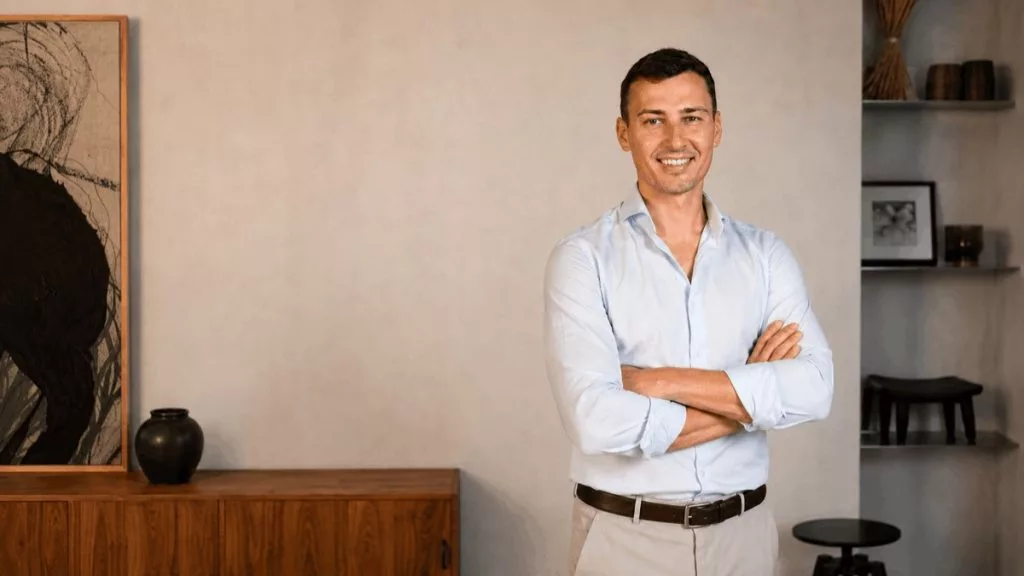
Gleb Shtraib entered the art world from corporate investment banking. Three years after launching digital art marketplace Arts.me, the platform hosts over 760 verified Central Asian painters and sculptors exhibiting more than 2,200 original artworks. RAEM.KZ sat down with Shtraib to discuss marketplace unit economics, high sales commissions, artist psychology, and the realities of building an e-commerce platform for original fine art.
Background: Finance Rather Than Gallery Curating
Before launching Arts.me, Shtraib spent over 15 years in financial services, managing risk modeling, corporate portfolios, and digital transformations at major banking institutions. Lacking formal gallery curatorial training, he approached fine art not as an emotional bohemian salon, but as a fragmented, opaque two-sided marketplace suffering from catastrophic friction: physical galleries charging 50% markups with zero price transparency, while hundreds of talented regional artists had no secure payment rails or domestic reach.

760 Artists and 2,200 Artworks on the Platform
Bootstrapping the marketplace required overcoming severe chicken-and-egg dynamics. Shtraib personally visited artist studios, convincing master painters that digitizing their catalogs would not devalue their prestige. Today, the catalog spans contemporary oils, traditional nomadic motifs, sculptures, and graphic prints priced from 30,000 KZT ($60) to over 5,000,000 KZT ($10,000).
The Commission Model: 35% to 57% Take-Rates
Arts.me operates on an explicit take-rate structure: a standard 35% commission on sales to corporate entities (B2B), expanding up to 57% for certain retail transactions. While independent artists initially balk at these figures, traditional brick-and-mortar European and Central Asian galleries typically take 50% to 60% while demanding exclusivity and physical consignment.
The commission covers comprehensive operational execution: packaging logistics, insured doorstep delivery, international customs export certifications from the Ministry of Culture, secure escrow payments, and targeted digital acquisition marketing.

Artist Pain Points: Technical Rather Than Financial
Surprisingly, the most frequent friction points with sellers are technical usability issues rather than commission disputes: high-resolution photo cropping, accurate dimension inputs, and remembering passwords. By automating packaging logistics and establishing reliable payment settlement cycles, Arts.me demonstrates that vertical marketplaces can successfully formalize creative industries in Central Asia.



