
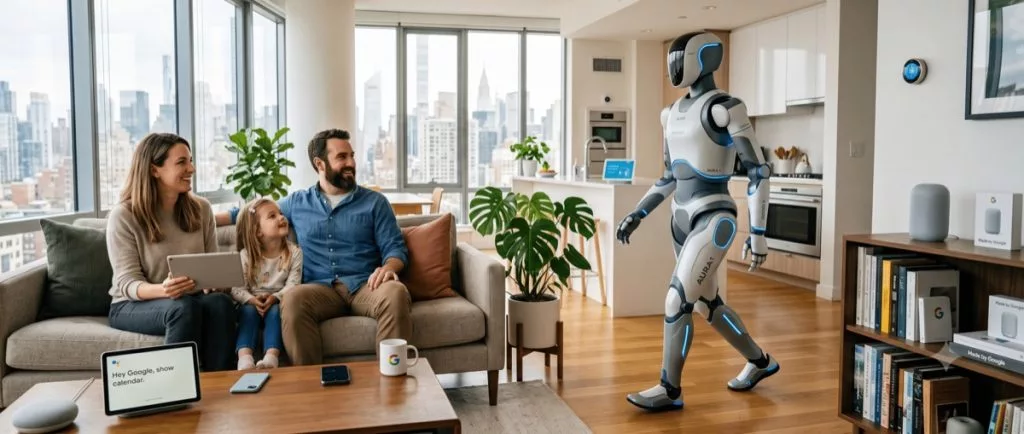
On July 30, Google DeepMind unveiled Gemini Robotics 2—its first foundational artificial intelligence model engineered to govern an entire humanoid robot holistically, coordinating everything from bipedal locomotion to fine finger dexterity. In the promotional demonstration, an Apollo humanoid navigates across a room to place a watering can precisely onto a designated shelf. Behind the polished video, Google’s technical report reveals a much more nuanced reality.
From Tabletop Manipulation to Full-Body Physical Coordination
Prior iterations of Gemini Robotics were constrained to tabletop manipulation: coordinating upper-body robotic arms to grasp stationary widgets, sort blocks, or rearrange coffee mugs while the robot’s torso and lower limbs remained static. For an overview of domestic humanoid demonstrations in Central Asia, read our report on industrial humanoid demonstrations at the QAZBOT Forum in Astana.
Gemini Robotics 2 unifies whole-body kinematics: orchestrating simultaneous walking, crouching, bending, balance recovery, and dexterous grasping. In DeepMind’s benchmark evaluation running on Apptronik’s Apollo 2 humanoid platform, the robot received the high-level voice prompt: “Place the watering can inside the green container on the lower shelf.” Apollo autonomously traversed the room to a desk, retrieved the watering can, balanced across open space to the shelving unit, and deposited the item into the designated container.
The underlying architecture consists of three specialized foundation models operating in concert:
- Gemini Robotics 2: A Vision-Language-Action (VLA) foundation model translating real-time camera visual feeds and natural language prompts directly into joint motor trajectories.
- Gemini Robotics ER 2: The cognitive reasoning engine that formulates multi-step operational plans and coordinates synchronized teamwork across multiple robotic agents.
- Gemini Robotics On-Device 2: A lightweight, quantized local variant running edge inference directly on onboard robotic compute without cloud latency.
The Technical Audit: Reliable Pickups vs. Fragile Fine Dexterity
While promotional marketing reels showcase effortless domestic fluidity, DeepMind’s technical whitepaper provides concrete success probability benchmarks.
In gross object manipulation, performance proves solid: grasping items from a tabletop achieved a 68% success rate, retrieving from an elevated shelf reached 76%, and lifting objects from floor level logged 45.8% reliability.
However, intricate manual dexterity reveals acute bottlenecks. Apollo’s five-fingered robotic hand successfully unscrews a lightbulb in 92% of trials, but successfully screwing it back into a socket drops to just 36%. Tying a standard plastic trash bag knot succeeded in 44% of attempts, while sweeping debris using a handheld dustpan reached only 32% task completion.
A humanoid that effortlessly unscrews a lightbulb yet fails two out of three times to screw it back in highlights the fundamental reality of contemporary robotics AI: success reflects the statistical density of specific physical trajectories within the training dataset rather than generalized physical understanding.
Commercial Strategy: Google as the Operating System for Third-Party Hardware
Public developer access remains tightly gated. While the high-level ER 2 reasoning engine is accessible via Google AI Studio and Gemini Enterprise Agent Platform, the actual low-level VLA motor execution model and On-Device package are restricted to an exclusive waitlist of enterprise robotics partners.
This rollout strategy mirrors Google’s historical Android playbook: Google is not constructing proprietary commercial humanoid hardware. Instead, DeepMind aims to establish the universal “cognitive intelligence layer” powering third-party robotics manufacturers—partnering at launch with Apptronik, Boston Dynamics, and Agile Robots.
Iterative Evolution Over Revolutionary Breakthrough
Gemini Robotics 2 marks the fourth major milestone in Google’s embodied AI roadmap over an 18-month cycle. Each iteration demonstrates expanding physical capability, followed by technical evaluations that temper viral hype with pragmatic engineering constraints.
A one-minute video demo showing an autonomous humanoid tidying a living room looks futuristic; achieving a consumer domestic assistant that can safely maintain a household without human supervision remains at least another full model generation away.



