The government of Kazakhstan has established an ambitious target under its national digitalization roadmap: deploying industrial “digital twins” across at least 60% of the country’s major enterprises by 2029. In heavy industry, oil and gas, metallurgy, and mining, digital twins represent the pinnacle of Industry 4.0. However, realizing tangible economic benefits requires distinguishing between genuine telemetry-driven predictive models and superficial 3D visualizations designed merely for regulatory compliance.
A Strategic State Objective, Not an Overnight Mandate
The 60% benchmark formulated by the Ministry of Industry and Construction and the Ministry of Digital Development reflects a policy vector rather than a mandatory administrative penalty for factories. The initiative aims to modernize aging legacy assets across extractive giants (such as ERG, Kazakhmys, KazMunayGas, and Kazatomprom) by incentivizing domestic and international enterprise automation vendors.
What Distinguishes a Genuine Digital Twin from a 3D Model?
Many organizations mistakenly label basic BIM models or static 3D animations as digital twins. In industrial engineering, a true digital twin requires three non-negotiable components:
- Physical-to-Virtual Real-Time Data Flow: Thousands of IoT sensors, temperature gauges, vibration monitors, and SCADA systems continuously streaming real-time operational parameters to a centralized data lake.
- Dynamic Mathematical Simulation: Physics-based and machine-learning models that simulate thermodynamic, mechanical, or chemical processes under shifting operational stresses.
- Actionable Feedback Loop: The model does not merely report current status; it predicts equipment degradation, anticipates component failures weeks in advance, and recommends optimized control setpoints to plant engineers.
Promising Industrial Use Cases in Kazakhstan
In Kazakhstan’s resource-rich economy, digital twins offer substantial return on investment (ROI) across several core sectors:
- Mining & Processing Plants: Simulating ore throughput in grinding mills and floatation circuits to optimize chemical reagent consumption and boost mineral extraction yields.
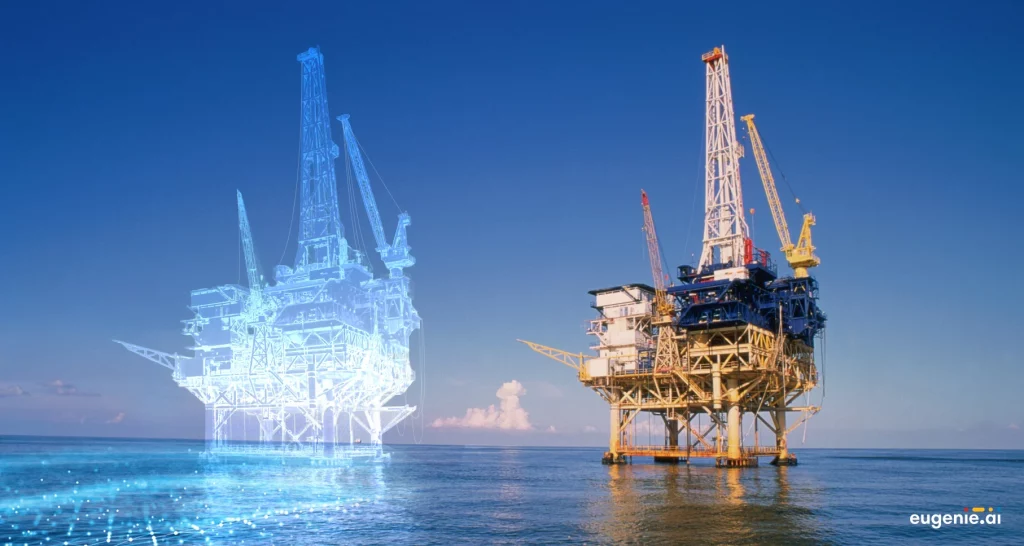
- Oil & Gas Well Operations: Modeling subterranean reservoir pressures and multiphase pipeline flows to prevent parafinnic clogging and predict pump rod fatigue.
- Power Generation & Transmission: Monitoring thermal stress on turbine blades and power transformers to schedule predictive maintenance during low-demand seasons, preventing catastrophic blackout events.
Separating Economic Reality from Marketing Hype
Deploying a comprehensive enterprise digital twin costs millions of dollars and demands extensive sensor instrumentation, robust industrial cybersecurity, and data harmonization across disconnected legacy databases. If an enterprise lacks fundamental data hygiene, investing in a digital twin results in “garbage in, garbage out.”
Industry leaders recommend a phased implementation strategy: start with a focused digital twin for a single critical machine bottleneck (such as a ball mill or gas compressor) to validate measurable payback before attempting a sprawling plant-wide simulation.
Key Risks: Digital Twins for “Show and Report”
The primary hazard of state-driven percentage targets is the proliferation of “Potemkin” digital twins — visually impressive 3D dashboard walkthroughs that lack live sensor telemetry and predictive algorithms, constructed solely to report compliance to ministerial committees. To create enduring industrial competitiveness, Kazakhstan’s industrial giants must anchor digital twin initiatives in rigorous unit economics, downtime reduction metrics, and genuine engineering excellence.