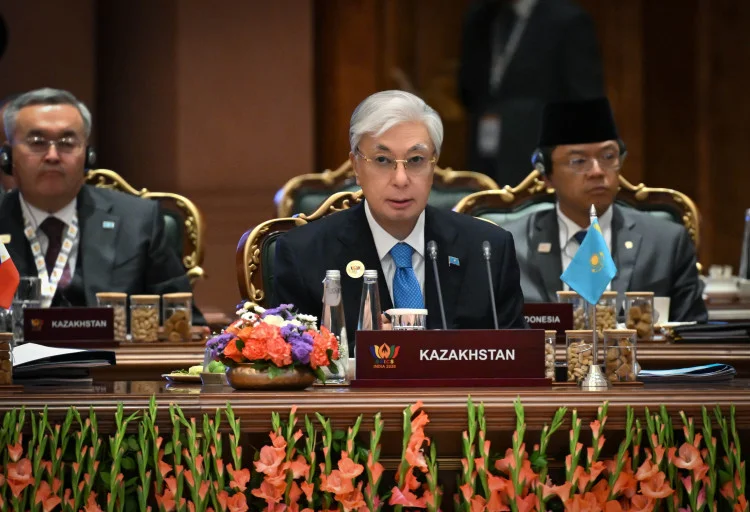
Kazakhstan has proposed establishing an international artificial intelligence partnership interconnecting the national AI hubs and research centers of BRICS+ member states. The initiative aims to provide participants with shared access to computational laboratories and joint scientific research, with the collaborative development of multilingual neural models identified as a prime priority.
The proposal was articulated by President Kassym-Jomart Tokayev on September 13 during the BRICS Plus Summit in New Delhi. At this stage, the project represents a strategic concept: technical network architecture, multilateral funding mechanisms, and protocols governing cross-border scientific data exchange remain to be formalized.

What Kazakhstan Proposes
The core concept envisions building an integrated intergovernmental AI cooperation network across participating BRICS+ nations. Rather than launching a new supranational agency from scratch, the plan involves linking existing and emerging national computing centers into a collaborative alliance.
Kazakhstan’s proposal highlights three primary pillars:
- Shared Laboratory Infrastructure: Facilitating mutual access for researchers, academic universities, and technology startups to partner computing clusters and testing facilities;
- Joint Applied Research: Initiating multinational AI projects in climate modeling, water resources, digital agriculture, public healthcare, and industrial automation;
- Sovereign Multilingual Models: Training open and foundational neural architectures tailored to the national languages and cultural contexts of the Global South and Central Asia.
Countering Western Monopolies in Language Models
The emphasis on multilingual models reflects a strategic technological dilemma facing emerging economies. The overwhelming majority of cutting-edge frontier models are trained predominantly on English-language web corpora, inevitably embodying Western cultural viewpoints and colloquial standards.
Minority and regional languages — including Kazakh, Uzbek, Swahili, and various dialects across Eurasia — remain drastically underrepresented in global training sets. Training localized foundation models requires massive computational budgets and curated datasets that individual developing nations struggle to fund independently. Pooling compute, tokenized corpora, and linguistic expertise within a BRICS+ framework could make regional LLMs commercially and academically viable.

Kazakhstan’s Growing Compute Infrastructure
Kazakhstan’s pitch is underpinned by its own rapid computational buildout. In Astana, construction is underway on a National Artificial Intelligence Center, backed by a planned sovereign supercomputing cluster designed to serve domestic scientific institutions and tech founders.
By positioning itself as an early advocate for multilateral AI integration, Kazakhstan seeks to establish itself as a central digital and computational transit hub bridging Central Asia, China, the Middle East, and South Asia. Participating in a shared compute network would give Kazakhstani AI startups access to massive regional datasets and international scientific partnerships.
Key Implementation Hurdles
While the strategic rationale is compelling, several severe diplomatic and technical obstacles must be navigated before an interconnected BRICS+ AI network can materialize:
- Compute Inequality: China and India possess immense domestic computing resources and sovereign chip manufacturing ambitions, whereas other member states face severe GPU shortages;
- Data Sovereignty Laws: Strict national regulations on personal data residency and cross-border data transfers make training distributed models across borders legally complex;
- Western Export Controls: High-end AI accelerators (such as NVIDIA H100 and Blackwell GPUs) face complex international trade sanctions and compliance constraints that could complicate shared physical compute clusters.
Nonetheless, the proposal marks an important evolution in Central Asian tech diplomacy: Kazakhstan is actively striving to transition from an importer of foreign algorithms into an architect of international digital alliances.