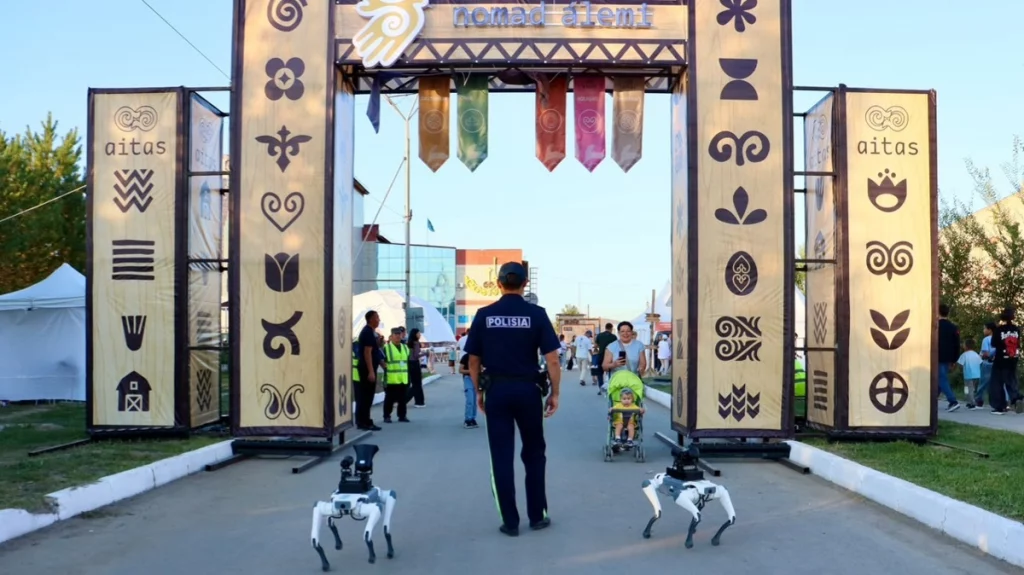
At the Nomad Álemi nomadic culture festival in East Kazakhstan, public safety was reinforced for the first time by robotic quadruped dogs. The four-legged machines patrolled public grounds, streamed high-definition video directly to field command, conducted automated computer vision analytics, and, according to local police officials, were capable of facial recognition.
RAEM investigated the technical specifications of these robotic units, their real-world capabilities, degree of autonomous navigation, and how similar police robotics are deployed internationally.
Deployment at the Nomad Álemi Festival
The cultural festival took place in the village of Kasym Kaysenov in the Ulan District of East Kazakhstan, attracting over 5,000 attendees. Alongside standard police foot patrols and tethered observation drones with strobe lights and loudspeakers, the police department deployed quadruped robot dogs.
According to the East Kazakhstan Police Department, the robots were programmed to patrol pre-designated geofenced zones, maintain continuous 360-degree video surveillance, conduct perimeter thermal checks, and assist in identifying individuals flagged on investigative watchlists.
Which Robots Were Deployed: The Unitree Connection
While official police press releases did not specify the hardware manufacturer, analysis of field footage indicates the units are industrial quadrupeds produced by Unitree Robotics — specifically the Unitree Go2 Pro/Enterprise or B2 industrial series.
Chinese robotics manufacturer Unitree has emerged as the dominant supplier of commercial quadrupeds globally due to aggressive pricing: its consumer and enterprise models range from $1,600 to $15,000, compared to over $75,000 for a Boston Dynamics Spot robot. Features of these units include:
- Ultra-wide 4D LiDAR sensors offering 360° x 90° spatial awareness and real-time obstacle avoidance;
- Integrated HD and thermal camera payloads transmitting low-latency video via 4G/5G and Wi-Fi 6;
- All-terrain traversal over gravel, grass, stairs, and steep inclines up to 30 degrees;
- Battery endurance of 2 to 4 hours per charge depending on payload weight and walking speed.
How Facial Recognition Operates on Edge Quadruped Robots
Police statements regarding real-time facial recognition require technical nuance. The robot dog itself does not carry the full biometric database on its onboard edge processor. Instead, onboard high-resolution optical cameras capture video streams and transmit face crops via cellular data to a centralized police server.
At the command server, computer vision algorithms compare detected facial embeddings against national watchlists (such as missing persons, wanted criminal suspects, or court-restricted individuals). If a high-confidence match is detected, an automated alert is triggered on the tablet of the supervising officer.
In crowded festival environments with dynamic lighting, headwear, and sunglasses, optical facial recognition accuracy typically hovers between 70% and 85%, serving as an advisory alert rather than definitive forensic identification.
Global Precedents: From New York to Seoul and Singapore
Quadruped robots are steadily entering global municipal policing, though public acceptance has varied sharply:
- New York City (NYPD): Deployed Boston Dynamics’ Digidog for hostage negotiations and hazardous inspections, but temporarily shelved the program following fierce civil liberties controversies before reintroducing it under restricted protocols;
- South Korea: Police in Seoul utilize quadrupeds for automated nighttime patrols in industrial zones and suburban parks;
- Singapore: Deployed quadrupeds in public parks to monitor social distancing and pedestrian congestion with automated audio broadcasts.
Future of Police Robotics in Kazakhstan
The East Kazakhstan trial marks a visible experimental milestone for Kazakhstan’s law enforcement modernization. As municipal surveillance systems like Sergek expand into AI-driven behavioral tracking, mobile robotic units offer flexible surveillance where stationary CCTV cameras cannot reach.
However, wide-scale operational adoption will require clear legal frameworks governing public biometric data capture, rigorous privacy guarantees, and verifiable cybersecurity safeguards preventing third-party interception of mobile surveillance streams.