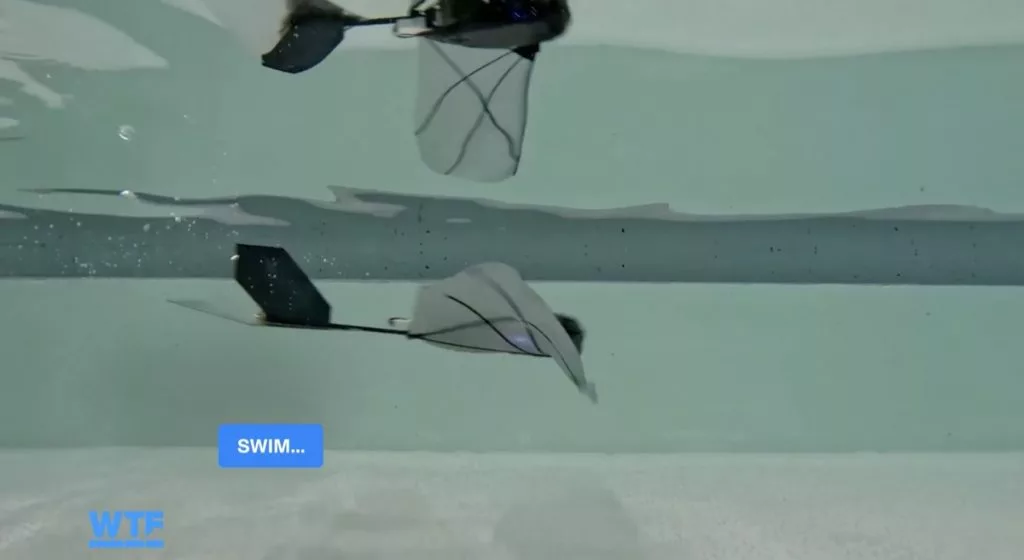
Engineers from MIT and EPFL have unveiled a bio-inspired flapping-wing aerial-aquatic vehicle (FAAV) capable of seamless multimodal locomotion: soaring through the atmosphere, diving into water, swimming underwater using the exact same wing structure, and relaunching autonomously into flight. The breakthrough research was officially published in the journal Science, marking a major milestone in cross-medium robotics.
Single Wing Mechanism Operating in Air and Water
Nature solved the air-water transition millions of years ago in diving seabirds such as puffins, shearwaters, and kingfishers. These avian predators navigate both air and dense aquatic environments using identical wings. Drawing direct inspiration from their morphology, the research team engineered a lightweight vehicle featuring two flexible, waterproof wings, an active pitch-control tail, and an encapsulated waterproof electric motor.
To eliminate surface tension friction upon breaching the surface, the wings are treated with hydrophobic nanoparticle coatings, ensuring rapid water shedding during atmospheric takeoff.
Flight Dynamics: 22 km/h Flight and Subsurface Swimming
Researchers evaluated three distinct wing spans (60 cm, 80 cm, and 100 cm), determining that the 80 cm configuration delivered the optimal thrust-to-drag balance across both media. In flight, the vehicle achieves atmospheric speeds of roughly 6 meters per second (approx. 22 km/h) at a flapping frequency of 5 Hz. Underwater, the identical wing mechanics propel the craft at nearly 1 meter per second.
Validation trials progressed from controlled indoor hydrodynamics tanks to open-water field tests on Lake Geneva in Switzerland.
The Critical Engineering Challenge: Surface Egress
The primary barrier in bimodal robotics is escaping water surface tension, which is hundreds of times denser than air. To breach the aquatic barrier, the vehicle reorients its chassis to a steep 70-degree climb angle and executes high-amplitude wing strokes. Remarkably, while biological seabirds rely on webbed feet to paddle violently against the water surface during takeoff, the robotic vehicle accomplishes successful atmospheric egress purely through aerodynamic wing thrust and chassis attitude control.
Real-World Environmental and Oceanographic Applications
The ultimate objective of the FAAV project extends beyond mechanical biomimicry toward cost-effective oceanographic telemetry. Traditional ocean research requires capital-intensive research vessels that cannot maintain continuous multi-point observation. An autonomous aerial-aquatic robot could launch from coastal stations or automated buoys, fly kilometers to an iceberg or marine wildlife cluster, dive to capture water chemistry and sensor samples, surface, and return autonomously on an hourly basis.
Potential applications include monitoring harmful algal blooms, surveying coral reef health, tracking fish migrations, and inspecting port underwater infrastructure. For insights into terrestrial and humanoid industrial automation, review our coverage of the QAZBOT Robotics Forum 2026 and AGIBOT A3 Ultra debut in Astana.