

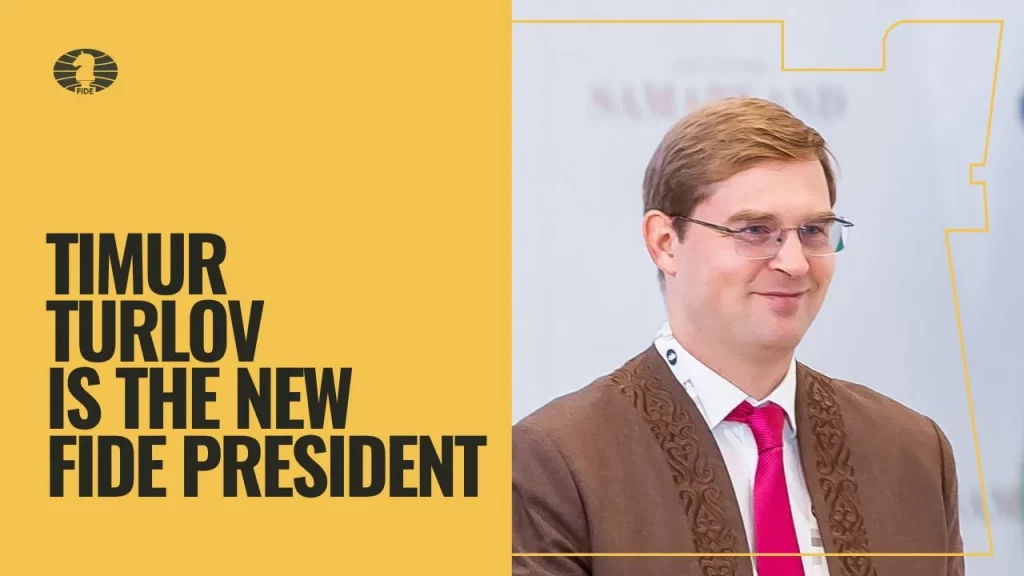
Kazakhstani entrepreneur Timur Turlov has been elected president of the International Chess Federation, FIDE. The election took place on September 26 in Samarkand during the organization’s General Assembly.
In the second round, Turlov received 110 votes to Vadim Rosenstein’s 85. At 38, he became the youngest FIDE president in the organization’s history.
One vote short in the first round
Three candidates contested the presidency.
In the first round, Turlov received 96 votes, Vadim Rosenstein 76 and Jan-Henric Buettner 20. A total of 192 delegates voted.
Turlov fell one vote short of an absolute majority.
The second round took place two hours later, with Turlov winning 110–85. Representatives of 196 national chess federations participated in the election overall.
Turlov became FIDE’s eighth president, succeeding Arkady Dvorkovich, who led the federation from 2018 to 2026.
Viswanathan Anand elected alongside Turlov
Candidates for FIDE president and deputy president run on a joint ticket.
Alongside Turlov, Viswanathan Anand, the five-time world chess champion, was elected deputy president. Their joint candidacy was officially registered in the summer.
FIDE brings together national chess federations worldwide and regulates international tournaments, ratings and championships.
From Kazakhstan’s federation to the global organization
Turlov has headed the Kazakhstan Chess Federation since January 2023. He was also the founder and president of the International School Chess Federation, which promotes school chess.
According to FIDE, Freedom Holding has committed around $30 million over the past three years to chess development in Kazakhstan and support for more than twenty major international tournaments.
In April 2026, Freedom Holding also became FIDE’s official partner for chess development programs. The partnership includes funding for tournaments, training centers, educational programs and identifying young talent.
How conflicts of interest will be handled
Turlov’s simultaneous role at Freedom Holding prompted discussion of potential conflicts of interest during his election campaign.
FIDE’s materials state that Turlov will have to abstain from voting on potential contracts between FIDE and Freedom Holding, as well as Kazakhstan Chess Federation bids to host international competitions.
Other FIDE bodies are to consider those decisions.
Turlov wants to accelerate FIDE’s digitization
Turlov’s platform emphasized technology as well as tournaments and funding.
His stated priorities include a unified digital infrastructure for FIDE, services for national federations, online education and AI-based tools.
The new leadership faces the task of turning a sporting federation more than a century old into a much more modern digital organization.
Turlov will lead FIDE against a backdrop of Kazakhstan’s growing role in global chess: the country hosts major international tournaments, develops school programs and has substantially increased funding in recent years.