
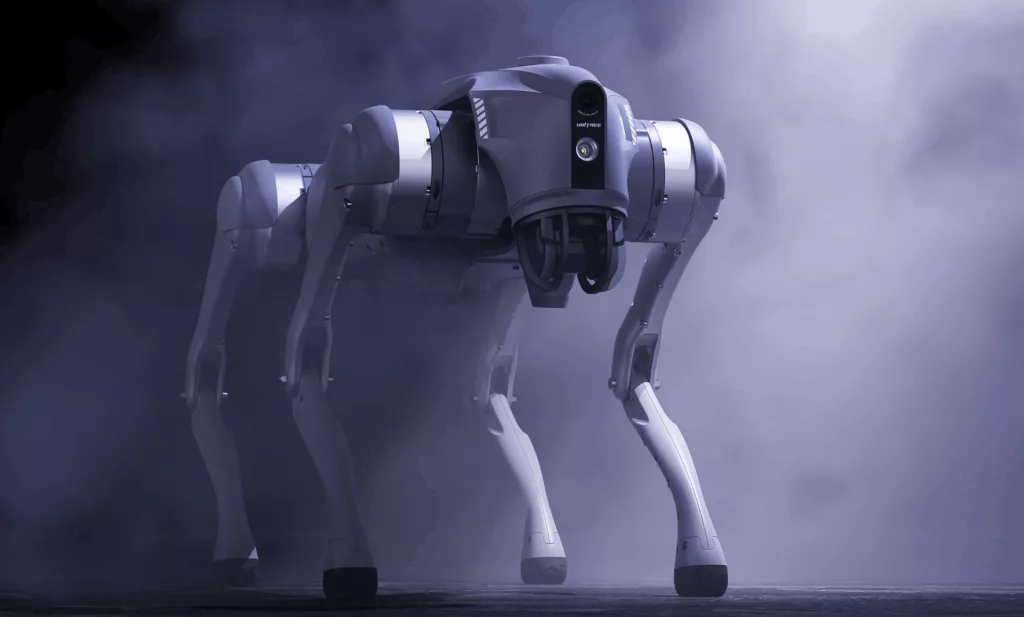
On August 19, Chinese robotics pioneer Unitree Robotics listed on the STAR Market of the Shanghai Stock Exchange, becoming the first humanoid robotics manufacturer to go public in mainland China. Shares opened 629% above their initial offer price. While the stock settled slightly by market close, it finished up an astonishing 460%, commanding a market capitalization of approximately 341.8 billion yuan (roughly $50.7 billion USD). RAEM examined the underlying financial telemetry, vertical integration economics, and export dynamics powering the IPO.
The company priced its offering at 150.8 yuan per share, issuing 40.45 million new shares—representing 10% of post-offering equity—raising 6.1 billion yuan (~$904 million USD). Its pre-IPO valuation stood at roughly 61 billion yuan (~$9 billion). In a single trading session, public capital repriced Unitree nearly sixfold. To understand how regional founders engineer global deep-tech breakthroughs, review our case study on Erzat Dulat and the creation of generative AI models at Higgsfield.
Retail Frenzy: 8,000x Oversubscription on Shanghai’s STAR Market
Retail demand shattered previous exchange records, with the retail tranche oversubscribed more than 8,000 times. For 9.7 million available shares, retail brokerages logged 9.8 million distinct applications, yielding an allocation lottery probability of roughly 0.018%. For context, the average first-day gain for Chinese IPOs in 2026 hovered around 279%; Unitree delivered 460% on a day when the broader CSI 300 index tumbled nearly 3%.
A month earlier, domestic DRAM manufacturer CXMT listed on the same board, soaring 466% on debut. This indicates not an isolated anomaly, but aggressive liquidity concentrating into China’s strategic “hard tech” sovereignty champions.
Unitree Is Actually Profitable—A Rare Feat in Robotics
Historically, deep-tech robotics startups exhibit steep revenue expansion accompanied by compounding structural losses. Unitree breaks this paradigm. In 2025, company revenues reached 1.70 billion yuan (~$250 million USD), up from 392.77 million yuan in 2024 and 159.13 million yuan in 2023—a tenfold revenue surge over two fiscal years.
Net profit for 2025 totaled 278.21 million yuan, with adjusted core net profit attributable to the parent company reaching 590.75 million yuan. Gross margins across its core business hit 60.27%. By contrast, UBTech Robotics, which listed in Hong Kong in 2023, has remained persistently unprofitable since at least 2020. Unitree represents a rare case where speculative excitement coincides with genuine operating margins.
Humanoids Outpaced Quadrupeds, But Academia Buys Them—Not Factories
Humanoid systems have rapidly surpassed four-legged robot dogs as Unitree’s primary revenue driver. However, customer breakdown data in the prospectus reveals a crucial operational insight: over 70% of humanoid shipments are acquired by university robotics laboratories, corporate R&D divisions, and academic research institutions rather than active manufacturing lines.
Industrial enterprises are piloting single units for telemetry and proof-of-concept testing, but wholesale shop-floor replacement remains in early exploratory phases. The bulk of cash flows stems from global researchers using Unitree hardware as affordable physical testbeds for reinforcement learning and embodied AI algorithms.
Humanoid Prices Fell 72% in Two Years While Margins Expanded
Unitree’s average selling price (ASP) for a humanoid dropped from 593,400 yuan in 2023 to 167,600 yuan in 2025—a precipitous 72% cost deflation. Crucially, gross margins did not contract; they expanded from 44.22% to over 60%. Unitree achieved this through aggressive vertical integration: designing and manufacturing its own electric coreless motors, cycloidal reducers, proprietary motor controllers, and LiDAR modules rather than procuring third-party assemblies.
Component production costs declined faster than retail pricing. Today, the Unitree R1 retails from $4,900, while the full-sized G1 bipedal humanoid starts at roughly $13,500—bringing a dynamic walking robot within the discretionary budget of a standard academic research grant.
The US Market Closure: Geopolitical Sanctions and Export Friction
International sales generated 731.66 million yuan in 2025—accounting for 43.65% of core revenue—with the United States representing approximately 18% of overseas shipments. In late July, however, the US Federal Communications Commission (FCC) placed foreign-manufactured quadruped and humanoid robots onto its Covered List citing national security, while the Pentagon designated Unitree on its Section 1260H military-civil fusion registry. Consequently, Unitree achieved its record-setting public valuation precisely as one of its most lucrative Western export corridors was effectively severed.
What Lies Behind the $50 Billion Valuation?
At market close, Unitree traded at a price-to-sales multiple exceeding 200x and an estimated price-to-earnings ratio near 1,300x. For comparison, American competitor Figure AI secured a $39 billion valuation in its late-2025 private round, whereas Unitree briefly touched $66 billion on opening day. Founder Wang Xingxing (age 36) retains roughly one-third of company equity, valued at 103 billion yuan. Key institutional stakeholders include Meituan (8.7%), Tencent, Alibaba, and DeepSeek (which invested 140.8 million yuan into the IPO tranche).
Strategic Implications from the Perspective of Central Asia
On August 19, while Unitree stock surged in Shanghai, Astana hosted the QAZBOT Robotics Forum 2026. The synchronization offers a grounding perspective for Central Asian technology leaders: while regional ecosystems debate multi-year roadmaps, global capital in Shanghai paid over 200 times annual sales for a hardware manufacturer with $250M in revenue—pricing in the expectation that embodied AI will transform physical labor.
For regional industrial buyers in Kazakhstan and Uzbekistan, the takeaway is clear: the barrier to entry for humanoid automation has fallen threefold in two years. Systems that previously cost as much as luxury real estate now price equivalent to a mid-range passenger vehicle. Yet the critical open question remains: what happens to extreme market valuations once university research budgets complete their initial procurement wave, if mass industrial adoption lags behind? For insights on how Central Asian multimodal software captures international market share, read our feature on Kazakhstani AI startup Perceptis in Japan and Germany.



