Афиша: TESSERA
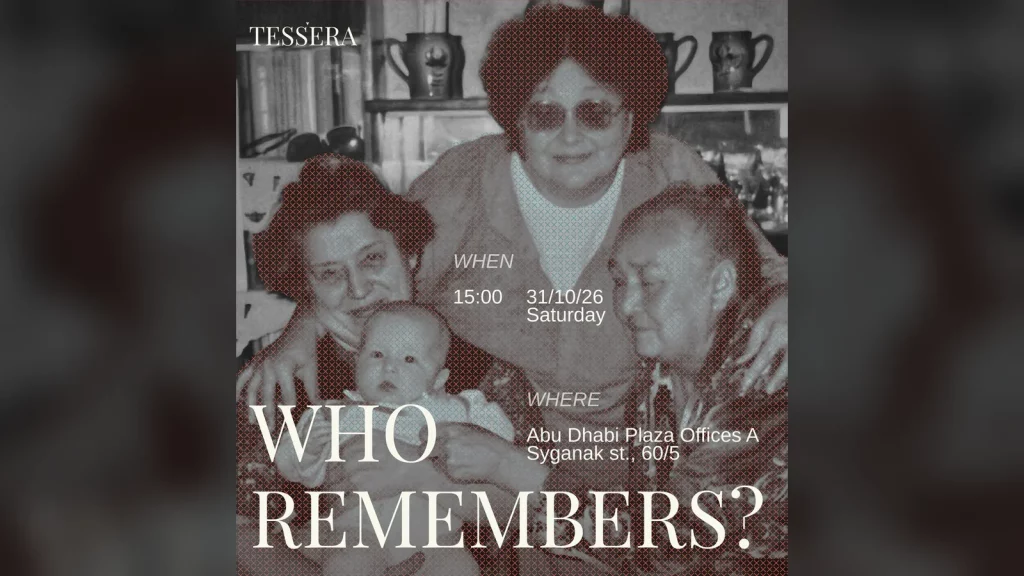
Cultural accelerator TESSERA is opening its own exhibition space at Abu Dhabi Plaza in Astana. Its first exhibition, “Who Remembers?”, opens to the public on November 1, featuring works by 17 women artists from Kazakhstan, Iran, Belarus and the United Kingdom (TESSERA). It explores women’s lives and how family memory lives on in objects, crafts and everyday gestures.
What happened
TESSERA selected the artists for its first exhibition through an open call. Most of the participants live and work in Kazakhstan. The exhibition will bring together painting, photography, ceramics, felt, textiles and jewellery.
The title “Who Remembers?” brings together two questions: what does a woman remember, and who remembers her? The artists turn to the stories of mothers, grandmothers and great-grandmothers. They look for traces of these experiences in embroidery, clothing, decorative patterns and family rituals.
One of the works is a necklace by Zhanna Asanova made from embroidery by three generations of a family from Gilgit-Baltistan in Pakistan. It brings together the work of a grandmother, mother and daughter. The necklace’s vertical and horizontal lines follow the structure of a shezhire — a family tree, traced here through the female line.
What it means
The exhibition shows different ways to preserve a woman’s story, even when few of her belongings remain. Ghazal Abbasi, from Shiraz, photographs herself in her grandmother’s dress. After the death of her husband, who used to give her brightly coloured outfits, her grandmother stopped wearing colour.
Shakir Sheker reconstructs a chapan from the Russian Museum of Ethnography’s collection, retaining its cut and decorative patterns. Transparent oilcloth and coloured plastic bags replace the fabric. The work is dedicated to the artist’s great-grandmother, a dowry craftswoman from western Kazakhstan: the family has kept none of the things she made.
“Almost every woman has a grandmother who left behind three stories and one photograph. This exhibition is about how women leave behind far more than that; we’re just not used to noticing it,” says artist and TESSERA co-founder Anastasia Zharko.
When the exhibition opens
An invitation-only opening will take place on October 31. The exhibition opens to the public on November 1. The space is at Abu Dhabi Plaza on Syganak Street in Astana.
TESSERA was founded by Anastasia Zharko and designer Dina Akhilbekova. The accelerator works with artists and creative industries across Central Asia, bringing together art, education, research and international collaboration.
Its first public project was an art pavilion at AQBOZAT OPEN AIR FEST in June 2026. It hosted an exhibition of Central Asian artists and workshops open to the public. “Who Remembers?” will be TESSERA’s first exhibition in its own space.