Illustration: AI
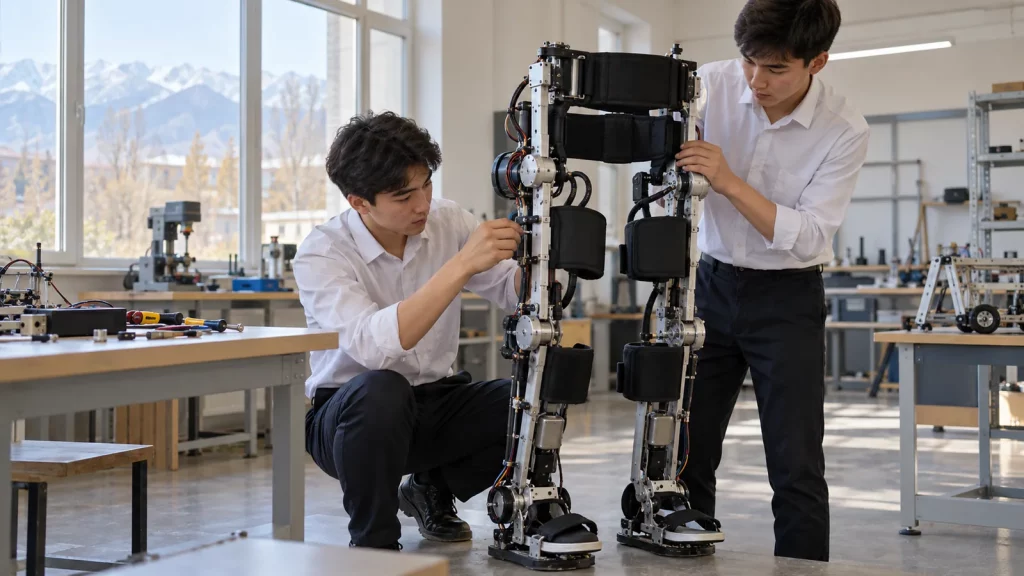
Nursultan Serikov and Sheikhislam Nurmukhambetuly, students at Nazarbayev Intellectual School in Taraz, are developing the ORKEN exoskeleton to help restore leg movement. They plan to sell the device for 250 thousand tenge, though sales have yet to begin (er10.kz). The team wants to help patients continue their exercises at home after a course at a rehabilitation centre.
What happened
The idea came after Sheikhislam’s grandfather fell ill. Sessions at a rehabilitation centre helped him, but at home he had to exercise without ongoing support and supervision. His experience prompted the students to create a device for rehabilitation at home.
The team built the first prototype with their own money, spending around 30–40 thousand tenge. Nursultan said it helped them test the basic principle behind a soft exoskeleton. The prototype was tested at rehabilitation centres in Almaty and Taraz, and the team is building a second version in the school laboratory.
How ORKEN works
The device uses fabric, straps and cables. Its motors and electronics sit in a small waist bag, with cables transferring force to the leg. According to the developers, sensors track muscle tension and the angle of the leg so the device can assist the wearer as they move.
Nursultan handles the software and works with rehabilitation centres. Sheikhislam is responsible for the design, electronics and assembly. Nursultan said this division of work allows them to refine the prototype while preparing tests with their partners.
What it means for patients
ORKEN is one of the projects in rehabilitation technology. The team is focusing on patients and their families who need to continue rehabilitation after completing a course at a centre. Alongside sales, the founders are considering renting out the device so patients would not have to buy it straight away.
“We plan to sell ORKEN for 250 thousand tenge,” Nursultan said. That is a target price for the future: the developers are still refining the technology. One task is to make the device easy for patients to put on by themselves at home.
The team sees rehabilitation centres as its main partners. The founders plan to work through doctors to introduce patients to ORKEN and offer it as a way to continue exercising after their course.
What the team plans next
The project is being developed in the NIS incubator. Nursultan said the team is adding an app with exercises and a feature that checks how they are performed. The app already has an AI assistant—a chat where patients can ask questions.
Nursultan said the next steps are to register copyright and obtain a patent. After finishing school, both founders intend to go to university and continue working on ORKEN. Nursultan wants to study business or economics, while Sheikhislam plans to study electrical engineering.