
Illustration: AI
The government has yet to back a single 2–3% rate for Kazakhstan’s simplified tax regime. The base rate is 4%, and maslikhats can set it anywhere from 2% to 6% (vlast.kz). Deputy Prime Minister and Minister of National Economy Serik Zhumangarin outlined the government’s position in response to a parliamentary inquiry from the Ak Zhol party.
What is the simplified tax rate in 2026?
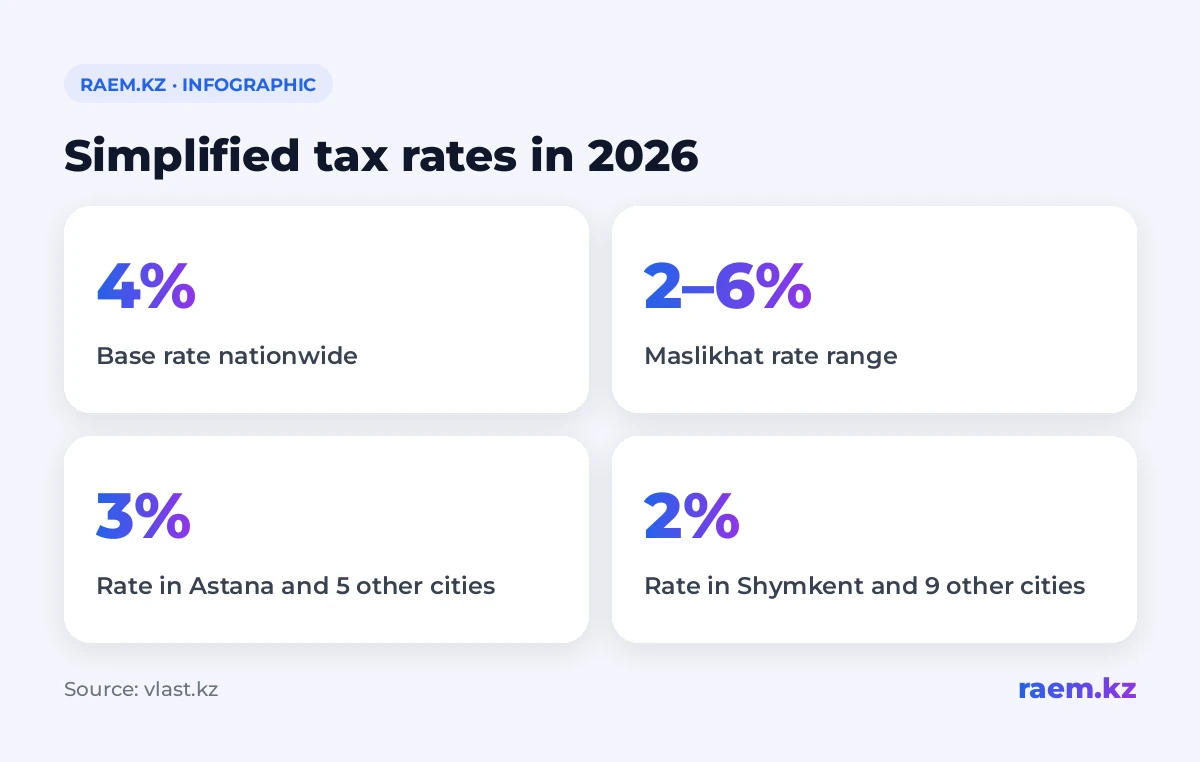
Under the new Tax Code, the base rate for the special tax regime based on a simplified declaration is 4%. It is commonly known as the simplified tax regime. Maslikhats — local representative bodies — can adjust the rate within a range of 2% to 6%.
The 4% base rate does not mean businesses pay the same tax rate nationwide. The cities listed by the government have set rates of either 2% or 3% for 2026.
What rates have Kazakhstan’s cities set?
Zhumangarin’s response lists the following rates for 2026:
- 3% — Astana, Almaty, Aktobe, Pavlodar, Petropavlovsk and Uralsk.
- 2% — Shymkent, Karaganda, Atyrau, Kyzylorda, Taraz, Taldykorgan, Turkestan, Ust-Kamenogorsk, Semey and Konayev.
The lawmakers proposed setting a single nationwide rate of 2–3% and removing maslikhats’ power to adjust it. This would change the current system, in which rates are set locally within the permitted range.
Why has the government not backed a single rate?
The government believes the proposal needs further assessment. Its effects on local budgets, business conditions and the tax burden on different categories of entrepreneurs need to be studied.
A separate argument concerns maslikhats’ powers. Zhumangarin’s position is that removing these powers would limit the ability to take regional circumstances into account when setting the rate.
“The current mechanism already allows rates to be set below the base level,” the deputy prime minister explained in his written response to lawmakers.
How does the deputy prime minister assess businesses moving to pay less tax?
The deputy prime minister says there are currently no signs of businesses re-registering in other regions on a large scale. Zhumangarin cites income figures reported by taxpayers on Form 910.00 for the first half of 2026.
According to the figures he provided, reported income rose:
- in Astana — by 23.2%;
- in Karaganda Region — by 23%;
- in Almaty — by 18.3%.
The deputy prime minister also pointed to the experience with the retail tax before 2026. In 2024, the rate was 4% in Almaty, 3% in Astana and 2% in Karaganda Region. He said no large-scale movement of businesses out of Almaty was recorded at the time.
When could the simplified tax rules be reviewed?
The Ministry of National Economy proposes continuing to monitor how the regime works in practice. It then considers it necessary to assess how differences in rates affect small and medium-sized businesses.
The government may consider changes based on that analysis. For now, the proposal to introduce a single 2–3% rate and remove maslikhats’ power to adjust it has not won support.
In plain terms
For businesses using the simplified tax regime, the current rules remain in place: a 4% base rate that can be adjusted locally to between 2% and 6%. If you use this regime, follow the rate set by your maslikhat. The lawmakers’ proposal does not change it for now.