Illustration: AI
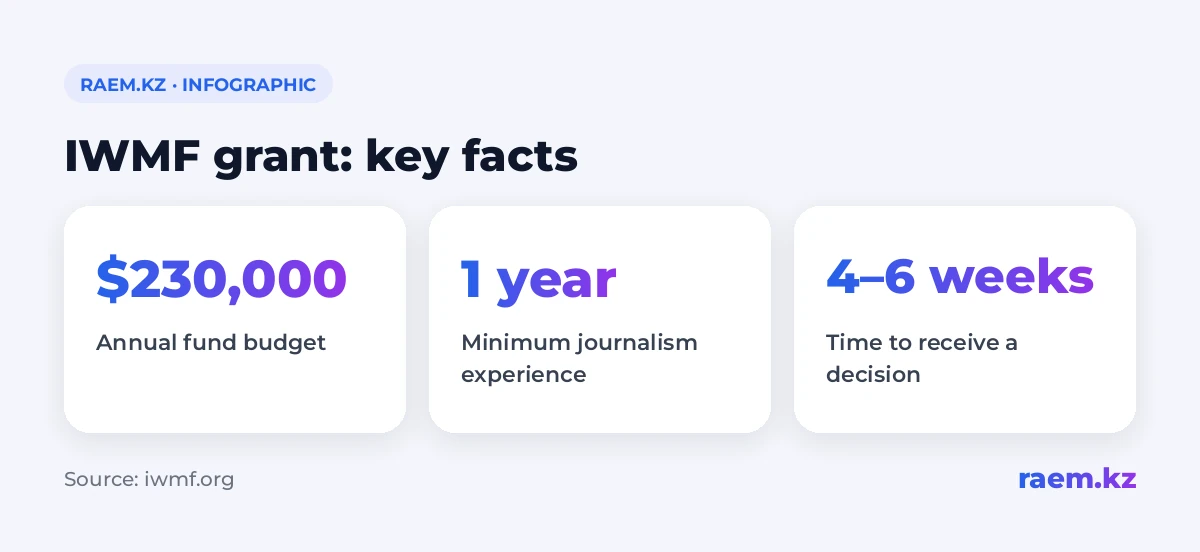
The International Women’s Media Foundation (IWMF) provides $230,000 a year for journalism projects through its Howard G. Buffett Fund. Professional women and nonbinary journalists from around the world can apply individually or as a team. There is no fixed deadline: applications are accepted on a rolling basis (iwmf.org).
Who can apply
Applicants must work full-time as professional journalists and have at least one year of experience. They must also have work published in outlets other than student media.
The programme is open to women and nonbinary people. Teams must meet two additional conditions: the team leader must meet this requirement, and at least half of the members must be women or nonbinary journalists.
How much funding is available and what it covers
The fund’s total annual budget is $230,000. This covers all successful applications, with no set limit on individual grants. There is no fixed number of recipients either: the fund awards support within its annual budget.
The fund supports ambitious journalism projects and coverage of underreported issues of global importance. Applicants are encouraged to plan where and how their completed work will be published.
The budget, project scope and timeline are then set out in a grant agreement. Recipients must sign this document to accept the funding.
How to apply
- Read about IWMF’s mission, the fund’s areas of focus and the programme’s frequently asked questions. This will help you assess how well your project fits its goals.
- Develop your story idea, publication plan and intended outlet. You can also prepare a letter of support for the project if you wish.
- Follow the link from the IWMF website to the Submittable application platform.
- Create an account: you will need a username and password to get started.
- Complete the application in English. The system lets you save your work and return to it before submitting.
- Submit your completed application and check your email: you should receive a confirmation message after submission.
What documents to prepare
Application information must be provided in English. You may attach a letter of support for the project, but it is not listed as a requirement.
It is worth developing a publication plan before you start filling out the form. This will help connect your journalism idea to a concrete outcome: the work you intend to publish.
Once approved, you will need a signed grant agreement. It sets out the project, budget and work schedule, so review these terms carefully before signing.
Timelines and selection process
Recipients are selected by a vote of a committee of experienced working journalists and editors. The fund notifies applicants of its decision approximately four to six weeks after submission.
The deadline for completing the work is agreed individually with each recipient. Most projects run for six months to a year. Funds are transferred after recipients have been selected.
During the project, recipients must report periodically to IWMF. The format for these brief reports is agreed with programme staff. Intellectual property rights to the work remain with applicants and grant recipients throughout the collaboration.
What to check before submitting
Check the eligibility requirements: full-time professional work in journalism, one year of experience and publication in outlets other than student media. For teams, also check the membership and the proposed leader’s eligibility. Failure to meet these requirements means the application does not meet the programme’s criteria.
Do not expect detailed feedback on a rejection: because of the high volume of applications, the fund can provide only limited feedback. Before submitting, it is therefore worth checking your project against IWMF’s mission once more and reviewing your publication plan.
For urgent community projects, the directory includes a separate programme: Urgent Action Fund grants. It has its own application requirements.
The next step in applying to IWMF is to prepare a publication plan and complete the English-language form in Submittable.