Illustration: AI
Refinancing can lower the payment on an existing loan: a new loan pays off the old one. But a smaller payment can increase the total cost of borrowing if you extend the repayment period. Finance expert Aigerim Ilyasova, who holds a Candidate of Economic Sciences degree, explained which terms to compare before switching loans (kursiv.media).
How refinancing lowers your payment
When refinancing, a borrower takes out a new loan and uses it to pay off the existing one. The aim is to get better terms. But judging the savings by the monthly payment alone is risky: it depends on both the interest rate and the repayment period.
Start by deciding what you want to achieve. Easing the pressure on your household budget and reducing the total cost of borrowing can lead to different outcomes. A longer term means smaller monthly payments, but you will be paying interest for longer.
Which interest rate to compare before taking out a new loan
Ilyasova recommends looking at the annual effective interest rate, known as GESV. It helps you assess the cost of a loan, including fees and loan-related payments. The nominal interest rate alone is not enough to compare offers.
“For the borrower, the actual cost of the loan is higher than the nominal rate,” the finance expert notes.
Which additional charges to check
According to Ilyasova, some banks offer additional services that are not included in the GESV calculation. She cites “financial guarantee” and “insurance coverage” as possible names for these services. These costs also need to be factored in when choosing a new loan.
Before refinancing, ask for details of all payments included in the offer. Compare the full cost with the amount you still have to pay on your current loan. This will show whether you still save money after the additional services are included.
When a smaller payment increases the total cost
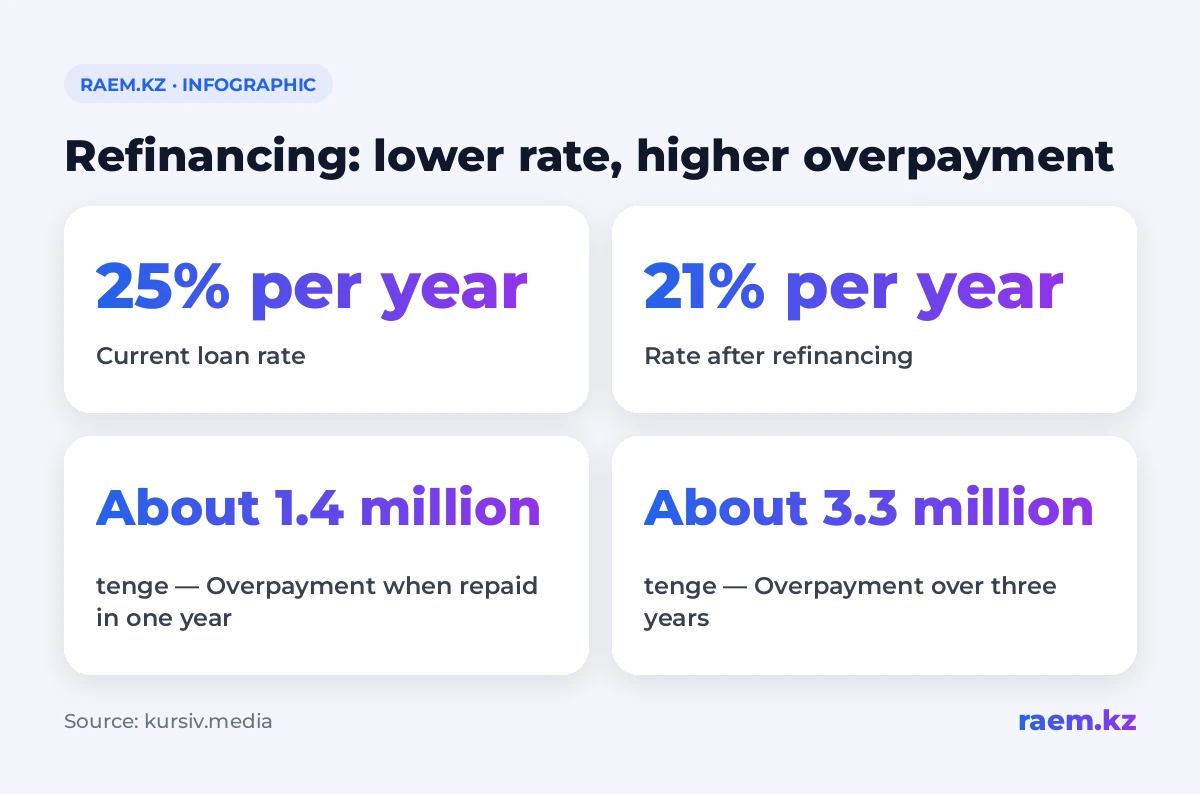
Ilyasova gives the example of a 10 million tenge loan at 25% a year, with one year left until it is fully repaid. According to her calculations, the remaining borrowing cost would be about 1.4 million tenge.
If this debt is refinanced at 21% but the term is extended to three years, the borrowing cost rises to about 3.3 million tenge. The monthly payment, meanwhile, falls by more than half.
| Terms in the example | Keep the existing loan | Refinance |
|---|---|---|
| Interest rate | 25% a year | 21% a year |
| Time until repayment | One year | Three years |
| Borrowing cost calculated by the expert | About 1.4 million tenge | About 3.3 million tenge |
Other ways to reduce the cost of borrowing
Another option is to repay the loan early, either in full or in part. This reduces the cost of borrowing. Check the terms with your bank.
If your aim is to pay less each month, check separately how much the total borrowing cost will increase.