Photo: NeuroGlove
Alua Nauryzbay, Aruzhan Azimbay and Aidana Ismail, 10th-grade students at Nazarbayev Intellectual School in Shymkent, are developing NeuroGlove, a robotic glove designed to read brain signals and help people move their fingers after a stroke. The team estimates that the main components for one prototype cost around 100–150 thousand tenge. They say they had to rebuild almost the entire mechanical system over six months of work. They now have a working experimental prototype and need funding and medical partners to continue development.
The idea grew out of a personal experience. “In 2022, Aruzhan’s grandmother had a stroke and, sadly, passed away,” the team writes. They say this motivated Aruzhan to study stroke in greater depth, and the girls then began looking for ways to help people regain movement. That led to the idea of a glove that could use EEG to detect a person’s intention to move and turn it into mechanical movement.
Alua Nauryzbay, Aruzhan Azimbay, Aidana Ismail: from robotics to NeuroGlove
The team says all three members are in the 10th grade at Shymkent’s NIS. The project is supervised by Zh. Sh. Baidildayeva. The girls study the science behind NeuroGlove, develop the hardware and write the software themselves.
Before working on the glove, they competed in the international FIRST Tech Challenge robotics competition. The team says they reached the final at the Central Asian championship and qualified for the world stage, and took second place at an international round in Turkey, representing Kazakhstan. Another win was the ENACTUS 2026 national entrepreneurship cup. The students write that robotics gave them practical skills in programming, mechanical design, electronics and collaborative development.
“We develop the project ourselves, from researching the science behind it to building the hardware and software,” the team says. The developers also consult scientific mentors and specialists. They discuss the device’s technical capabilities and directions for further work.
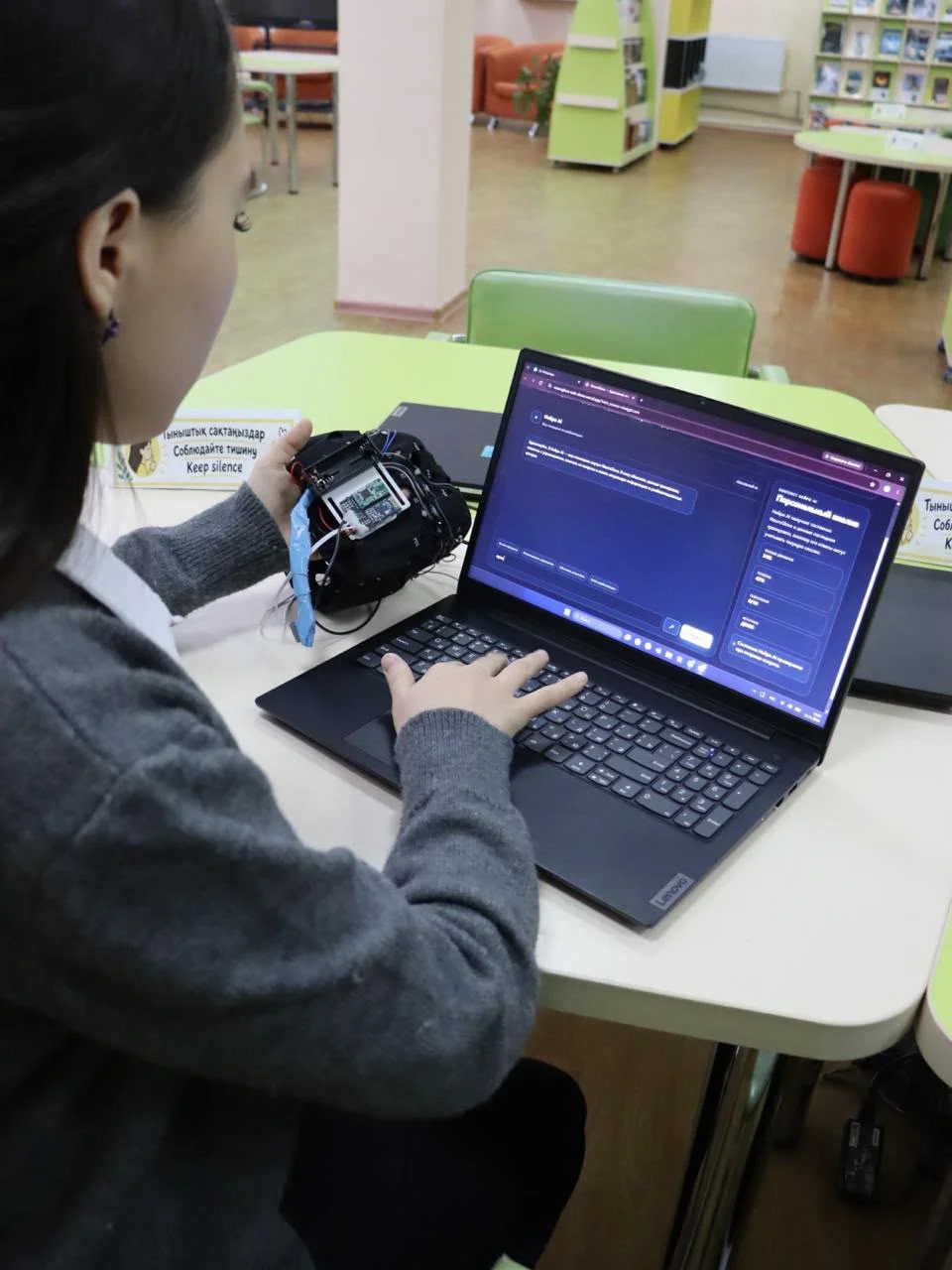
A girl holding an electronic glove works on a laptop in a library. · Photo: NeuroGlove
The glove receives commands through brain signals
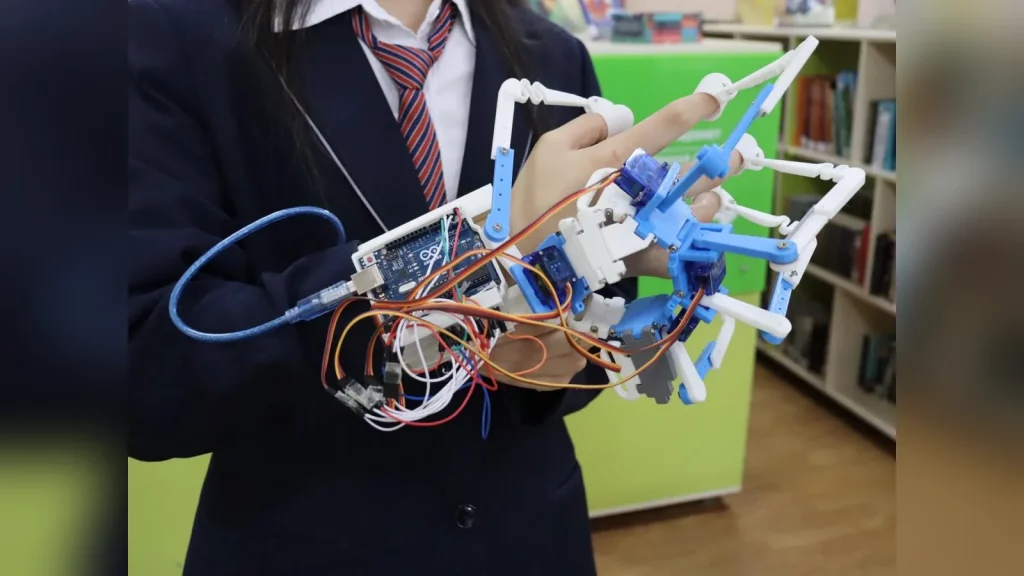
NeuroGlove uses a BCI, or brain-computer interface. The developers describe a system designed to recognise a person’s intention to move their hand. It then sends a command to a mechanism that bends or straightens the glove’s fingers.
The team says a four-channel EEG device records the brain’s electrical activity. When a person imagines a movement or tries to make it, signals in certain areas of the brain change. The recording is sent to a Raspberry Pi 4 microcomputer for preprocessing.
Next, the developers explain, artificial intelligence algorithms identify the intended movement. A command goes to an Arduino controller, which operates five servomotors. These motors bend or straighten the glove’s fingers.
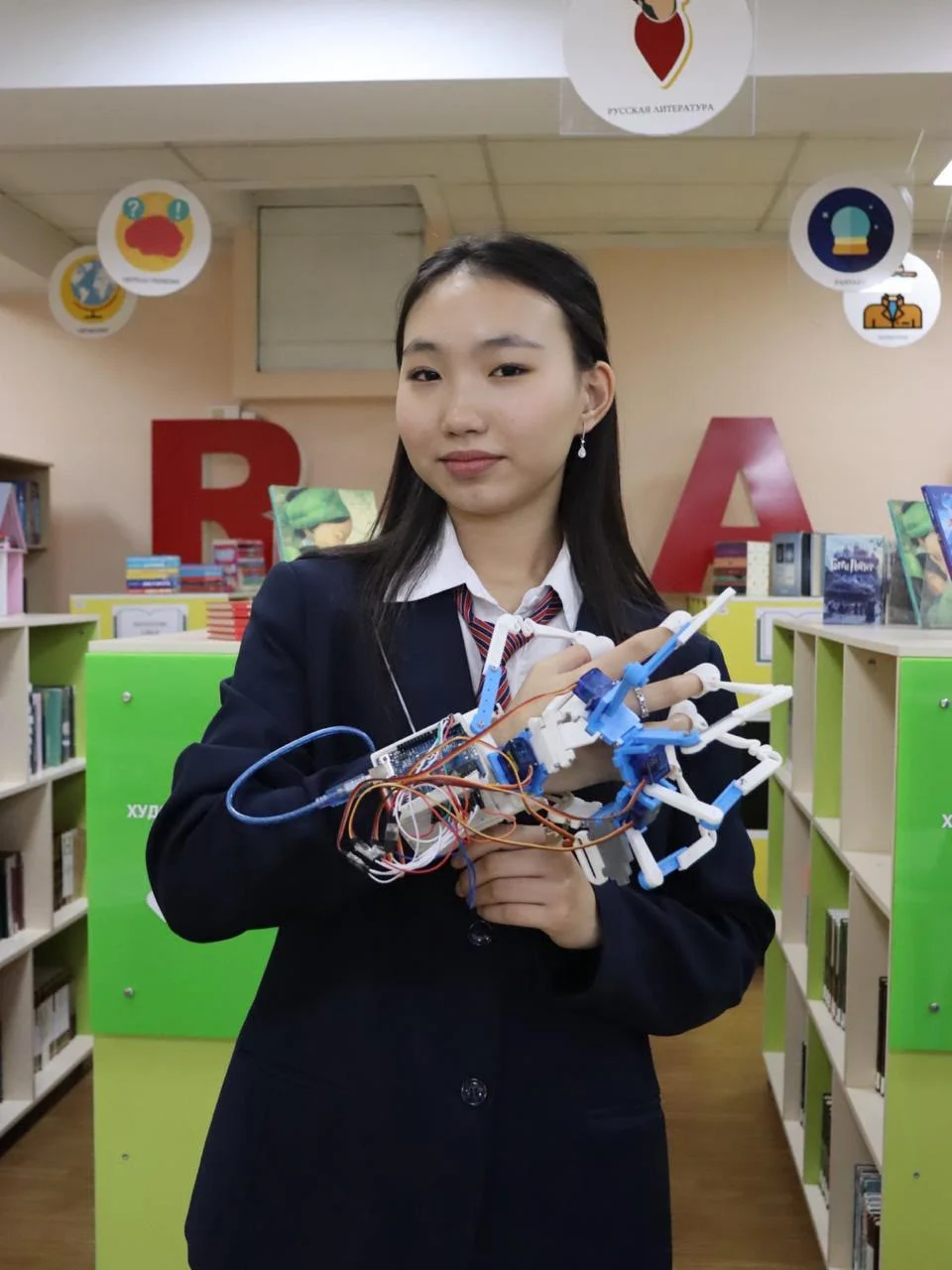
A girl in a school uniform demonstrates a robotic glove in a library. · Photo: NeuroGlove
The algorithm was trained on public datasets and the team’s own recordings
The team says it trained the AI in two stages: “First, we used publicly available EEG datasets, then added our own experimental recordings.” This combined public recordings with data the developers collected while working on NeuroGlove.
The students say they ran ten experimental sessions. These tested the quality of the brain activity recordings and the software’s ability to recognise movements.
The team says the experimental system recognises six types of movement. These include making a fist, fully opening the hand, pointing with one finger and holding up two fingers. The developers also list a thumbs-up and the “OK” gesture.
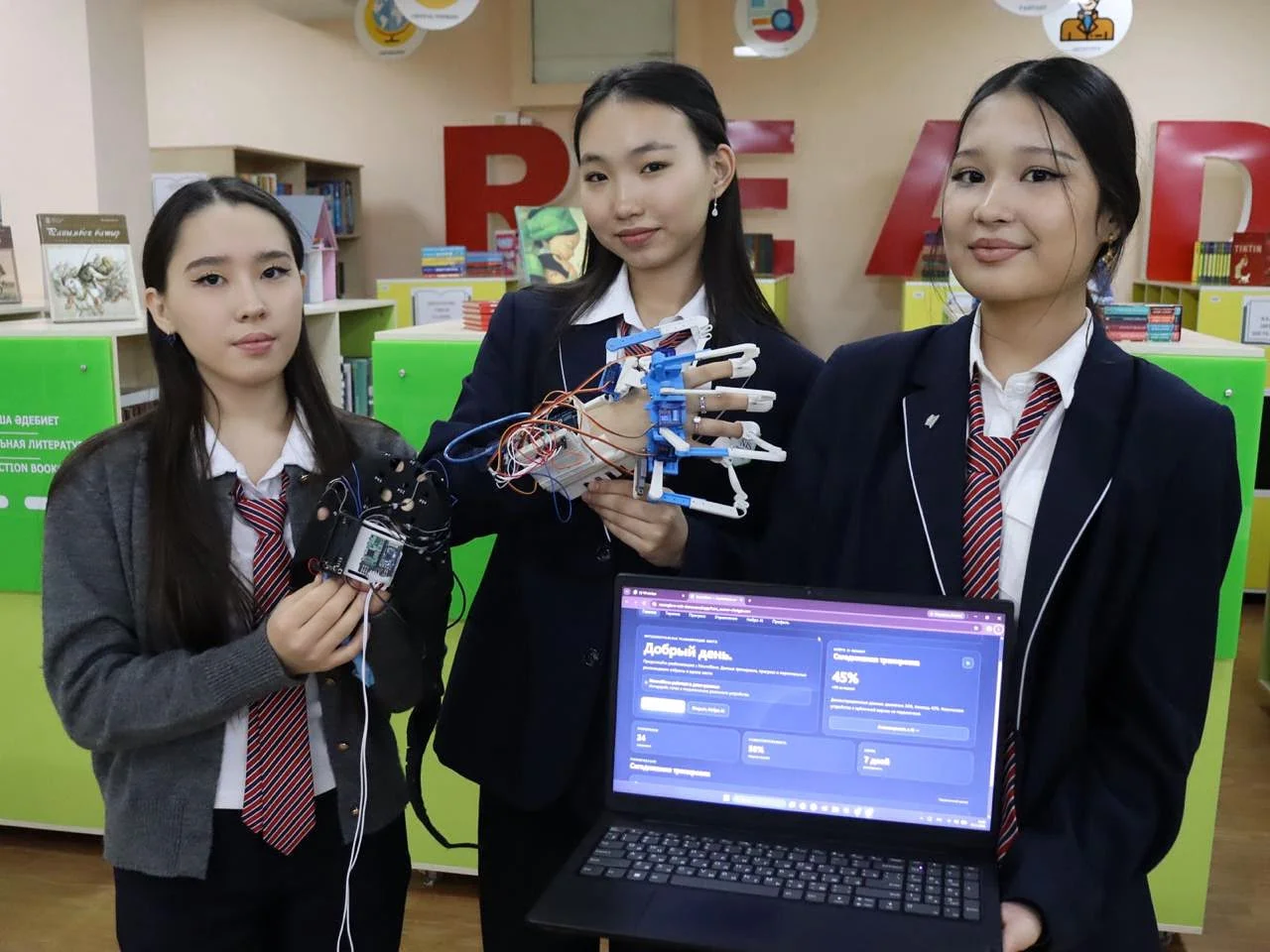
Three schoolgirls display a robotic glove, electronics and a laptop in a library. · Photo: NeuroGlove
The main components cost 100–150 thousand tenge
The team estimates that the main components for one prototype cost around 100–150 thousand tenge. That includes a four-channel EEG device, a Raspberry Pi 4, an Arduino Uno and an ESP32. The developers also count five servomotors, an MPU-6050 sensor and other electronic and mechanical components.
“We tried to use affordable components, open-source software and mechanical solutions we designed ourselves to bring down the cost of the device,” the team explains. The figure covers the main parts of the experimental prototype. The girls describe their work as a school science and engineering initiative.
The developers say they design the glove’s housing in Fusion 360 and print it on a Bambu Lab printer. They write the software in Python. Designing the mechanics themselves and choosing affordable electronics helps them keep the device’s cost down.
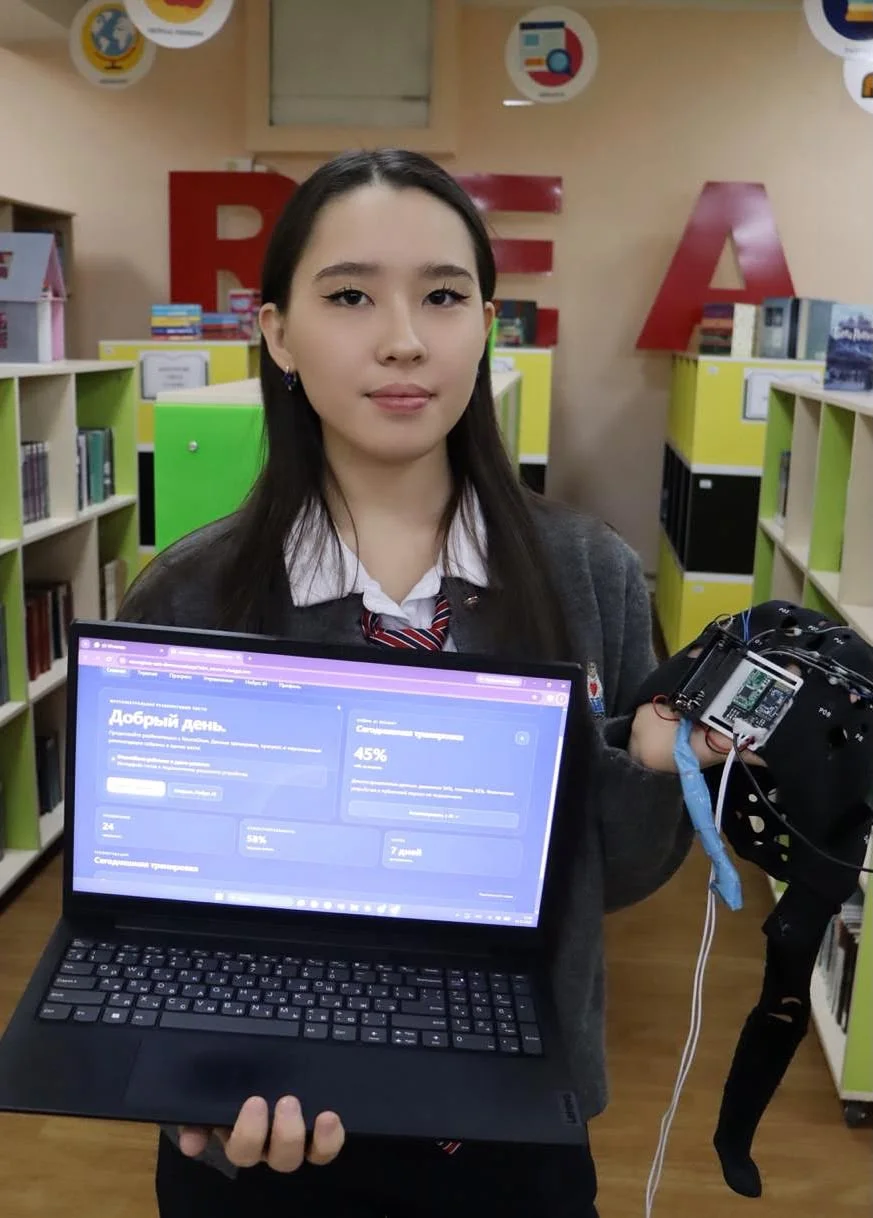
A girl holds a laptop and a glove with a circuit board and wires in a library. · Photo: NeuroGlove
The mechanical system needed an almost complete rebuild
The team says the hardest task was connecting brain signal recognition to the mechanical system. Early in development, EEG recordings were unstable, and the algorithms sometimes misidentified the intended movement. This meant several parts of NeuroGlove needed work at the same time.
The developers also had to get the boards working together. Separately, they worked on synchronising the motors and distributing power between components.
The mechanics needed changes too. The developers found that the glove’s original material was too soft to provide enough support for people with severe spasticity. In some cases, the motors were not powerful enough either.
“So we had to almost completely redesign the mechanical system and strengthen the structure,” the team says. They say there were three versions before the current prototype. The changes affected both the glove itself and its hardware design.
Alongside this, the girls worked on the software and movement recognition system. Another part of NeuroGlove is a digital rehabilitation platform. Refining the project therefore involved more than replacing the material or motors.
Doctors’ advice led to a right-hand version of the glove
The team says the prototype underwent a seven-day trial at the Victoria medical centre. The developers also spoke with specialists at CityMed. Doctors’ feedback focused on specific details of the device.
The specialists suggested revising the design and repositioning the servomotors. They also recommended adapting the glove for the right hand instead of the original left-hand version. “We took these comments on board and made the corresponding changes to the prototype,” the project members report.
The developers also describe tests involving people who had had a stroke. “The initial tests showed that the glove can help people perform hand movements,” the students write.
The girls discussed NeuroGlove’s technical features with Nazarbayev University professor Prashant Kumar Jamwal. The team says the consultations covered medical robotics and possible directions for the project’s development. Feedback from specialists helps them identify shortcomings and take account of the needs of people undergoing rehabilitation.
Further development needs components and medical partners
The students say NeuroGlove is now being developed with support from the NIS Incubator programme. The team regularly presents its progress to trackers, specialists who guide the project and offer recommendations. The developers use this feedback to refine the glove.
The team plans to use funding to build a more functional version of the device. This will need additional components. The developers want to spend some of the money on software and better processing of brain signals.
The girls are looking for partners who can help with funding. They are also open to technical assistance and advice from specialists. The team needs this support to continue working on NeuroGlove.
Working with medical organisations would allow more frequent contact with doctors and rehabilitation specialists, the developers explain. In the longer term, they want to build a more comfortable and reliable version for rehabilitation centres. “Getting feedback from people with practical experience is especially important to us,” the developers say, explaining why they continue to show the prototype to doctors and specialists.
Startup Radar: NeuroGlove
More on RAEM: Founders, Nurtai Abilgaliyev and Vyacheslav Kim.