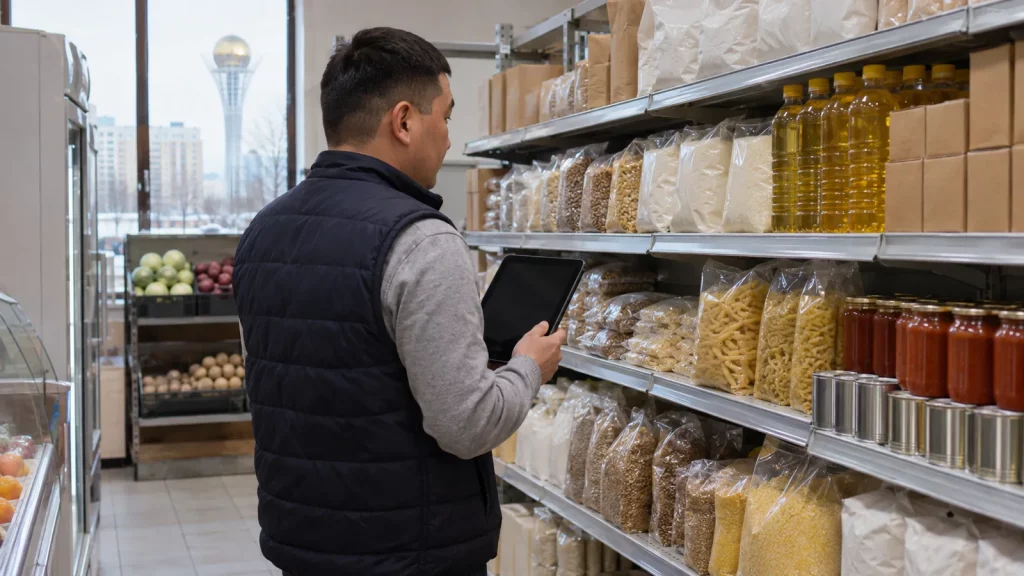
Illustration: AI
SalesBox is a distribution management system being developed by Mukhtar Leker and Almaz Kisapov. Sales representatives use it to take orders, while managers track their teams’ work and market coverage. The product grew out of EZapp, a company the partners bought in 2025 (digitalbusiness.kz).
SalesBox: What the system does and how it works
SalesBox helps distributors manage sales to stores. The system has a mobile app for sales representatives and a web interface for managers.
In the app, employees check their visit schedules, take orders and log store visits. Managers plan the work and track results. The system can connect to accounting software, particularly 1C.
SalesBox includes Census, a location analytics tool created by Almaz Kisapov. It compares the customer database with the potential market. Managers can see stores missing from the database and areas their teams do not yet cover.
Kisapov believes every unnecessary action in the app costs an employee time. Sales representatives open it many times during a shift, so the team paid close attention to the interface.
How the founders came to build SalesBox
Mukhtar Leker worked at logistics IT company Relog. He joined in sales, then became chief operating officer and later CEO. Leker says he expected to receive a stake in the company, but ownership was never legally transferred to him.
Almaz Kisapov also worked with the company. He already had Census when he approached Relog and proposed selling location analytics to its customers as an add-on to the core product. He says he presented management with a development plan for the service twice, but was turned down.
When Kisapov learned that Leker was leaving, he proposed a partnership. They knew each other’s strengths: Kisapov handled product and technology, while Leker focused on sales and business development. More entrepreneurs’ stories appear in the biographies of Kazakhstan’s founders section.
Buying EZapp and developing the product
In August 2025, the partners completed the purchase of EZapp, a developer of field sales software. Leker knew its founders from working on an integration and had heard they planned to sell. Before the deal, the partners carried out due diligence on the company.
According to the founders, EZapp had about 300 customers in seven CIS countries at the time of the purchase. The buyers acquired an operating business, the team’s expertise and an established customer base making recurring payments. Sales representatives used EZapp to take orders and manage their customer databases.
Leker put money from the sale of another business into the purchase. He says friends helped him secure additional loans; Kisapov also took out a loan.
The team initially worked on improving EZapp, but adding new features became increasingly difficult. So they built SalesBox from scratch, drawing on what they had learned. Leker admits he underestimated the complexity of the accounting: they had to recreate the pricing and discount logic, while also accounting for promotions and product statuses.
Who SalesBox serves and how the company returned to profit
The product is designed for distributors whose sales representatives visit stores and collect orders. For employees, it is a work tool on their phones; for managers, a way to plan visits and track team results.
After the purchase, the founders hired developers and expanded the sales team. Leker says costs rose and the business began losing money. To return to profit, the company needed to increase revenue.
A customer from Kyrgyzstan helped. According to the founders, after a three-month pilot, the customer brought in ten distributors. Payments from this customer covered expenses, and the company became profitable again about six months after the purchase.
According to the founders, the time needed to roll out the system for a team of 60–100 sales representatives fell from about two months to three weeks. Some modifications began taking a day instead of a week. These are the company’s estimates.
Who created SalesBox
Before working in IT, Mukhtar Leker launched several ventures, including a chess school, an English language school and a coffee shop. At SalesBox, he handles sales, major deals and business development.
Almaz Kisapov created Census in 2019. It began as a prototype map showing active retail outlets, along with new stores and those that had closed. At SalesBox, he handles product and development.
Telegram orders and shelf analysis
The team is developing a way to place orders through Telegram. Kisapov’s idea is to let stores submit repeat orders themselves, freeing sales representatives to find new outlets or work with customers.
Another area of development is computer vision for analysing shelf photos. The team wants to check product availability and how goods are displayed. Kisapov says they are developing a Go-to-Market tool intended to plan sales representatives’ visits and help allocate territories and workloads among employees.
“If a store orders similar products every week, why visit just to take the order?” Kisapov says. These are the kinds of repetitive tasks the team wants to reduce.
Startup Radar: SalesBox