
Photo: Tumisu / Pixabay
The National Bank of Kazakhstan will not introduce a cap on debt at eight times a borrower’s annual income in 2027. The limit on monthly payments will remain in place, Kursiv reports, citing a representative of the regulator (kz.kursiv.media).
Consumer lending growth slowed after earlier measures
The National Bank had planned to introduce an additional restriction using a debt-to-income ratio, or DTI. It measures a person’s total debt against their annual income.
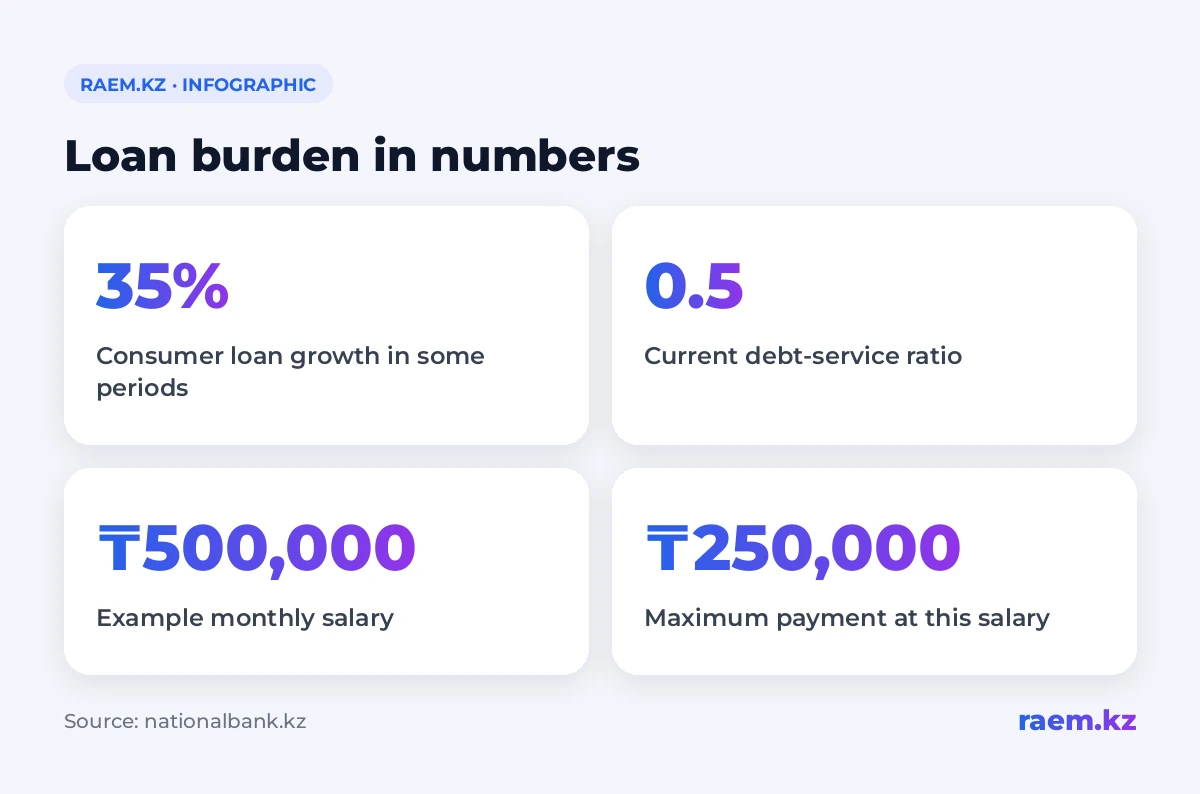
Olzhas Kubenbayev, director of the National Bank’s financial stability and research department, said the decision came as lending slowed. He said consumer loans had grown by 35% in some periods, a pace that worried the regulator.
Earlier measures helped contain that growth, Kubenbayev said. “We can now see that lending has slowed and growth in the loan portfolio itself has returned to normal,” he explained.
The National Bank considered it premature to introduce another restriction that could make loans harder to obtain. The regulator had also previously proposed measures to make installment plan terms more transparent.
The cap was planned for January 1, 2027
The National Bank introduced the DTI into its regulatory framework in August 2024. The measure was in a monitoring period until the regulator published its announcement on May 20, 2026 (nationalbank.kz).
At the time, the National Bank planned to cap total debt at eight times a borrower’s annual income from January 1, 2027. A draft resolution was prepared for that purpose, LS reported (lsm.kz).
For example, a salary of 500,000 tenge a month would amount to 6 million tenge a year. The original proposal set the cap at eight times that annual income. The cap will not be introduced in 2027.
Loan payments are capped at half of income
Kazakhstan already uses another measure, the debt service ratio, or DSR. It shows how much of a borrower’s monthly income goes toward loan repayments.
Under the standard ratio of 0.5, payments on all loans must not exceed half of income. Someone earning 500,000 tenge can put no more than 250,000 tenge a month toward loan repayments.
That restriction remains in place. Banks’ requirements for borrowers’ ability to repay also continue to apply.
The DTI would measure debt against annual income instead. Kubenbayev said the two measures complement each other: monthly payments may appear low even when total debt remains high.
The DTI calculation includes part of the credit limit
The DTI calculation takes into account outstanding loans and microloans, overdue payments and the portion of a credit limit already used. It also includes 10% of the unused portion of the limit (prg.kz).
Total annual income is calculated using salary and other income from the six months before the borrower applies. The average monthly amount is multiplied by 12.
This gives the regulator a figure to compare with total debt. The DTI will continue to be used to monitor the market, although no mandatory cap will be introduced in 2027.
The DTI was intended for mortgages and car loans
Kubenbayev said the highest debt burden has historically been in consumer lending. The DTI, however, was intended primarily to assess long-term loans, including mortgages and car loans.
A large debt can be spread over a long period. Monthly payments may then fit within the existing limit even though total debt is several times the borrower’s annual earnings.
These are the situations the National Bank had hoped to identify using the DTI. Kubenbayev said manageable payments on long-term loans can coexist with a high total debt burden.
The National Bank will keep collecting loan data
The DTI is not being abandoned entirely. The National Bank receives data on specific categories of loans, including consumer loans, secured loans and car loans.
Problems emerged during the collection of statistics. Kubenbayev said the regulator is working with market participants to fix them.
The National Bank had previously reserved the right to change the overall DTI cap if risks in retail lending increased. The regulator had also considered different caps for different types of loans.
The regulator’s other research includes a competition on wealth distribution in Kazakhstan.