
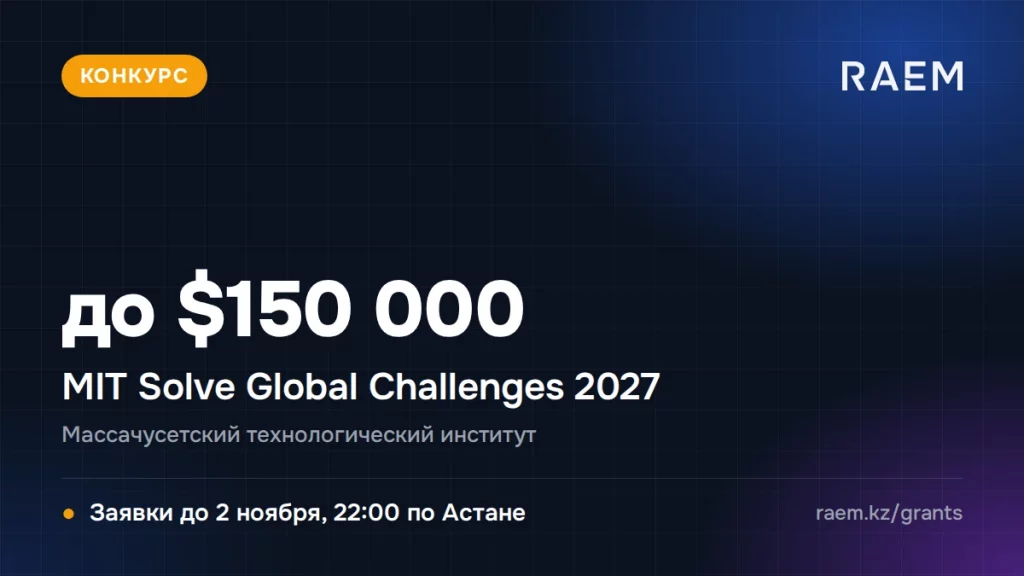
MIT Solve, a program of the Massachusetts Institute of Technology, has opened applications for its 2027 Global Challenges. It selects technology solutions addressing climate, economic, health and education challenges. Every selected team receives a $10,000 grant from Solve, and the total selection-stage prize pool exceeds $1 million.
Applications close on November 2, 2026, at noon US Eastern Time. In Kazakhstan, that is November 2 at 10:00 p.m. Astana time.
Which challenges are open
Applications opened on September 22. Four challenges are suitable for teams from Kazakhstan:
- Global Climate Challenge: adaptation to warming and emissions reduction, including low-carbon cities, construction and mobility, protection from heat, floods, drought and fires, agrifood systems, oceans and coastal areas.
- Global Economic Prosperity Challenge: people’s financial resilience, access to quality jobs, particularly for young people, and affordable housing resilient to climate risks.
- Global Health Challenge: continuity of care during outbreaks, conflicts and funding disruption, prevention of noncommunicable diseases, mental health, elderly care and primary care for underserved communities.
- Global Learning Challenge: closing education gaps. Organizers seek proven tools for teachers, solutions for crisis-affected and resource-constrained areas, assistive and multilingual technologies, diagnostics and early detection of learning challenges.
The fifth, the Indigenous Communities Fellowship, is limited to the United States and Canada.
What participants receive
Only one amount is guaranteed: a $10,000 grant for each selected team. Solve says teams receive about $40,000 on average after selection. This is an average: the additional funding comes from partner prizes, which not every team receives.
The winner support program lasts nine months. It includes workshops on marketing, PR, business models and impact measurement, leadership coaching, free access to resources such as software licenses and legal services, introductions to investors and partners, media exposure and conference appearances. Organizers estimate a total commitment of around 25 hours.
Two in-person events are scheduled: four days of orientation in Cambridge, Massachusetts, in April, and four days at the Solve Challenge Finals in New York in September 2027. The terms do not specify who pays for travel and accommodation. They also contain no statement on taking company equity.
Partner prizes
- The Patrick J. McGovern Foundation’s AI for Humanity Prize: up to $150,000 to at least one team using AI, machine learning or data analysis.
- Seeding the Future Prize: $150,000 to at least one team working on climate-resilient food systems.
- Crescent Enterprises AI for Social Innovation Prize: up to $100,000, for a maximum of four teams.
- E Ink Innovation Prize: $100,000 to one team, covering sustainability, education and cross-cultural understanding.
- Prince Albert II of Monaco Foundation Ocean Innovation Prize: up to $100,000 to one team.
- Schmidt Marine Wavemaker’s Prize: up to $100,000 to one team with marine technology ready to scale.
- Citizens Workforce Innovation Prize: $100,000, limited to US teams.
For the Collegium Prize for Innovation, Morgridge Family Foundation Innovation Prize and Philips Foundation Social Impact Award, organizers currently say details will follow.
Who the program is for
Solutions must be technology-based, but technology is defined broadly: apps, SMS services, software, AI, robots, drones, blockchain and VR. Both for-profit and nonprofit projects are accepted.
An idea alone is insufficient. The global challenges consider prototype, pilot, growth and scale stages. Concept-stage projects are accepted only by the Indigenous Communities Fellowship. A prototype-stage startup may have no investment, while a scaling commercial company would typically already have a Series A round.
The global challenge terms do not impose country restrictions. Solve has received applications from more than 190 countries over its history. Teams can enter multiple challenges. Previous winners can apply again, but only with a new solution. Challenge pages do not specify a separate language requirement, although the website and descriptions are in English.
How selection works
Applications are first reviewed by Solve staff and its community, then assessed by experts, with the final decision made by the challenge leadership group. Criteria include alignment, potential impact, feasibility, innovation, user-centered design, scalability and partnership potential. Finalists also undergo technical feasibility assessment.
Finalists will be announced in February 2027. They will deliver an online pitch and answer jury questions, after which the winning cohort is formed. Organizers do not specify how many teams will be selected or the exact results announcement date.
How to apply
Choose a challenge at solve.mit.edu/challenges, register on the Solve platform and complete the application before the deadline. The official website does not mention Central Asian solutions among past Solve winners.
Program profile in RAEM’s grants directory
Terms checked on September 26, 2026.