

In September 2026, designer Ilya Birman published a case study of the Jetem Taxi app. His website said the new taxi service was preparing to launch in Almaty. The news spread on social media, but founder Baur Rustemov soon clarified that Jetem would not launch and work on the service had stopped.
By then, the team had developed apps and an internal management system, automated its fleet, bought 90 Hongqi E-QM5 electric cars and created a car-sharing service for drivers. The passenger app had around a hundred designed screens, covering everything from a normal booking to changing the destination during a ride (ilyabirman.ru).
The problem was not the product. Jetem could not raise the money needed to expand its fleet to 500 vehicles.
The story illustrates why launching a taxi service is harder than building an app, buying cars and hiring drivers. A service needs enough bookings and enough vehicles simultaneously. Otherwise passengers wait too long, drivers sit idle and the economics stop working.
Jetem Had a Product, but Not Yet a Market
Jetem planned to launch in Almaty in 2023 as a business-class electric taxi service. Every vehicle would be a black Hongqi E-QM5. The company could control drivers, cars, fares and ride quality itself.
For passengers, that model is clearer than a conventional aggregator: they know what car will arrive, the condition of its interior and the driver’s service standards.
For the company, owning the fleet changes the entire economics.
Yandex Go and inDrive primarily connect passengers with drivers and fleet operators. Aggregators do not need to buy thousands of cars themselves. If demand falls, vehicle owners bear most of the idle-time risk.
For Jetem, every idle car meant tied-up capital. Beyond app development and passenger acquisition came vehicle purchases, insurance, repairs, charging, cleaning, storage and driver-shift management.
A Hongqi E-QM5 currently costs around KZT 7.5 million in Kazakhstan (kursiv.media). Using that solely as a benchmark, 500 cars would cost around KZT 3.75 billion. Expanding from the existing 90 to 500 would require another roughly KZT 3 billion.
This is not Jetem’s budget: procurement prices in 2023 may have differed. The calculation indicates the scale of investment, excluding charging infrastructure, maintenance, team salaries, driver subsidies, passenger discounts and working capital for the first months.
Five hundred vehicles was therefore more than a round-number target. The team probably considered it the minimum for acceptable pickup times and driver utilisation.
Yandex’s Advantage Begins With Scale
Kazakhstan’s Agency for Protection and Development of Competition explicitly classifies taxi-aggregator markets as having strong network effects. More drivers mean faster pickups; more passengers mean shorter waits for drivers between bookings (gov.kz).
The cycle reinforces itself. A large service attracts drivers with bookings. More drivers shorten pickup times. Faster pickups attract passengers, generating still more bookings.
A new entrant starts from the opposite position. Few bookings make it unattractive for drivers to stay online. Few cars mean longer passenger waits and a return to familiar services.
The size of Yandex’s lead depends on the measure. In a 2024 survey, 59.2% of taxi users named it their main service, up from 48.6% a year earlier. inDrive’s share fell from 23.9% to 18.9% (kursiv.media).
In March 2025, an antitrust-agency representative estimated Yandex Taxi’s share at around 90% of the aggregator market (tengrinews.kz). These figures cannot be compared directly: one is a user survey and the other an estimate of a particular segment. Both nevertheless suggest a widening gap.
Yandex also has a technological advantage. Its maps, traffic data, millions of past journeys and dispatch algorithms help estimate fares and pickup times accurately. Competitors must build that infrastructure or buy it elsewhere.
China’s DiDi operated in Kazakhstan for around eighteen months before leaving in 2022. Bolt attempted launches in Astana and Almaty, but currently offers no taxi bookings. Regional services remain active without reaching comparable national scale (forbes.kz).
Green SM Bought Itself a Chance to Try
Three years after Jetem’s planned launch, a service with an almost identical model arrived in Almaty.
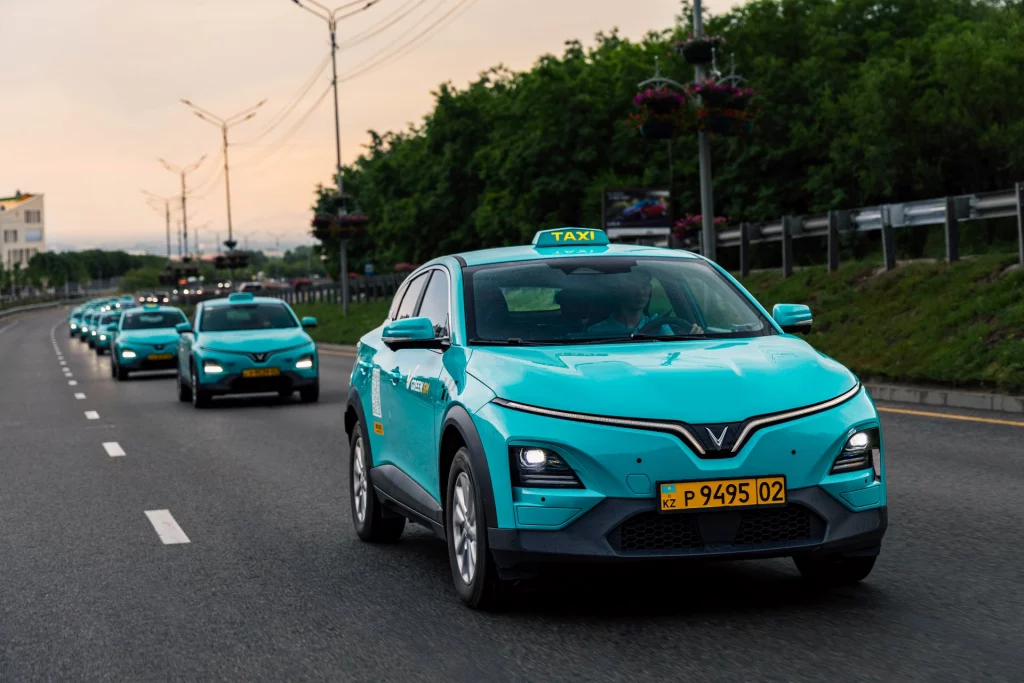
On 23 June 2026, Vietnam’s Green SM launched electric taxis using VinFast VF 6 vehicles. Drivers’ personal cars are not accepted. An affiliated entity owns the fleet, and drivers rent vehicles to join the platform.
Green SM had around 500 cars at launch, with only part of the fleet operating. Its Kazakhstan head later said around 900 vehicles had arrived. He estimated that sustainable operating efficiency required at least 1,000 electric cars (kursiv.media).
That figure helps explain Jetem’s story. The Kazakhstani team sought funding for 500 cars. An international player brought almost twice as many and still described 1,000 as the necessary minimum.
At Green SM’s presentation, Almaty’s entrepreneurship and investment department head estimated investment at $100 million. The company did not publicly confirm that figure; its representatives later referred only to a “significant” investment (bizmedia.kz, kapital.kz).
Green SM can afford this experiment because it is backed by Vingroup, one of Vietnam’s largest private conglomerates. For the group, electric taxis are both a transport business and a route to market for its VinFast cars.
Jetem lacked that financial support. It needed to assemble a fleet, prove the model and then attract another investor. But obtaining those first results itself required money for scale.
An Owned Fleet Does Not Solve the Driver Problem
Control over cars helps maintain common standards, but does not guarantee drivers will accept the platform’s conditions.
Green SM drivers rent an electric car for KZT 11,000–16,500 a day and pay a 17% commission. Charging and cleaning may cost extra (forbes.kz).
Within days of launch, dozens of drivers gathered outside the office, complaining about insufficient bookings, payment calculations and rental deductions. Drivers said a collective appeal had more than a hundred signatures.
Green SM confirmed receiving the appeals and said it was investigating disputed charges. It attributed some discrepancies to working-time accounting (liter.kz).
This does not prove the model failed, but reveals a vulnerable point.
When an owned car has no driver, costs continue. When a driver works but receives too few bookings, moving to a competitor becomes more attractive. Retaining drivers requires top-up payments, guaranteed income or temporary rental reductions.
Passenger discounts are needed too, otherwise customers will not switch apps. At launch, the company effectively subsidises both sides of the market.
A Good Car Cannot Solve Poor Utilisation
Jetem planned to compete on vehicle quality and predictable service. Green SM makes a similar bet: one vehicle type, driver selection and training, and common service standards.
Passengers choose a taxi at a particular moment. Price, pickup time and the likelihood of acceptance usually matter first. The vehicle brand becomes relevant after those basics are met.
In its first months, Green SM operated only within a limited Almaty zone, from 08:00 to 22:00. It also decided to replace Google Maps with 2GIS following complaints about inaccurate addresses and routes (kursiv.media).
Each restriction reduces the app’s value. If it cannot be used at night, in part of the city or without linking a card, passengers still need a competitor’s app. Once that main app is installed, the new service becomes a backup.
Jetem’s hundred well-designed screens could not compensate for insufficient cars. An interface can simplify booking, but cannot create an available driver nearby.
Kazakhstani Origins Offer No Guarantee Either
In 2024, 38.4% of surveyed Kazakhstanis said they would prefer a domestic taxi service, down from 44.8% a year earlier. For 55.2%, the company’s place of registration no longer mattered.
The proportion ordering taxis through apps rose to 63.1% (kursiv.media).
Passengers are becoming more digital without necessarily becoming more loyal to local brands. They choose an app that finds a car quickly at an acceptable price. “This is a Kazakhstani service” may help secure initial installations but does not guarantee repeat rides.
inDrive shows that competition is possible. It has long held strong positions in regional and intercity transport through a different model: passengers propose a price and drivers decide whether to accept. The antitrust agency says inDrive remains considerably more popular than Yandex Go in intercity travel (gov.kz).
Survival does not require copying the leader in every respect. Occupying a segment where its model works less well can be more effective.
Jetem Stopped Before the Most Expensive Launch Stage
Jetem had cars, software, an automated fleet and a carefully designed app. All of that was preparation for a business, rather than an operating business.
The most expensive stage began after development: achieving sufficient fleet density, attracting passengers, keeping drivers busy and financing the period before the system became self-sustaining.
Green SM advanced further through much greater capital. It brought hundreds of cars and launched, yet within weeks encountered navigation problems, driver utilisation issues, payment calculations and a need to expand towards 1,000 vehicles.
It is therefore premature to call Jetem’s model mistaken. It required an investor willing to finance the fleet, infrastructure and months of demand-building simultaneously.
Nor is it accurate to say Yandex cannot be beaten. A competitor needs more than a beautiful app, good cars or local origins: thousands of drivers, steady bookings, accurate maps, clear ride economics and financial reserves while those elements are not yet working together.
Jetem did not lose the fight for passengers. It could not afford to enter it.