While autonomous robotaxis capture mainstream media headlines, self-driving heavy trucks are quietly transforming freight logistics: moving commercial freight between distribution hubs and hauling sand to oil extraction fields. In the United States, commercial unmanned runs without a safety driver behind the wheel are already an operational reality. However, this is not yet a transportation system that can be deployed onto any random road under all weather conditions.
For Kazakhstan, the most immediate practical application lies at land border checkpoints and repetitive point-to-point shuttle routes between major logistical hubs. The “Smart Customs” pilot project along the border with China highlights precisely where this autonomous technology is needed most. Yet an initial project announcement, closed-loop testing, and regular driverless freight operations represent distinct developmental milestones that must not be conflated.
Aurora Enters High-Speed Highways and Adds Night Routes
Aurora announced the commercial launch of its driverless freight services between Dallas and Houston in the spring of 2025. Its inaugural commercial customers included Uber Freight and Hirschbach Motor Lines. The heavy trucks completed highway legs of the route without a safety driver behind the wheel: representing actual paid customer cargo deliveries rather than controlled closed-course demonstrations.
The “daytime-only” operational restriction frequently cited in legacy technology reviews has become obsolete. In the summer of 2025, Aurora announced the launch of nocturnal driverless freight operations along this corridor. Nonetheless, expanding operational hours does not automatically translate into clearance for all weather conditions and unpaved arterial routes.
In its Q2 2026 financial and operational report, the company unveiled Aurora Driver 2 built on the International LT heavy truck platform and reported rolling out a newly built driverless fleet. Its year-end target of 200 autonomous semi-trucks should be interpreted as an operational roadmap rather than already finalized deployment. The company also projected that its second-generation hardware kit would cost half as much as the legacy suite.
For fleet operators, equipment cost is a decisive variable. An autonomous driving suite must amortize not only software research and development overhead, but also supplementary lidar/radar sensors, redundant compute stacks, specialized maintenance, and remote fleet management operations. The mere existence of paid commercial freight runs does not by itself prove the economic profitability of the entire operating model.
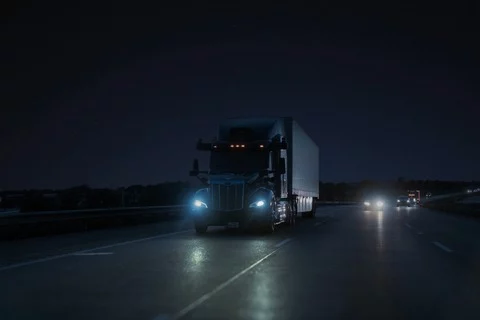
Aurora operating on a nocturnal interstate highway. The company announced the expansion of driverless commercial hauling to nighttime operations in summer 2025. Photo: Aurora / Business Wire.
Kodiak Capitalizes on Specialized Heavy Industrial Logistics
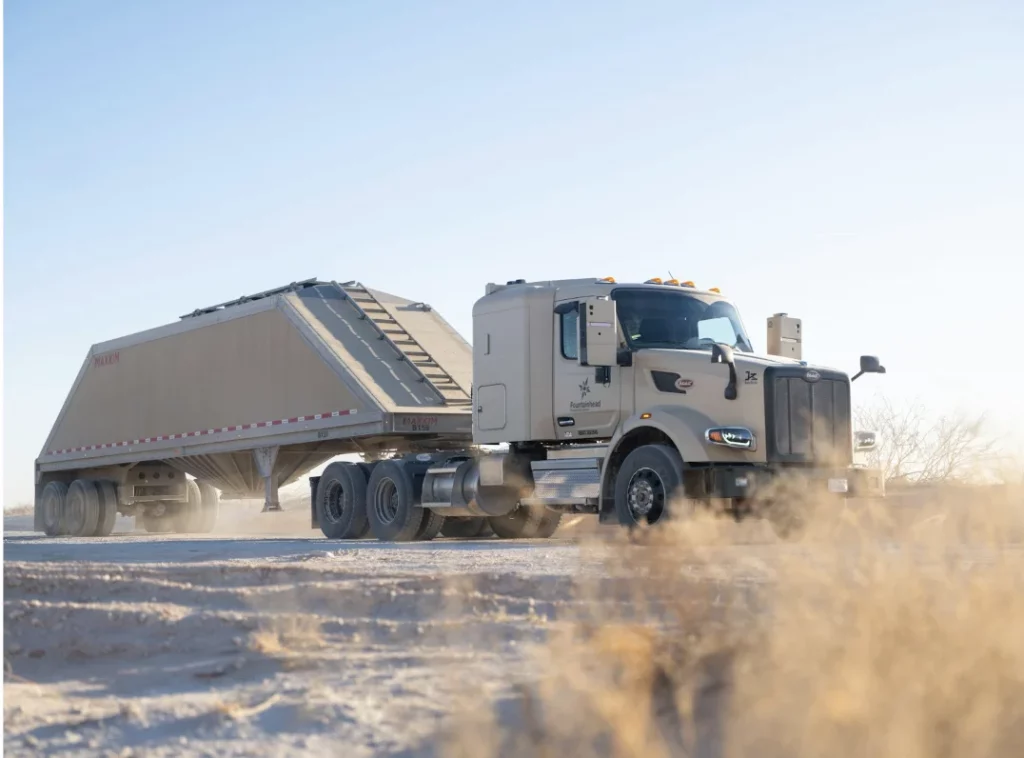
Kodiak (formerly Kodiak Robotics) initiated its commercial driverless operations within specialized oilfield logistics. In early 2025, Atlas Energy Solutions took delivery of its first two customer-owned RoboTrucks equipped with the Kodiak Driver autonomous system. The vehicles hauled proppant—specialized industrial sand used in hydraulic fracturing—across the harsh terrain of the Permian Basin.
Under this commercial model, the industrial client owns and deploys the trucks within its day-to-day operations, while the technology developer provides the autonomous software stack, remote diagnostics, and support services. According to Kodiak, Atlas personnel were trained to manage machine dispatches, alongside dedicated regional maintenance depots.
Dedicated industrial routes significantly constrain engineering complexity: pickup points, drop-off terminals, and payload characteristics are strictly predetermined. However, private unpaved lease roads present unique robotic challenges. Heavy dust clouds, surface irregularities, moving construction machinery, and shifting site terrain demand ultra-reliable sensor perception. Operational success in an oilfield cannot be mechanically transposed onto a high-speed interstate highway crowded with consumer traffic.
Waabi Tests Scalability via Simulation and Universal Virtual Drivers
Waabi focuses heavily on training and validating its AI system inside Waabi World, a high-fidelity closed-loop simulator. This synthetic environment allows millions of edge-case scenarios to be simulated and tested without risking physical assets. However, simulation does not replace physical highway validation: its utility is directly bounded by how accurately it mirrors the chaotic physical world.
In summer 2026, Waabi reported transferring its foundational autonomous system onto the Volvo VNL Autonomous platform without requiring ground-up retraining for the new vehicle chassis. According to the developer, the truck navigated highways and urban arterials autonomously. For trucking enterprises, this offers potential capital savings when standardizing autonomous software across diverse fleet models. Yet technical transferability does not equate to the immediate launch of mass unmanned commercial shipping.
Evocargo Eliminates the Cabin on Controlled Warehouse Loops
Evocargo addresses an entirely different operating environment: automated transport inside closed industrial plants and distribution yards. Its electric N1 model is natively designed without a driver’s cabin, steering wheel, or pedals. Directly comparing this vehicle to long-haul Class 8 highway semi-trucks is misleading: they operate under fundamentally different payload capacities, speeds, and operating domains.
In one of the deployments detailed by the company, the N1 transports heavy equipment across Santechkomplekt’s warehouse terminal. The one-kilometer dedicated route connects six loading docks. The client purchases autonomous freight through a Robotics-as-a-Service (RaaS) subscription model with recurring monthly fees, avoiding massive upfront capital purchases.
Such controlled closed-campus environments provide clean benchmarks for unit economics: operators can rigorously quantify delivery costs per transit point, vehicle downtime, and schedule reliability. Open intercity highways introduce exponentially higher environmental variables and legal liabilities.
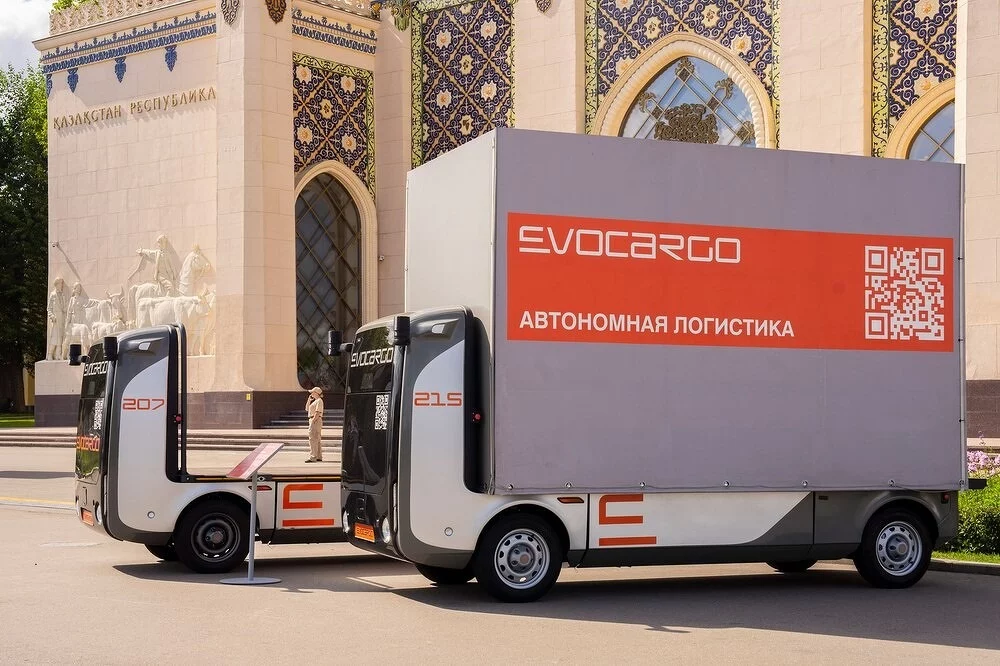
Evocargo N1 exhibited at VDNKh in Moscow, summer 2026. The “Kazakhstan” sign refers to the historic architectural pavilion in the background, not to active commercial deployment inside Kazakhstan. Photo from CNews coverage of the demonstration.
Why Industry Heavyweights Exited the Autonomous Trucking Race
The autonomous trucking market has already weathered multiple strategic consolidations and retrenchments. In 2023, Waymo announced it was pausing commercial and the bulk of technical development on Waymo Via (its trucking division) to concentrate resources entirely on consumer ride-hailing with Waymo One. This strategic pivot differs fundamentally from abandoning autonomous software technology altogether.
In that same year, Embark was acquired by Applied Intuition in a transaction valued at approximately $71 million; the buyer sought to integrate Embark’s simulation tooling, data assets, and software frameworks into its enterprise automotive stack. Crass claims that the pioneer “sold for scrap” misrepresent the commercial nature of deep-tech M&A.
TuSimple, once a Wall Street darling, announced a rebranding to CreateAI in late 2024, pivoting away from self-driving Class 8 trucks to generative AI for animation and gaming. These cautionary corporate trajectories illustrate the demanding capital runway required to bridge the gap between working algorithmic prototypes and a cash-flow-positive freight business.
Autonomous Cross-Border Logistics on the Kazakhstan-China Border
The Ministry of Finance of Kazakhstan announced the launch of the “Smart Customs” pilot initiative at the Bakhty–Pokitu border crossing with China. The intergovernmental agreement targets bilateral digitalization across border logistics. Unmanned autonomous shuttle transport is designated as an integral pillar alongside digital e-declarations, automated route tracking, and unified electronic screening.
The projected benchmark envisions scaling cargo turnover to 10 million tons annually while slashing customs clearance times. However, this represents a target milestone rather than currently verified driverless freight volume. The official ministry announcement outlines future autonomous operations and does not document ongoing daily driverless freight runs, existing fleet size, or total unmanned mileage achieved.
Border transfer zones represent an ideal testing environment: route distances are strictly bounded and customs clearance procedures are highly standardized. However, automating vehicle movement yields negligible economic benefits if cargo containers sit idle awaiting manual paperwork, physical inspections, or warehouse bay openings. Digital customs processing and robotic vehicle movement must be synchronized end-to-end.
In December 2025, Transport Minister Nurlan Sauranbayev pointed to 2027 as the target timeline for Kazakhstan’s inaugural full-scale autonomous trucking initiatives. He highlighted digital road passports inside the e-Joldar system and outlined long-term horizons for electric autonomous road trains by 2036–2040. These policy targets reflect strategic planning rather than mandatory nationwide fleet replacement deadlines.
RAEM previously examined the legal frameworks and regulatory hurdles for autonomous driving in Kazakhstan. For freight logistics, the critical next step requires verifiable data on dedicated pilot routes: identifying commercial operators, approved operational weather domains, verified freight trips, and real transportation tariffs per ton-kilometer.
Unit Economics, Operating Efficiencies, and the Human Role
Freight carriers invest in autonomous tech to maximize asset utilization and achieve predictable cargo arrival windows. If self-driving line-haul trucks eliminate mandatory driver rest breaks and double daily round-trips between freight terminals, the same capital asset delivers vastly higher operational productivity—especially on predictable routes connecting major transshipment hubs.
However, removing the human driver from the highway cab does not eliminate human labor costs entirely. Skilled personnel must inspect cargo tie-downs, calibrate and clean optical sensors, perform depot maintenance, and intervene during off-nominal road stoppages. Depending on operating models, human drivers will remain indispensable for complex urban deliveries, yard maneuvering, and the final mile.
Consequently, broad claims of saving “X cents per mile” carry little meaning without explicit contextual constraints. Complete lifecycle Total Cost of Ownership (TCO) models are mandatory: upfront vehicle and autonomous hardware costs, preventative maintenance, commercial insurance, route capacity utilization, deadhead miles, and terminal demurrage. Running trucks 20 hours a day delivers financial advantage only when backhaul freight is secured and receiving docks are equipped for automated reception.
For Kazakhstan, realistic validation begins with bounded, measurable deployments. Regular autonomous shuttle routes between two intermodal terminals or across a dedicated border corridor offer far more actionable insight than sweeping promises to automate nationwide trucking by a given decade. It is on the level of specific commercial freight contracts that we will see who truly profits from autonomous logistics and what premium shippers are willing to pay.