
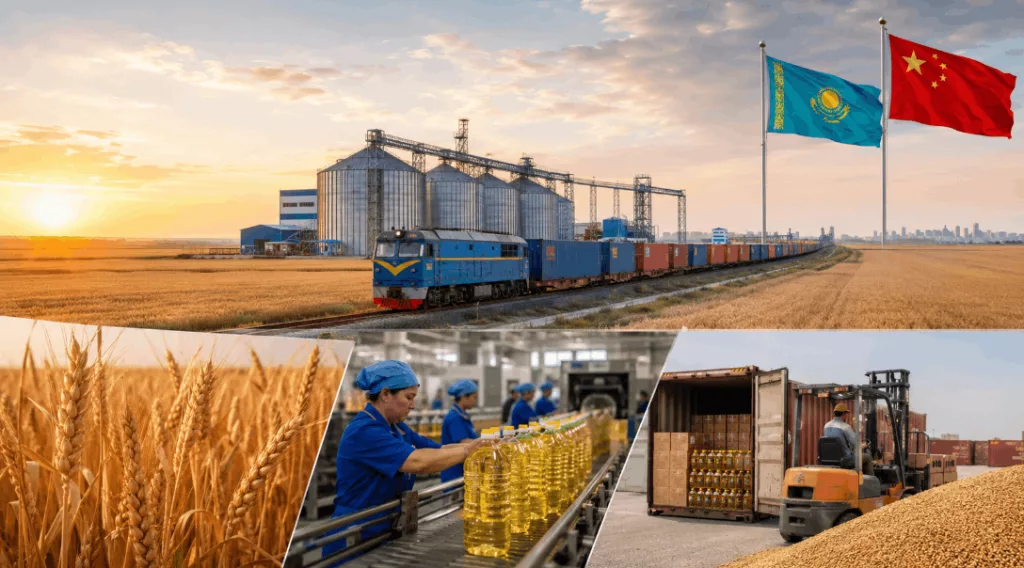
During the first quarter of 2026, Kazakhstan exported $550 million worth of agricultural and food commodities to China—an 82.4% surge compared to the same period last year. While top-line growth is undeniable, export shipments remain predominantly concentrated in animal feeds, oilseeds, and crude vegetable oils. While this extends beyond pure raw grain exports, mass penetration of value-added, branded Kazakhstani food products on Chinese retail supermarket shelves remains a distant frontier.
The Chinese consumer market is vast, yet penetrating it requires far more than dispatching freight railcars to the Dostyk or Khorgos border gates. Every specific category of meat, grain, or processed dairy demands independent bilateral protocol harmonizations, on-site facility inspections, and immutable digital supply chain traceability.
Quarterly Agri-Food Shipments Reach $550 Million
In 2025, bilateral agricultural trade turnover between Kazakhstan and China reached $1.97 billion, posting a 36.8% year-over-year increase. Kazakhstani agri-food exports accounted for $1.43 billion—up 35.3%. During January–March 2026, export velocity accelerated dramatically: shipments expanded to $550 million, representing an 82.4% year-over-year jump.
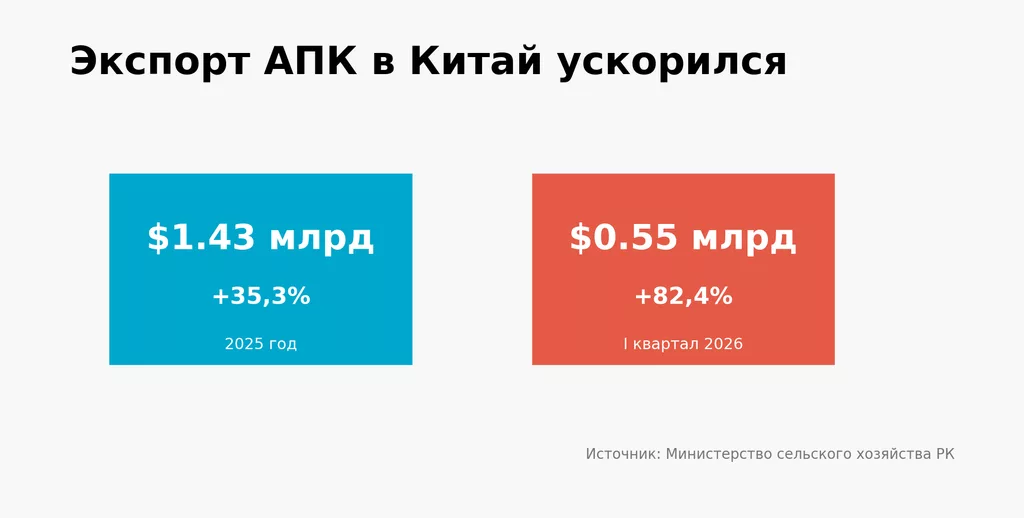
First-quarter export volumes cannot be mechanically annualized; the visualization illustrates baseline scale and accelerating growth velocity.
Simply extrapolating first-quarter velocity across twelve months yields a theoretical annual run-rate exceeding $2 billion. However, agriculture is subject to severe seasonal weather and harvest cyclicality. What is undeniably evident is that China has firmly established itself as the primary export growth engine for Kazakhstan’s agro-industrial complex.
China Procures Animal Feed, Seeds, and Bulk Vegetable Oils
Official customs registries indicate that the bulk of export shipments comprises animal fodder, vegetable oils, flaxseed, sunflower seeds, and rapeseed oil.
Dismissing this trade entirely as raw commodity extraction is inaccurate. Vegetable oil is an industrial processed product: seeds are crushed at domestic Kazakhstani extraction plants, retaining processing jobs and industrial margins in-country. However, finished packaged consumer goods carrying sovereign Kazakhstani brands and premium retail markups do not yet define the trade architecture.
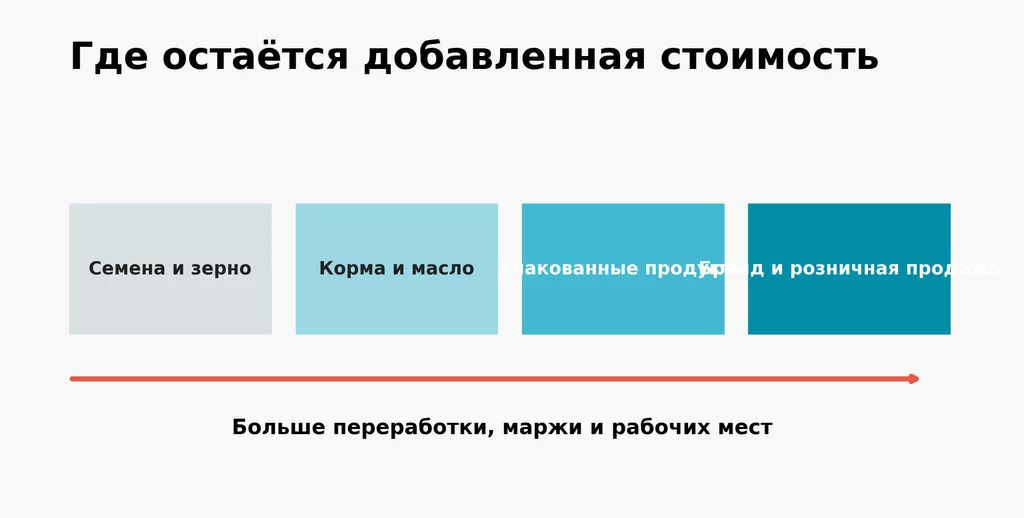
The deeper the processing stage, the greater the economic value-add and skilled employment retained within Kazakhstan. Infographic by RAEM.
Phytosanitary Protocols, Not Railcars, Unlock the Chinese Market
To date, Kazakhstan and China have formalized sanitary and phytosanitary protocols across 34 product categories: 21 crop varieties and 13 livestock classifications. An additional nine product categories are undergoing diplomatic review, prominently including high-value chilled beef and lamb.
Each protocol dictates rigorous quarantine, veterinary, and processing standards. Following treaty ratification, domestic food processors must pass audits by China’s General Administration of Customs (GACC). According to Kazakhstan’s Ministry of Agriculture, 3,601 domestic enterprises have obtained formal export clearance for China.
However, regulatory accreditation does not automatically equate to commercial shipments. An approved facility may remain idle due to uncompetitive pricing, cold-chain logistics bottlenecks, minimum container volume hurdles, or lack of established Chinese distributor relationships.
Chilled Meat Could Transform Export Quality and Margins
Seeds and bulk feeds are operationally straightforward to transport in bulk hopper cars, but carry modest operating margins. By contrast, premium chilled meat requires unbroken cold-chain temperature monitoring, veterinary traceability, and rapid border transshipment—delivering vastly higher profitability per ton.
Consequently, harmonizing remaining protocol annexes is essential not merely to pump up gross trade statistics, but to pivot national exports toward high-margin protein products where Kazakhstani livestock producers capture the lion’s share of value.
Fact-Checking the Purported $200 Million Agro-Park
Various regional publications frequently reference an impending $200 million Chinese-backed agro-technological park. Rigorous scrutiny reveals no official documentation verifying such an enterprise in that format. This speculative figure appears to have been conflated with an unrelated private equity life science fund.
The verified institutional project is quite different: Kozybayev University in North Kazakhstan is establishing an international agro-industrial park across 62 hectares. Chinese academic partners supplied initial high-yield seed trial batches, with total capital commitments estimated at approximately $10 million. Conflating these two distinct developments distorts commercial reality.
An 82% Surge Becomes True Success Only When Cargo Contents Evolve
To evaluate the structural health of this export boom, industry analysts must scrutinize four concrete indicators:
- The percentage share of packaged, shelf-ready food products and deep downstream processing;
- Trade composition breakdowns across discrete, high-margin agricultural categories;
- The actual count of accredited Kazakhstani food processors actively executing commercial shipments;
- The timeline for finalizing protocol clearances and initiating regular chilled meat freight runs.
China has demonstrated unprecedented commercial appetite for Kazakhstani agricultural commodities. The defining strategic challenge now is to export not merely higher tonnage, but higher processing complexity. If unrefined oilseeds are systematically replaced by bottled consumer oils, premium meats, and branded packaged foods, the 82% export jump will represent a durable qualitative industrial shift. If cargo contents remain unchanged, Kazakhstan will merely be loading freight trains faster with low-margin commodities.