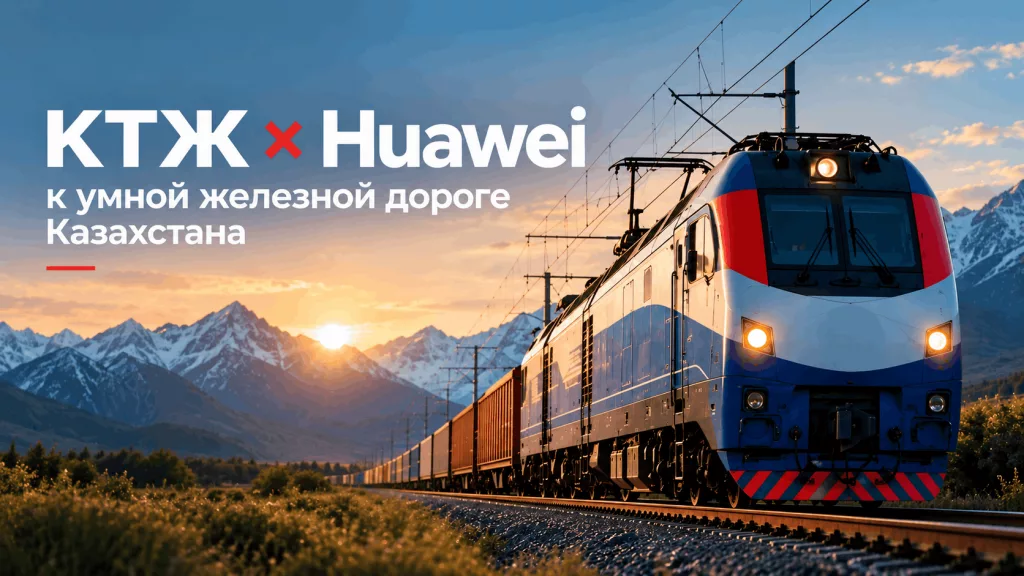
National railway operator Kazakhstan Temir Zholy (KTZ) has entered an advanced strategic partnership with Huawei to deploy a comprehensive «Smart Railway» digital ecosystem. The multi-phase modernization encompasses specialized LTE-R broadband railway telecommunications, predictive AI infrastructure monitoring, automated locomotive piloting, and a dedicated Rail Cyber Defense Operations Center.
Translating corporate terminology into operational reality: KTZ requires rolling stock, trackside sensors, regional dispatchers, and automated cargo logistics to communicate continuously across a low-latency, unified network rather than isolated data silos. This enables mechanical stress to be detected pre-failure, freight bottlenecks to be averted dynamically, and transcontinental transit schedules to be optimized in real time.
Crucially, this digital trajectory did not emerge overnight. In 2024, Huawei executed the foundational phase of KTZ’s wide-area network modernization, deploying SD-WAN architectures linking the Astana corporate headquarters with 16 major regional railway hubs. At that juncture, KTZ administrators acknowledged that substantial legacy routing equipment had operated past 15-year lifecycle limits.
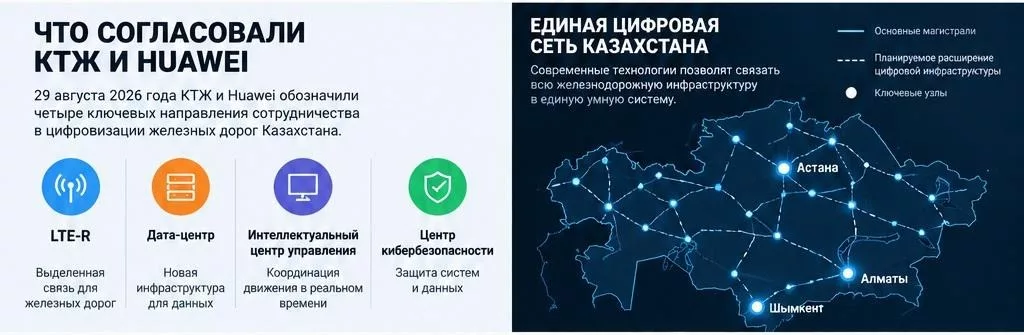
Chronological evolution of the strategic modernization partnership between KTZ and Huawei. RAEM Analytical Infographic
LTE-R: High-Speed Dedicated Broadband Connectivity for Trackside Operations
A central pillar of the initiative is LTE-R (Long-Term Evolution for Railway)—a purpose-built wireless broadband standard designed specifically for railway transit. Unlike legacy analog radio channels, LTE-R simultaneously transmits high-definition operational video feeds, locomotive telemetry, GPS coordinates, remote dispatcher commands, and real-time sensor streams without packet loss.
KTZ and Huawei have initiated technical consultations regarding the future transition to FRMCS (Future Railway Mobile Communication System)—the emerging global 5G-based successor to GSM-R and LTE-R. FRMCS mandates ultra-reliable low-latency communication (URLLC), massive machine-type telemetry, and hardware redundancy.
While full-scale nationwide deployment remains phased over several years, the strategic vector is evident: Kazakhstan’s railway network is receiving a dedicated digital nervous system uniting voice, telemetry, and automated signaling.
Predictive AI Maintenance: Solving Equipment Failures Before Costly Derailments
Unplanned rail downtime creates massive fiscal penalties. Through predictive AI analytics, trackside acoustic and thermal sensors continuously ingest telemetry from wheelsets, bearing housings, and switchgear, training neural anomaly models to flag microscopic wear long before catastrophic mechanical failure.
Huawei has validated similar architectures internationally: in 2026, Huawei and signaling giant CASCO commissioned an FRMCS railway deployment in Africa, resulting in a 60% expansion in corridor throughput and drastically shortened headway intervals. While operating conditions on the Kazakhstani steppe pose unique climatic extremes, the underlying economic imperative is identical.
Structural components comprising the KTZ modern Smart Railway architectural stack. RAEM Infographic
Dedicated Rail Cyber Defense Operations Center: Protecting Critical Infrastructure
As railway systems transition toward unified cloud repositories and automated switching, attack surfaces expand exponentially. Consequently, KTZ established a dedicated Cyber Defense Center.
This reflects a critical philosophical pivot. Digitalization no longer means deploying desktop office software; it governs physical train movements, high-voltage substations, and transcontinental routing. A cyber breach or operational outage is not merely an IT inconvenience—it threatens national economic security and physical safety.
The Freight Catalyst: Why High-Capacity Automation Is Non-Negotiable
Rail transit across Kazakhstan is the vital artery bridging commerce between China, Central Asia, the Caspian basin, and Western Europe. KTZ Express reported that in 2025, export container volumes surged by 43%, import container freight tripled, and traffic along the Trans-Caspian International Transport Route (Middle Corridor) jumped by 71%.
As cargo transit volumes explode, physical rail bottlenecks can no longer be solved solely by pouring more ballast or procuring diesel locomotives. Maximizing corridor throughput demands data-driven dispatching, reduced block intervals, and algorithmic traffic scheduling.
Field-Tested Automation: 425 Locomotives Running Trip Optimizer
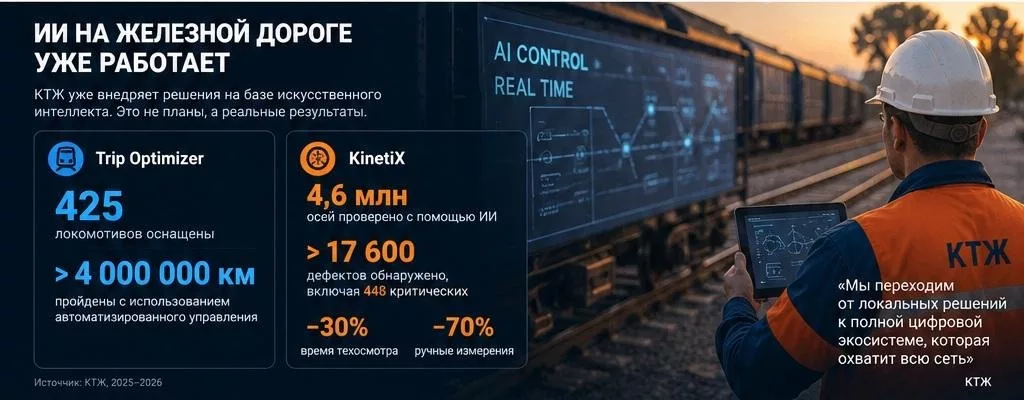
KTZ’s modernization extends well beyond Huawei. By August 2026, KTZ achieved commercial deployment of the Trip Optimizer automated driving system across 425 operational locomotives, logging over 4 million operating kilometers. The system serves as an algorithmic co-pilot, calculating dynamic fuel-efficient throttle and braking profiles based on route topography and train weight.
AI Diagnostic Vision: KinetiX Inspects 4.6M Wheelsets
Simultaneously, KTZ operates the KinetiX optical and acoustic inspection system equipped with computer vision. The system has automatically evaluated approximately 4.6 million wheelset axles, identifying more than 17,600 structural defects, including 448 safety-critical anomalies. KTZ credits the deployment with reducing manual inspection times by 30% and eliminating 70% of dangerous manual trackside measuring.
Autonomous trains remain a future horizon. Authentic industrial automation functions pragmatically: purpose-built algorithms execute specialized tasks while certified human engineers oversee master controls. The Huawei collaboration unifies these discrete applications into an integrated digital command nervous system.
The definitive test of the Smart Railway will be measured across years: diminished terminal dwell times, accelerated cross-border freight transit, and zero unpredicted mechanical derailments across the Silk Road corridor.